

What Should Publishers Test Before Mass-Producing Sound Books?



Publishers need to test those elements of sound accuracy, button operation, playback behavior, battery security, physical construction, durability and packaging before mass producing sound books. They should also validate assessments and documentation that need to be performed for the target market and age group.
A sound book may be finished with the wrong recording, improperly secured module, or a non-reliability button.
The best approval process is checking both printed book and electronics. While it is helpful to have their approval of the artwork and of the audio, it is not always enough, and certainly not as good as having a working, assembled sample.
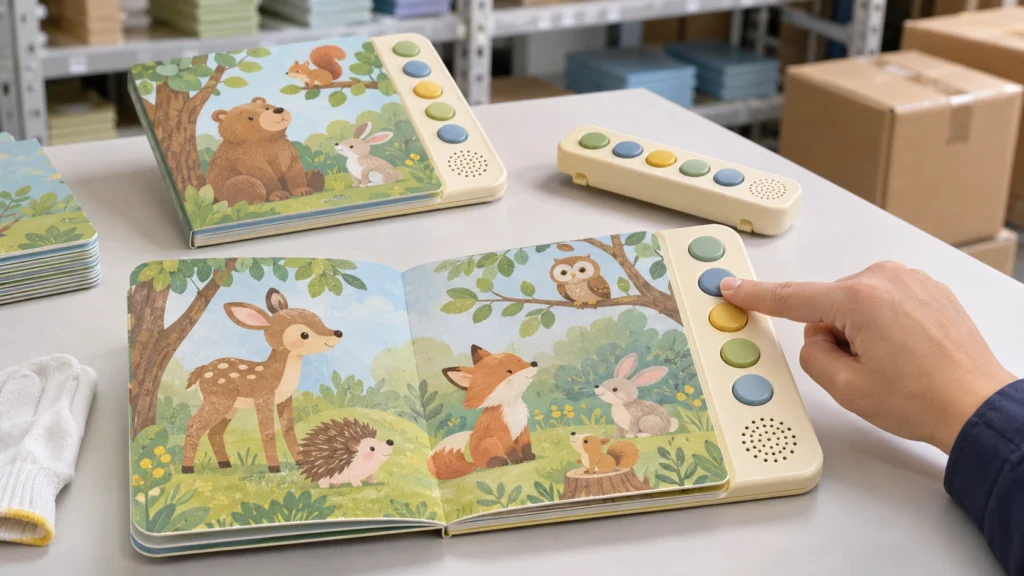
Start with a Written Test Plan
Define what the book should do before deciding whether it passes.
Record the approved artwork version, audio filenames, button mapping, module specification, battery arrangement, and packaging. Give each sample an identifiable revision.
| Test area | What publishers should verify | Evidence to retain |
|---|---|---|
| Audio content | Correct recording for every control | Approved track list |
| Controls | Reliable response and intended behavior | Functional test record |
| Sound output | Clear playback and appropriate acoustic assessment | Sample approval and relevant reports |
| Construction | Secure assembly and clean finishing | Physical reference sample |
| Power system | Agreed operation and secure battery enclosure | Specification and test results |
| Packaging | Protection and correct identification | Packed-sample approval |
Without this baseline, “the sound seems fine” becomes a subjective judgment rather than a repeatable check.
1. Check Every Recording Against the Printed Content
For each track, play the music and read through the relevant page.
Double check pronunciation, language, narration, music, sound effects and sequencing. Check for clipped words, missing endings, unwanted silence, distortion and varying levels.
In multi-language editions, ensure that a reviewer is available in the language. A factory operator can be sure that playback occurs but that they haven’t noticed that there is a wrong translation.
Maintain a list, track to button, indicating the name of the file and assigned control. Allow it at the same time as the final artwork, to avoid causing disruption to the match if it is changed after the final artwork is approved.
2. Test Buttons in Realistic Sequences
Press each button individually, then test combinations of actions readers may try.
What happens when someone presses a second button during playback? Does the current track stop, finish, or overlap? What happens after repeated presses or a prolonged press?
There is no single correct behavior for every book. The response should match the approved specification.
Check buttons near corners and the spine, where assembly may affect access. Confirm that the printed cues make the intended controls easy to identify.
3. Evaluate Audio Through the Finished Book
Headphones and desktop speakers cannot represent the installed sound module.
Listen through the actual speaker with the housing closed and the book assembled. Check for rattling, muffled speech, buzzing, or distortion.
A hand covering the speaker grille may also change the listening experience. Consider its position during normal handling.
Listening approval does not replace acoustic safety testing. Have the applicable assessment method and limits determined for the product’s market, classification, and intended users.
4. Review Batteries and Power Behavior
Test the agreed power functions: switching, standby, automatic shutoff, and restart behavior.
Battery-life evaluation should use a defined playback pattern and specified batteries. “Lasts a long time” is not a measurable acceptance criterion.
Review battery access and enclosure security with a qualified testing provider, particularly when small batteries are involved. A visible screw alone does not demonstrate that the complete construction meets applicable requirements.
Confirm whether the approved sample uses the same batteries and contacts planned for production.
5. Inspect the Printed Structure and Module Attachment
Check leaf bonding, rounded edges, binding, housing fit, and component attachment.
The module should not obstruct page turning or create unintended stress in the book. Look for exposed adhesive, lifting layers, uneven openings, and accessible wiring.
For children’s board book printing, review the leaf construction and electronic layout together.
If the concept also includes sensory materials, inspect the additional interfaces found in touch-and-feel board books. Every insert or opening adds another area to evaluate.
6. Agree on Durability Testing
A few successful button presses establish basic function, not durability.
Agree on repeated-operation checks and suitable handling assessments with the manufacturer and testing provider. Define the method, sample quantity, conditions, and acceptance criteria.
| Durability concern | What to examine afterward |
|---|---|
| Repeated button operation | Missed activation, sticking, or damaged controls |
| Repeated page turning | Binding stress and lifting layers |
| Agreed handling tests | Housing damage and component security |
| Relevant environmental conditioning | Warping, adhesion, and functional changes |
| Battery replacement, if intended | Closure condition and reliable operation |
Do not invent a universal cycle count or drop height. Formal assessments and internal quality checks serve different purposes and should be documented separately.
7. Test the Packed Product
A working sample can still arrive damaged.
Approve the individual protection, carton arrangement, and any measures intended to prevent accidental activation during transport. Recheck function after the agreed packaging evaluation.
Inspect labels, edition identification, instructions, and included accessories.
For a companion range of children’s hardcover picture books, use clear product identification so electronic and non-electronic editions are packed correctly.
8. Release Production Against an Approved Reference
Approve a representative assembled sample and record anything it does not represent.
Retain the reference sample, audio files, artwork, component specifications, and agreed test records. Material, battery, module, or programming substitutions should trigger a review.
Require representative production checks as well. A prototype demonstrates a design; it does not establish consistency across thousands of copies.
Frequently Asked Questions
Is a digital proof enough to approve a sound book?
No. It checks artwork but cannot demonstrate playback, button response, component attachment, or battery security.
Yes. Verify every control and its assigned recording, including relevant playback sequences.
Can publishers approve audio before the module is ready?
They can approve content, but final listening approval should include playback through the assembled book.
How many samples should be tested?
Agree on quantities according to the assessment method, production volume, and defect risks. One sample cannot establish batch consistency.
Does a supplier’s existing report cover my book?
Not automatically. Confirm that the report applies to the relevant construction, components, version, and requirements.
Should books be tested after packaging?
Yes. Recheck function and physical condition after the agreed packed-product evaluation.
Document the failure, investigate its cause and extent, and agree on corrective action before release.
When should mass production begin?
After the specification, representative sample, artwork, audio mapping, required assessments, and acceptance criteria are approved.
Separate technical reference check: sound-book production guidance identifies acoustic testing, while battery requirements depend on product classification and construction. Imago
Share on Social:


