

Pop-Up Books vs Lift-the-Flap Books

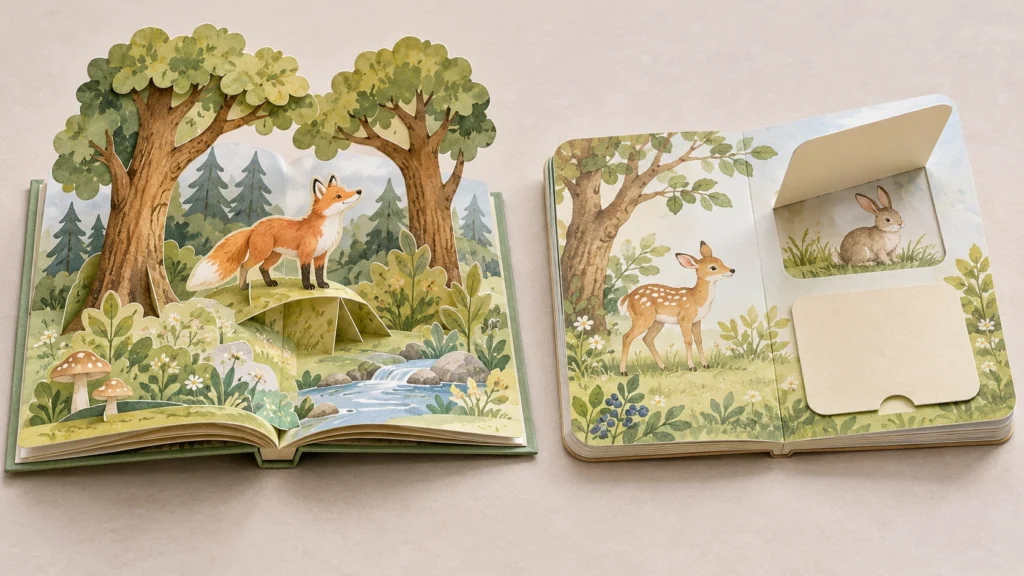
Pop-up books are books with 3-D elements that stand up from the page and lift-the-flap books are books that have removable flaps that show pictures or information underneath. The Pop-ups focus on depth and transformation. Flaps make an intentional discovery.
To publishers, the difference is more than looks—they are both different. The format has an impact on paper engineering, artwork, assembly, durability, and cost of production.
Begin with an interaction your content requires. A door to lift and reveal what’s behind it is something different from a land scape with a dinosaur rising up.
What Is a Pop-Up Book?
A pop-up book uses folded and attached paper structures to create dimensional scenes. Many mechanisms rise as a spread opens; others involve additional reader-operated features.
A simple spread might contain one folded character. A complex spread might combine several layers, platforms, and moving parts.
The mechanism must rise, move, and collapse within the available space. That makes structural development an essential part of the project.
With custom pop-up book printing, involve the paper engineer before finalizing illustrations. Artwork and movement need to develop together.
What Is a Lift-the-Flap Book?
Lift-the-flap book is a book that has a panel that is lifted to reveal content. Each reader raises it to show an answer, picture, character or a continuation of a scene.
Flaps can be either cut out of a page or attached as a separate sheet. They affect their operation because of their size, the way they are hinged and where they are attached.
Examples of common uses are question and answer content, counting, vocabulary and hide and seek stories.
A flap doesn’t have to form a 3-D shape. It is primarily used to manage when the reader will be able to see the information below.
How Do the Reading Experiences Differ?
Both formats invite participation, but they encourage different actions.
A pop-up can transform a spread as it opens. A flap usually asks the reader to find and lift a specific area.
| Comparison | Pop-up books | Lift-the-flap books |
|---|---|---|
| Main effect | Dimensional movement | Concealment and reveal |
| Typical action | Open a spread; sometimes operate another mechanism | Lift an individual panel |
| Strong applications | Dramatic scenes and spatial explanations | Questions, identification, and hidden details |
| Structural focus | Fold geometry and moving clearances | Hinge strength and accessible flap edges |
| Artwork challenge | Illustrating visible surfaces through movement | Coordinating concealed and covering images |
Neither format automatically creates better learning. The interaction should help readers understand or enjoy the content.
Which Format Suits Your Audience?
Consider handling ability and expected reading conditions rather than assigning either format a universal age range.
A broad flap with an accessible lifting edge may be straightforward to operate. A delicate, multilayer pop-up may need more careful handling.
However, a complicated flap arrangement can also be demanding, while a simple pop-up can operate with minimal intervention.
Request samples and observe how the intended interaction works. Check whether readers can identify where to act without pulling the wrong component.
For projects requiring rigid leaves, discuss interactive board book printing alongside the mechanism design.
Paper Engineering and Artwork Requirements
Either format will take advantage of an early physical dummy.
In the case of pop-up, see how each part performs as it is opened and closed. Pieces should not overlap or have edges sticking out of the closed book.
On flaps, check fold, lifting access, reveal area, and upper vs. lower artwork.
Do not sketch out all the illustrations first and then go and construct them. Changes in structure can change the cropping, glue areas, folds and visible surfaces.
A blank working model is useful to correct the problems before costly revisions to artwork.
What Affects Production Cost?
Pop-up books often involve substantial engineering and assembly, particularly when spreads contain many individual parts. But the format name alone does not establish the price.
A book with dozens of small flaps may require more work than one with a few simple pop-ups.
| Cost driver | Pop-up considerations | Flap considerations |
|---|---|---|
| Component count | Separate pieces and attachment points | Number of panels and attachment operations |
| Cutting | Complex outlines and internal details | Flap outlines and access features |
| Folding | Accurate creases and mechanism alignment | Consistent hinge formation |
| Assembly | Correct positioning of moving structures | Accurate alignment over hidden content |
| Sampling | Movement and closed-book fit | Opening action and reveal accuracy |
Request quotations based on the actual dummy, materials, quantity, and packaging. Avoid comparing prices for vaguely described “interactive books.”
Which Format Is More Durable?
Durability depends on construction and use.
Pop-ups can fail at folds, narrow connections, or glued attachments. Flaps can tear at hinges, bend, or separate from the base page.
Thicker material is not always the solution. Excess stiffness can interfere with folding or concentrate stress at a hinge.
Inspect representative samples for clean cutting, secure bonds, and smooth movement. Agree on appropriate repeated-operation checks and relevant product assessments.
For editions without movable elements, children’s hardcover picture books offer another approach when continuous illustration and straightforward page turning better serve the story.
Can Publishers Combine Both Formats?
Yes. A spread may include a dimensional illustration with smaller flaps that provide further details.
When two or more actions are combined, they are best if each has a clear intention. Too many mechanisms can overwhelm the artwork, make it harder to handle and add to the assembly requirements.
Create the full spread as a whole system. Ensure that opening a flap doesn’t block another part and that all parts close properly.
Pre-production approval of a bound working sample, final artwork, construction specifications and inspection criteria. Ensure that approved reference is kept as backup for repeat order.
Frequently Asked Questions
Are lift-the-flap books a type of pop-up book?
They belong to the broader family of movable books, but a flap does not necessarily create a pop-up structure.
Are pop-up books always more expensive?
No. Complexity, component count, assembly, materials, and quantity determine the comparison.
Can a board book include pop-ups?
Yes, with an appropriate construction. Rigid base leaves and movable components must be evaluated together.
Do flap books need paper engineering?
Yes. Flap geometry, hinges, access, and attachment require structural planning, even when the design looks simple.
Which format works better for educational content?
Choose according to the explanation. Flaps suit concealed answers; pop-ups can demonstrate spatial relationships and transformations.
Can the same artwork serve both formats?
Some illustrations may be reused, but layouts usually need adjustment for folds, hidden content, and attachment areas.
What sample should publishers request?
Request a working physical dummy, followed by a representative bound sample with the intended materials and artwork.
When should publishers finalize the format?
Choose it during concept development, before completing illustrations. Early structural testing reduces avoidable redesign.
Share on Social:


