

How Much Does Custom Sound Book Printing Cost?

Custom sound book printing costs combine the printed book, electronic sound module, audio preparation, assembly, testing, and packaging. The final price depends on quantity and specification, so there is no dependable universal cost per copy.
A simple book with one sound button is a different project from a narrated title with multiple controls and a custom-shaped housing.
For publishers, the useful question is: “What does the complete, working book cost to produce and deliver?” Separating the major components makes quotations easier to compare—and helps prevent unexpected charges later.
What Are You Paying For?
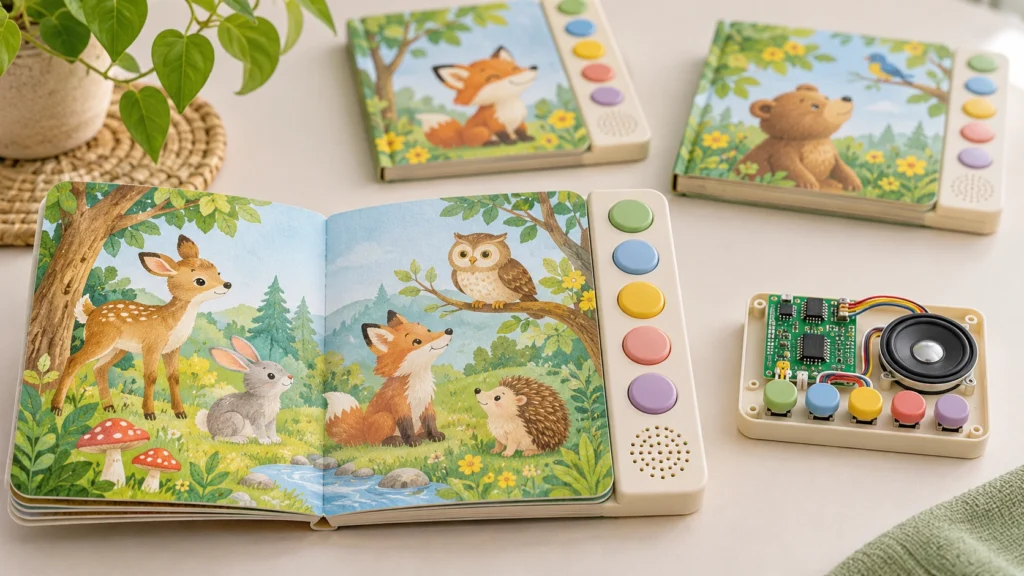
A sound book is both a printed product and an electronic assembly.
The book needs suitable pages, binding, and finishing. The module needs controls, audio storage, a speaker, a power source, and secure integration into the structure.
These elements must work together. An attractive printed sample does not establish that the audio is correct or every button functions.
| Cost component | What it may include | What to clarify |
|---|---|---|
| Printed book | Printing, mounting, cutting, and binding | Materials and finished construction |
| Sound module | Electronics, speaker, controls, and housing | Existing platform or custom development |
| Audio preparation | Editing, conversion, and programming | Supplied recordings or production service |
| Assembly | Installing and securing components | Included operations |
| Testing | Functional checks and agreed assessments | Scope and documentation |
| Packaging | Individual protection and shipping cartons | Retail and transport requirements |
Ask suppliers to price the same finished product rather than comparing a book-only offer with a complete electronic edition.
A Sample Budget for 1,000 Sound Books
The following figures are hypothetical planning numbers, not current market prices or a CAIMEI quotation. They illustrate how to organize a project budget.
Assume 1,000 identical board books using an existing sound-module platform, publisher-supplied audio, and a straightforward button layout.
| Budget item | Illustrative total |
|---|---|
| Printed book production | $2,800 |
| Sound modules and batteries | $2,200 |
| Audio preparation and programming setup | $400 |
| Prototypes and production setup | $600 |
| Assembly and functional inspection | $700 |
| Packaging | $300 |
| Illustrative production total | $7,000 |
That produces an illustrative manufacturing cost of $7 per copy.
Freight, destination charges, applicable taxes, external testing, illustration, recording rights, and storage are excluded. Suppliers may also bundle some lines together; avoid counting the same operation twice.
How Does the Sound Module Affect Price?
The module can be a significant expense item.
The number of buttons is important but it’s not all the specification. The solution is additionally impacted by total audio length, playback quality, speaker behaviour, and control behaviour.
For instance, if you press a second button while recording, will that stop the recording? Does it start again if the same button is pressed again? Is a volume control needed for this book?
Establish these behaviours first before you quote them.
Development effort may be minimized if developing on an existing module platform. A new housing or unusual control configuration, or custom electronics can require tooling, engineering, and additional prototype rounds.
Why Audio Duration and Preparation Matter
Animal sounds are short and there are ten; the passages are made up and there are ten of these also.
Set number of tracks, individual play times, total play time and desired play behavior. Inquire from the manufacturer what type of file and technical specifications are required.
The module may record, edit, noise reduce, level adjust and convert audio. State whether they are being done by whom.
Use the real installed speaker to listen to recordings. If you listen to the audio in the studio, it doesn’t mean that the finished book will be as good.
Accept a track to button list with artwork.
How Do Book Materials Change the Budget?
Trim size, page count, finished leaf thickness, surface finish, and binding all influence manufacturing.
Additional openings or shaped areas for electronics may introduce cutting and assembly requirements. The module must also fit without making the book awkward to handle.
When discussing children’s board book printing, submit the module layout and printed structure together.
If the concept combines sound with sensory elements, compare the extra assembly required for touch-and-feel board books before finalizing the design.
More features can add interest, but every feature should serve the reading experience.
What Changes with Quantity and Language Versions?
Larger runs can spread setup and development costs across more copies. However, the total investment and inventory also increase.
Request quotations at realistic quantities using identical specifications.
Language versions need separate attention. Shared hardware may still require different artwork, recordings, programming, labels, and packing controls.
Ask whether the minimum quantity applies to the whole project or each version. A combined order of 3,000 copies may not receive the same terms when divided into several small editions.
How Can Publishers Control Costs?
Start with a functional concept, then separate essential features from optional additions.
| Budget decision | Possible saving | What to preserve |
|---|---|---|
| Use an existing module | Less development and tooling | Suitable functionality and integration |
| Reduce unnecessary tracks | Simpler audio requirements | Coherent content |
| Standardize language layouts | More shared production elements | Correct version identification |
| Finalize recordings early | Fewer programming revisions | Approved audio quality |
| Compare nearby trim sizes | Potential material efficiency | Readability and handling |
For a companion edition without electronics, children’s hardcover picture books provide a separate format to evaluate. Quote it independently.
What Should Be Approved Before Production?
Approve a working prototype that represents the intended construction.
Check every button, recording, speaker position, component attachment, and battery arrangement. Confirm what production processes the prototype represents.
The quotation should identify the target market, intended age group, assessment scope, and documentation responsibilities. Agree on these requirements before committing to tooling.
Finally, confirm shipping terms and packed dimensions. Manufacturing cost is only one part of the delivered budget.
Frequently Asked Questions
Is a sound book more expensive than a standard board book?
Usually, because electronics, programming, integration, and functional checks add work beyond printing and binding.
Not by a fixed amount. Existing module capacity and layout may matter more than button count alone.
Are batteries included in quotations?
Only if specified. Confirm battery type, quantity, installation, and delivery arrangements.
Can I supply my own recordings?
Often, yes. Ask for file requirements and approve playback through the finished prototype.
Are tooling charges paid on every order?
It depends on the tooling and supplier terms. Confirm ownership, storage, reuse, and replacement conditions.
They may share hardware, but programming and version-control requirements must be confirmed.
Is the prototype price included in production?
Policies vary. Ask whether prototype charges are separate or credited against the order.
What produces the most accurate quotation?
Provide quantity, book specifications, button layout, audio list, module requirements, packaging, destination, and target schedule.
Share on Social:


