

Smyth Sewn vs Perfect Binding: Cost, Strength & Durability
There is an important choice to make when printing books and that is the proper binding technique. For novels, textbooks, catalogs and journals, art books and other printed publications, Smyth sewn binding or perfect binding is used. Both have their advantages for making a bookshelf, but they vary in their construction, durability, flexibility, cost, and best uses.
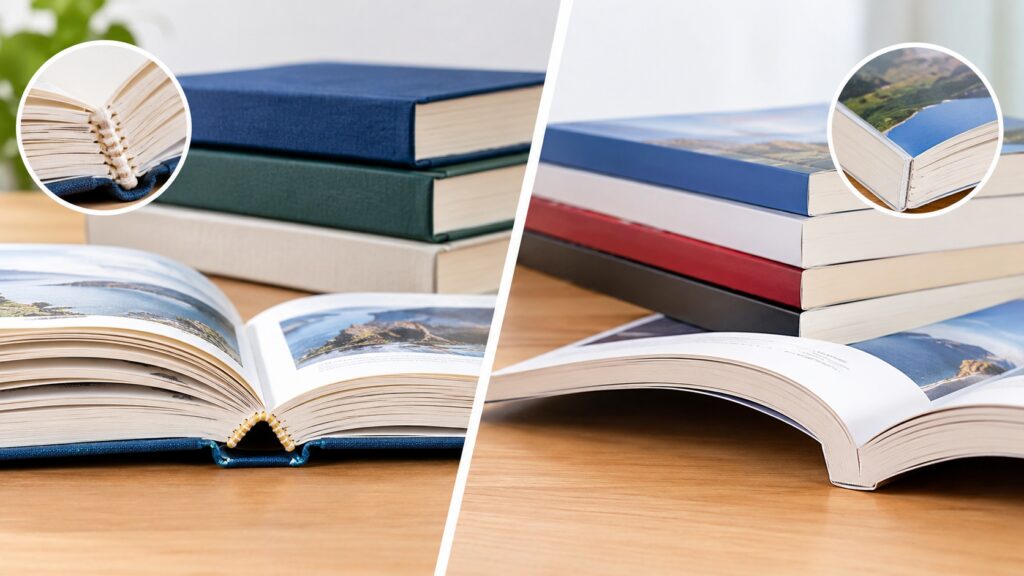
When it comes to book printing, knowing the difference between Smyth sewn vs perfect binding can help you choose the best method for your budget, production needs and your reader target audience.
This guide details the operation of every binding and contrasts their advantages and disadvantages and offers useful suggestions on which binding solution is ideal.
1. What Is Smyth Sewn Binding?
Smyth sewn binding is the type of book binding where signatures of printed pages are gathered together in folds and stitched with sewing thread. The sewn text block is then bound to a cover, which can be hardcover or a softcover (depending on the binding process).
Smyth sewn books are very durable and have excellent page security since the signatures are physically attached with thread.
How Does Smyth Sewn Binding Work?
The Smyth sewn binding process typically involves several steps:
- Printing and folding: Printed sheets are folded into signatures containing multiple pages.
- Signature gathering: The signatures are arranged in the correct sequence.
- Thread sewing: Specialized binding equipment sews the signatures together along their folds.
- Text block preparation: The sewn text block is trimmed and prepared for cover attachment.
- Cover finishing: The text block is attached to the selected cover, with additional finishing processes applied as required.
This construction allows the pages to open relatively flat and reduces the likelihood of individual pages becoming detached during normal use.
Advantages of Smyth Sewn Binding
Exceptional durability: Thread-sewn signatures provide a strong connection between sections, making this method suitable for books that will be handled frequently.
Better opening performance: Smyth sewn books typically open more comfortably than conventional perfect-bound books, especially when properly designed and manufactured.
Long service life: The sewn construction can help books withstand repeated reading, making it attractive for reference materials and premium publications.
Premium appearance: Smyth sewn binding is often associated with high-quality hardcover books, collector’s editions, and professionally produced publications.
Disadvantages of Smyth Sewn Binding
The primary disadvantage is cost. Sewing signatures requires additional materials, equipment, and production steps. The process can also involve longer manufacturing times, depending on the printer’s equipment and production schedule.
In addition, Smyth sewn binding requires suitable page signatures. Projects with very low page counts or unusual formats may not benefit from this construction.
2. What Is Perfect Binding?
Perfect binding is a widely used bookbinding method in which individual pages or gathered sections are assembled into a text block, and adhesive is applied along the spine to attach the pages to a separate cover.
The cover wraps around the spine, creating a clean, squared-off appearance. Unlike traditional thread-sewn binding, standard perfect binding relies primarily on adhesive to hold the pages together.
Perfect binding is commonly used for paperback books, magazines, catalogs, product manuals, and marketing publications.
How Does Perfect Binding Work?
The typical perfect binding process includes the following steps:
- Page printing: The book’s interior pages are printed and prepared for binding.
- Page gathering: The pages are assembled in the correct order.
- Spine preparation: The spine edge is trimmed, roughened, or otherwise prepared to improve adhesive bonding.
- Adhesive application: Glue is applied to the spine using the selected binding system.
- Cover attachment: A printed cover is wrapped around the text block and bonded to the spine.
- Final trimming: The finished book is trimmed to its required dimensions.
Different adhesives and production techniques can influence the strength, flexibility, and longevity of perfect-bound books. Modern PUR (polyurethane reactive) adhesive binding, for example, can provide strong bonding and good flexibility when correctly specified.
Advantages of Perfect Binding
Lower production costs: Perfect binding is often more economical than Smyth sewn binding, particularly for commercial paperback production.
Professional appearance: The squared spine provides space for a printed title, author name, publisher logo, or other identifying information.
Efficient manufacturing: Automated perfect binding supports high-volume production and can offer competitive turnaround times.
Wide application range: It is suitable for novels, catalogs, company brochures, training manuals, and many other publications.
Flexible design options: Printers can produce perfect-bound books with a range of cover stocks, finishes, trim sizes, and interior paper options.
Disadvantages of Perfect Binding
Perfect-bound books generally have less structural flexibility than well-made Smyth sewn books. Depending on the adhesive, paper, spine preparation, and book design, repeated opening may cause the spine to crack or pages to loosen.
Some perfect-bound books also resist opening flat, which can make them less convenient for technical manuals, cookbooks, or other publications that readers need to keep open while using.
However, high-quality adhesive selection and proper production can significantly improve performance.
3. Smyth Sewn vs Perfect Binding: Key Differences
The most important differences involve construction, durability, opening behavior, cost, and production requirements.
| Feature | Smyth Sewn Binding | Perfect Binding |
|---|---|---|
| Construction | Signatures sewn together with thread | Pages bonded with adhesive |
| Durability | Generally excellent | Depends on adhesive and manufacturing quality |
| Page security | Strong when properly manufactured | Depends on adhesive bond and spine preparation |
| Opening performance | Usually opens more easily and comfortably | Often has greater resistance near the spine |
| Production cost | Generally higher | Generally lower |
| Production complexity | More specialized steps | Often simpler and faster for commercial runs |
| Typical applications | Premium books, reference books, quality hardcovers | Paperbacks, catalogs, magazines, manuals |
| Spine appearance | Can be finished with various cover styles | Typically features a squared, printed spine |
| Best priority | Longevity and reading comfort | Cost efficiency and commercial versatility |
These comparisons describe typical production outcomes rather than absolute rules. Paper selection, page count, binding equipment, adhesive quality, and finishing specifications can affect the performance of either method.
4. Which Binding Method Is More Durable?
Smyth sewn binding is usually the preferable binding for books that are expected to be read on a regular basis and will have a long lifespan.
The pages are not only glued together, but also sewn together by the signatures. This can be a valuable benefit in the case of books that are often opened and closed, reference books and publications.
When done right, perfect binding can be terrific. Due to its strong bonding properties, PUR adhesive binding is frequently chosen for challenging paperback applications. However, the durability of an adhesive-bound book will depend on the entire production process.
For instance, a book made with good sewing is perfectly acceptable for a reference library, and a good perfect bound paperback is just fine for a novel for everyday leisure reading.
Practical suggestion: Smyth sewn binding may be used if durability is the most important factor. Perfect binding might be enough if the book is likely to have a shorter lifespan or if it must go to market at a competitive price.
5. Which Binding Method Is More Cost-Effective?
The cost of standard commercial book printing is usually lower between the two, perfect binding.
It is widely automated for its manufacture and is often used in large quantities. Therefore, this is appealing to publishers, businesses, education institutions and brands who want to achieve the best print quality and the lowest unit cost.
In general, Smyth sewn binding requires extra sewing and special machinery. The additional cost is in manufacturing but depends on the specification and order size.
Variables that impact the cost of both approaches are:
- Total page count and book dimensions
- Interior paper weight, thickness, and finish
- Cover material and finishing options
- Order quantity and production setup
- Hardcover versus softcover construction
- Printing method and delivery requirements
For example, a company printing 5,000 product catalogs may prioritize perfect binding to control unit costs. A publisher producing a premium illustrated book may prefer Smyth sewn binding to enhance durability and perceived value.
To compare prices accurately, request quotations for both methods using the same page count, paper, trim size, cover specifications, and quantity.
6. Which Binding Method Is Better for Different Types of Books?
The best binding method depends on the purpose of the publication and how readers will use it.
Novels and Fiction Books
Perfect binding is a popular choice for paperback novels because it offers an attractive appearance at a competitive price. Smyth sewn binding is worth considering for premium editions, collectible releases, and hardcover novels intended for long-term ownership.
Textbooks and Reference Books
Smyth sewn binding is often advantageous for textbooks and reference books that undergo repeated use. Its durable construction and comfortable opening behavior can improve the reading experience.
For cost-sensitive educational publications, however, high-quality perfect binding may still be appropriate.
Art Books and Photography Books
Smyth sewn binding can be a strong option for premium art and photography books, particularly when readers need to view images across facing pages. The final result also depends on the paper, page layout, cover construction, and opening requirements.
Catalogs and Marketing Materials
Perfect binding is commonly used for product catalogs, company profiles, annual reports, and promotional publications. It provides a professional appearance and supports efficient commercial production.
Cookbooks and Instruction Manuals
Smyth sewn binding may be preferable when a book needs to remain open during use. However, neither method automatically guarantees a fully flat opening. If lay-flat functionality is essential, discuss alternative constructions or specialized binding options with your printer.
7. Can Smyth Sewn Binding Be Used for Hardcover and Paperback Books?
Yes. Smyth sewn binding can be used with hardcover books and certain softcover formats.
For hardcover books, the sewn text block is typically attached to a rigid cover structure. This combination is popular for premium publications, gift books, and durable reference titles.
Sewn softcover books combine thread-sewn signatures with a flexible cover. They can offer improved durability compared with conventional adhesive-only paperbacks, although the final performance depends on the materials and construction.
Perfect binding is also commonly used for both softcover publications and certain hardcover production systems. In either case, it is important to distinguish the cover style from the method used to assemble the interior pages.
A hardcover does not necessarily mean the pages are Smyth sewn, and a paperback does not necessarily mean the book is perfect bound.
8. How to Choose the Right Binding Method for Your Project
Before selecting a binding method, evaluate the following considerations.
1. Define the expected lifespan. If readers will use the book repeatedly for years, prioritize durability. If it is a short-term promotional publication, perfect binding may offer better value.
2. Establish your budget. Compare the total manufacturing cost rather than considering binding expenses alone. Paper, cover materials, finishing, packaging, and shipping can significantly influence the final price.
3. Consider the reading experience. Books containing detailed illustrations, reference tables, or instructional content may benefit from improved opening performance.
4. Evaluate the page count. Very thin books may not have enough spine width for conventional perfect binding, while thick publications require careful consideration of adhesive performance and sewn construction.
5. Discuss paper compatibility. Paper thickness, coating, grain direction, and flexibility can influence how well a book opens and how securely its pages remain attached.
6. Request physical samples. If durability and opening behavior matter, ask your printer to provide samples or a production mock-up. Testing a physical book is often more useful than relying on photographs alone.
Conclusion: Smyth Sewn vs Perfect Binding
The answer is that there is no one that works best for all books between Smyth sewn and perfect binding.
Typically, the Smyth sewn binding option is a better way to go for publications that require durability, frequent use, and an excellent reading experience. Perfect binding is typically used for cost-effective paperback books, catalogs, magazines, and commercial publications that are looking to give the publications an attractive look and efficient production.
The best choice for publishers and businesses is the one that takes into account a number of factors, including quality, cost, page count, intended use, and expected longevity.
When ordering a custom book printing job, it’s always best to ask a book manufacturer for recommendations on the most appropriate binding style based on your requirements. You can compare samples and get price estimates for both to get the best of both worlds when it comes to production cost and finished book quality.
Frequently Asked Questions
Is Smyth sewn binding better than perfect binding?
Smyth sewn binding is generally better for durability and repeated use. Perfect binding is usually more economical and is suitable for many commercial paperback books and catalogs.
Is Smyth sewn binding more expensive?
Generally, yes. Sewing signatures adds manufacturing steps and costs. However, the actual price difference depends on order quantity, page count, cover type, paper selection, and finishing requirements.
Do perfect-bound books fall apart easily?
Not necessarily. Properly manufactured perfect-bound books can be durable. Their longevity depends on adhesive quality, spine preparation, paper characteristics, and how the book is handled.
Can a Smyth sewn book lay flat?
Smyth sewn books generally open more comfortably than conventional perfect-bound books, but a completely flat opening is not guaranteed. Cover construction, paper, spine design, and page layout all affect the result.
Which binding is best for a 200-page book?
Both methods can work well for a 200-page book. Choose Smyth sewn binding if durability and opening performance are priorities. Choose perfect binding if affordability and a conventional paperback appearance are more important.
What is the difference between Smyth sewn and PUR perfect binding?
Smyth sewn binding connects folded signatures with thread. PUR perfect binding uses polyurethane reactive adhesive to attach pages along the spine. Smyth sewing is generally favored for long-term durability, while PUR binding offers a strong adhesive-bound alternative for many commercial books.
The right choice ultimately depends on your book’s intended use, production budget, and desired quality.
Share on Social:


