

Saddle Stitch vs Perfect Binding: Key Differences
Publishers, printing firms, businesses and self-publishing authors all have to make the right choice of book binding method. There are two main types of binding which are popular: saddle stitch and perfect binding. They are both used to produce professional print products, but differ in their build, look, lifespan, price and use.
When deciding between saddle stitch and perfect binding for catalogs, magazines, brochures, booklets, or paperback books, it’s important to know these two differences so you can make the right choice for your project.
This guide helps you understand the different binding methods, their pros and cons, and which one is ideal for specific printing requirements.
What Is Saddle Stitch Binding?
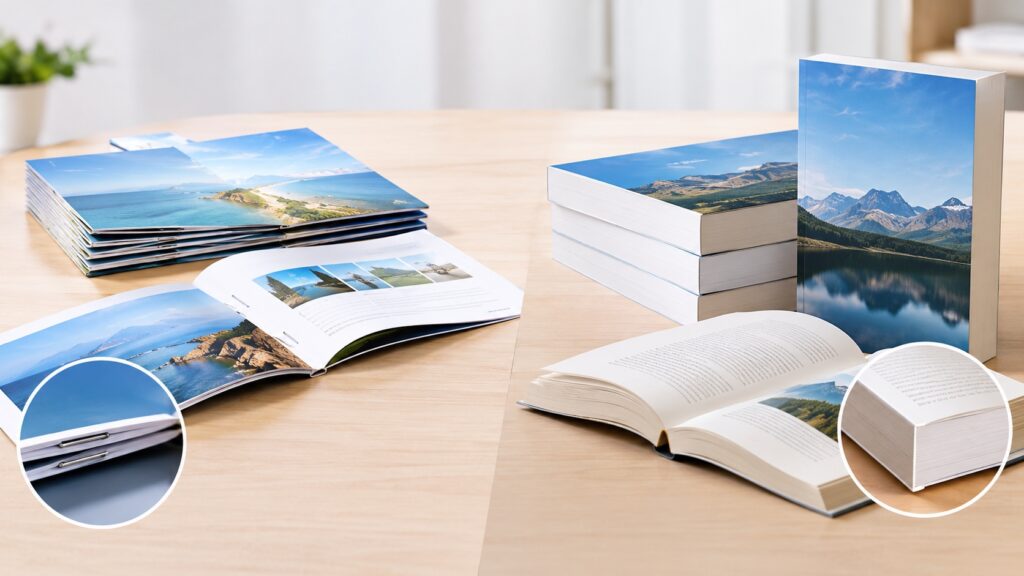
Saddle stitch binding is the simplest and least costly type of bookbinding which is accomplished by metal staples fastened between the folded crease. The printed sheets are folded in half, then stacked together and stapled through the fold to make a booklet.
Saddle stitch binding uses staples to bind the pages, unlike those that involve adhesive or attaching the cover separately.
How Does Saddle Stitch Binding Work?
The saddle stitch printing process typically involves four steps:
- Printing: Pages are printed on large sheets, often with multiple pages arranged on each sheet.
- Folding: The printed sheets are folded in half to create the booklet’s page structure.
- Collating: The folded sheets are nested in the correct sequence.
- Stapling and trimming: Metal staples are inserted through the center fold, and the booklet is trimmed to its finished size.
This process is efficient and suitable for short-run and high-volume printing projects.
Advantages of Saddle Stitch Binding
1. Lower printing costs
Typically, saddle stitch binding is among the least costly binding choices. It is produced relatively simply and uses few materials, thus it is ideal for businesses requiring large numbers of brochures, promotional booklets, or event programs.
2. Portable, easily transported
Saddle-stitched booklets have low weight and small size. These can be easily packaged, mailed, sent to trade shows, or sent with product deliveries.
3. Professional appearance
Although saddle stitch binding is a basic binding method, it gives a neat and tidy look. Ideal for marketing materials, product catalogs, newsletters and short magazines.
4. Easy to use for shorter publications.
Saddle stitch binding is particularly suited for publications with relatively few pages because the pages are folded together instead of being bound together with a thick adhesive spine.
Disadvantages of Saddle Stitch Binding
Saddle stitch binding has a few shortcomings. The paper thickness and equipment used determine its page capacity. The outer pages may also extend beyond the inner pages as the booklet becomes thicker and more pages will need to be cut off.
It doesn’t also offer a printed flat spine to hang a book title. If there is a substantial spine required for the publications, a more appropriate binding may be required.
Another factor is the durability. Saddle stitched booklets are suitable for general use, but may not be suitable for books or publications that are thicker or require frequent, long use.
What Is Perfect Binding?
Perfect binding is a bookbinding method that uses adhesive to attach individual pages or grouped sheets to a separate cover. The spine edges of the pages are usually trimmed or prepared to help the adhesive bond securely, while the cover wraps around the front, spine, and back.
This method is widely used for paperback books, company reports, product catalogs, magazines, and other publications that require a polished, book-like appearance.
How Does Perfect Binding Work?
The perfect binding process generally includes the following steps:
- Printing and folding: The interior pages are printed and organized into sections, depending on the production method.
- Spine preparation: The spine edges are trimmed or roughened to improve adhesive bonding.
- Adhesive application: Glue is applied to the prepared spine edge.
- Cover attachment: A cover is wrapped around the page block and bonded to the spine.
- Three-side trimming: The top, bottom, and fore edge are trimmed to create a clean, uniform finish.
The result is a paperback-style publication with a flat spine and a smooth exterior appearance.
Advantages of Perfect Binding
1. Professional book-like appearance
Perfect binding creates a square spine that can display the book title, author name, publisher logo, or other information. This makes it suitable for publications displayed on bookstore shelves or arranged in libraries and offices.
2. Suitable for thicker publications
Compared with saddle stitch binding, perfect binding is generally better suited to thicker books and publications with larger page counts. The final capacity depends on paper thickness, adhesive selection, and binding equipment.
3. Flexible cover design
Perfect-bound books support a wide range of cover finishes, including matte or gloss lamination, specialty coatings, and custom printed designs. These options help businesses and publishers create distinctive products.
4. Good for commercial publishing
Perfect binding is commonly used for paperback novels, manuals, annual reports, and product catalogs because it combines a professional appearance with efficient commercial production.
Disadvantages of Perfect Binding
Perfect binding generally costs more than saddle stitch binding because it requires adhesive, additional processing, and specialized equipment.
The spine may also crack or lose pages if the adhesive is poorly selected, the book is improperly manufactured, or the publication is subjected to repeated stress. Some perfect-bound books are less flexible when opened than saddle-stitched booklets, particularly when they are thick or tightly bound.
In addition, perfect binding usually requires a minimum practical spine thickness. Very short publications may not be suitable for this method, depending on the printer’s equipment and production specifications.
Saddle Stitch vs Perfect Binding: Key Differences
The best way to choose between these two methods is to compare their core characteristics.
| Feature | Saddle Stitch Binding | Perfect Binding |
|---|---|---|
| Binding method | Metal staples through the center fold | Adhesive along the spine |
| Appearance | Folded booklet | Paperback-style book |
| Page capacity | Best for shorter publications | Better for thicker publications |
| Printed spine | No | Yes, when spine thickness permits |
| Production cost | Generally lower | Generally higher |
| Production process | Relatively simple | More processing steps |
| Cover options | Standard or custom printed covers | Wide range of cover finishes |
| Mailing and distribution | Lightweight and convenient | Suitable for heavier publications |
| Common applications | Brochures, event programs, short magazines | Paperback books, reports, catalogs |
| Opening behavior | Often opens relatively flat | Depends on binding construction and paper |
The exact cost and page capacity of either method depend on paper weight, finished dimensions, print quantity, finishing requirements, and the printer’s equipment.
Which Binding Method Is More Cost-Effective?
For most short publications, saddle stitch binding is the more economical option. Its simple construction and efficient production process make it ideal for promotional materials, event booklets, and short-run marketing projects.
Perfect binding generally involves additional production steps, so its unit cost may be higher, particularly for small print runs. However, it can offer better value for thicker publications that need a professional spine and a more substantial appearance.
When comparing printing quotes, consider more than the binding price alone. Paper selection, cover design, color printing, finishing, shipping, and order quantity can all affect the final cost.
For large quantities, ask your printing supplier to provide quotations for different binding options if both are technically suitable.
Which Binding Method Is Best for Different Projects?
Your publication’s purpose, length, and presentation requirements should guide the decision.
Brochures and promotional booklets
Saddle stitch binding is usually the better choice for short marketing booklets, event programs, product introductions, and handouts. It keeps costs low while delivering a clean, professional finish.
Paperback books and novels
Perfect binding is generally preferred for novels, educational books, and other longer publications. Its square spine supports a conventional bookstore appearance and can carry printed text when sufficiently thick.
Product catalogs and company reports
Perfect binding works well for substantial catalogs, annual reports, and corporate publications that need a refined presentation. For shorter catalogs, saddle stitch binding may be more cost-effective.
Magazines and newsletters
Saddle stitch is common for shorter magazines and newsletters. Perfect binding may be more suitable for thicker issues, special editions, or publications intended for longer-term storage.
How Many Pages Can Each Binding Method Handle?
Page count is one of the most important factors when comparing saddle stitch vs perfect binding.
Saddle stitch binding is commonly used for booklets containing approximately 8–64 pages, although some printers support different ranges. The total must generally be divisible by four because the pages are created from folded sheets. The practical maximum depends heavily on paper thickness and the equipment used.
Perfect binding is often selected for publications with approximately 40 pages or more, but this is not a universal minimum. The key consideration is whether the finished page block provides sufficient spine thickness for reliable adhesive bonding and the required cover design.
Remember that page count and sheet count are different. One sheet folded in half produces four booklet pages when both sides are printed.
Before placing an order, provide your printer with the page count, interior paper weight, finished size, and cover specifications. These details help determine which binding method is feasible.
Can You Choose Between Saddle Stitch and Perfect Binding for the Same Book?
Sometimes. If your publication is relatively short and both methods are technically feasible, you can compare the visual appearance, total cost, and intended use before deciding.
For example, a short product catalog may work well with saddle stitch binding when portability and budget are priorities. If the same catalog requires a printed spine or a more substantial shelf presence, perfect binding may be preferable, provided the page block is thick enough.
However, the two methods are not always interchangeable. A very thin booklet may not provide enough spine width for perfect binding, while a thick publication may exceed the practical capacity of saddle stitch binding.
Frequently Asked Questions
Is saddle stitch binding cheaper than perfect binding?
Yes, in most cases. Saddle stitch binding generally has lower production costs because it uses a simpler binding process and fewer materials. Actual prices depend on print quantity, paper, size, and finishing requirements.
Does perfect binding last longer than saddle stitch binding?
Not necessarily in every situation. Perfect binding can be suitable for thicker books, but durability depends on adhesive quality, manufacturing, paper selection, and how the book is handled. Saddle stitch binding can be durable for short booklets used under normal conditions.
Can saddle stitch books have a hardcover?
Traditional saddle stitch binding is typically used with flexible covers. Hardcover construction generally requires a different binding approach, although specialized designs may combine multiple techniques.
Does perfect binding allow a printed spine?
Yes, provided the finished spine is wide enough to accommodate readable text. Very thin perfect-bound publications may have limited or no usable spine-printing space.
Which binding method is better for self-publishing?
Perfect binding is often the better option for self-published paperback novels, nonfiction books, and longer guides. Saddle stitch binding may be more appropriate for short workbooks, zines, poetry booklets, and compact instructional materials.
Conclusion: Saddle Stitch or Perfect Binding?
There are several practical benefits of saddle stitch and perfect binding, but each type of binding is suited for different types of printing.
Consider saddle stitch binding when you want to create a lightweight, low-cost solution for short brochures, booklets, newsletters and magazines.
Use perfect binding when you need an appearance like a paperback book, a square spine, and a binding for thicker catalogs, reports, novels and commercial books.
Some factors you should take into account before you can make your final decision on your page count, thickness of paper, budget, cover design, way of distributing it and the way it will look at the end of the day. An experienced printing supplier can be able to you balance the cost, look and durability to get your project to be the best that it could be.
Share on Social:


