

FSC Paper vs Recycled Paper: Key Differences and Benefits

With the significant environmental impact it can have on the planet, choosing sustainable paper has become more important than ever for publishers, packaging manufacturers, printers and businesses seeking to do their part to reduce the impact on Earth. There are two major types of paper that are available: FSC paper and recycled paper. Both are able to source paper in a more responsible manner but they are not the same.
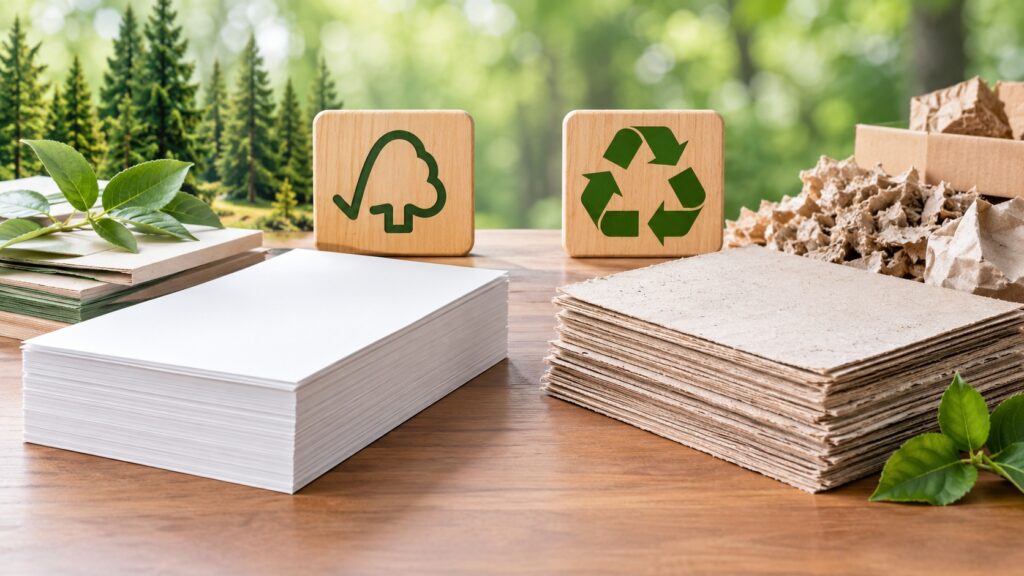
The main concerns of FSC paper are responsible forest management and traceable sourcing; reusing recovered paper fibres are the main concerns of recycled paper. By knowing the differences between them, businesses are able to choose the most appropriate material to be used in printing, packaging, marketing as well as other paper products.
In this guide, we’ll discuss the differences between FSC paper and recycled paper in terms of advantages for the environment, quality, cost, uses, and certifications.
1. What Is FSC Paper?
FSC paper is paper that is sourced from forest-based resources that comply with the Forest Stewardship Council (FSC) sourcing requirements. The FSC is an international body that encourages responsible forest management and enables companies to certify forest products.
Depending on the label, virgin wood fibers from responsibly managed forests or recycled, or a mix of virgin and recycled fibers, may be used in FSC-certified paper.
There are three types of FSC labels that are relevant to paper products.
- FSC 100%: All forest-based material comes from FSC-certified forests.
- FSC Recycled: The product meets FSC requirements for recycled material.
- FSC Mix: The product contains a permitted combination of FSC-certified forest materials, recycled materials, and/or other controlled sources.
FSC certification does not automatically mean that paper is made entirely from recycled fibers. Instead, it provides assurance about material sourcing and compliance with the relevant FSC requirements.
Benefits of FSC Paper
Responsible forest management: FSC certified sourcing promotes forestry practices that help to protect biodiversity, maintain forest ecosystems, and support the rights of workers and Indigenous Peoples.
Supply chain traceability: FSC Chain of Custody designates materials as certified through appropriate production, processing and distribution stages.
Print quality: FSC paper comes in many grades, such as coated paper, uncoated paper, specialty printing paper and packaging board.
Brand credibility: Companies can leverage on the use of sustainability certified paper to promote responsible sourcing and build brand credibility.
FSC paper is especially beneficial for businesses that need transparency in their sourcing practices, predictable print results and authentic sustainability claims.
2. What Is Recycled Paper?
Recycled paper is paper made from recovered paper fibers not just from newly harvested wood fibers. They can be derived from post-consumer waste, like used office paper, newspapers, cardboard and waste packaging materials, or pre-consumer waste obtained during the production process.
There are two types of recycled paper.
- Post-consumer recycled paper: Made with fibers recovered after consumers or businesses have used and discarded paper products.
- Pre-consumer recycled paper: Made with qualifying manufacturing waste or other materials recovered before reaching the end user.
Paper manufacturers collect recovered paper, sort it by grade, remove contaminants, and process it into pulp. Depending on the product, the pulp may undergo deinking, cleaning, screening, and bleaching before being formed into new sheets or rolls.
Not every recycled paper product contains 100% recycled content. Some grades combine recycled fibers with virgin pulp to achieve specific strength, brightness, smoothness, or printing requirements.
Benefits of Recycled Paper
Lower virgin fiber demand: The ability to recycle recovered paper can help lower virgin fiber demand.
Waste reduction: Recycling is the reuse of suitable paper materials without going to landfill or incineration.
Potential resource savings: Recycled paper may save virgin paper, water, energy and other resources depending on the manufacturing process and supply chain.
Circular production: Support to create new packaging and printing systems with recycled paper.
But, the benefit of recycled paper to the environment depends on fiber quality, collection efficiency, transportation, types of electricity used, water treatment, and the manufacturing process. Recycling consumes energy and water, too, and paper fibers tend to get shorter and weaker with each recycle.
3. FSC Paper vs Recycled Paper: Key Differences
Although FSC paper and recycled paper are both used in sustainable printing and packaging, they differ in their main environmental purpose, material composition, and certification requirements.
| Comparison factor | FSC Paper | Recycled Paper |
|---|---|---|
| Main focus | Responsible material sourcing | Reuse of recovered paper fibers |
| Raw materials | Certified forest fibers, recycled fibers, or approved combinations | Recovered pre-consumer or post-consumer fibers |
| Virgin wood pulp | May contain virgin fibers | May be blended in, depending on the product |
| Certification | FSC certification, where applicable | Recycled-content claims or other relevant certifications |
| Appearance | Available in bright white, smooth, coated, and natural finishes | Available in white, cream, gray, and natural finishes |
| Printing quality | Depends on paper grade and finish | Depends on fiber quality and manufacturing process |
| Environmental benefits | Supports responsible forest management and sourcing | Supports fiber reuse and waste reduction |
| Typical applications | Premium printing, books, labels, packaging | Office paper, recycled packaging, notebooks, and eco-friendly printing |
| Best suited for | Businesses prioritizing responsible sourcing | Businesses prioritizing recovered material content |
The most important distinction is that FSC certification and recycled content describe different attributes of a paper product. FSC relates to verified sourcing under a certification system, while recycled content describes the material used to manufacture the paper.
A paper product can satisfy both objectives. For example, an FSC-certified recycled paper product may combine verified recycled-material claims with FSC certification requirements.
4. Which Paper Is More Environmentally Friendly?
There is no universal answer to whether FSC paper or recycled paper is better for the environment. The result depends on the paper’s composition, manufacturing methods, transportation, and intended use.
Forest Conservation
FSC-certified virgin-fiber paper can support responsible forest management by requiring compliance with applicable forestry standards. It does not mean that no trees are harvested; rather, harvesting and sourcing must meet the relevant certification requirements.
Recycled paper reduces dependence on virgin fibers by using recovered materials. This can help preserve forest resources, particularly when products contain a high proportion of post-consumer recycled content.
Energy and Water Consumption
Recycled paper can reduce the need for certain virgin-pulp production processes, potentially lowering resource consumption. However, collecting, sorting, transporting, and deinking recovered fibers also requires resources.
FSC paper made from virgin pulp may involve different processing demands depending on the mill, pulping method, energy source, and paper grade.
Consequently, comparing the actual environmental footprint of two products requires more than looking at their labels. Product-specific life-cycle assessment data can provide a more reliable comparison.
Waste Reduction and Circularity
Recycled paper has a clear advantage when the primary objective is to incorporate recovered material and reduce reliance on newly sourced fibers.
FSC-certified paper contributes to responsible sourcing, but FSC certification alone does not guarantee a high recycled-content percentage.
Practical recommendation: If your priority is recycled content, check the percentage of post-consumer recycled fibers. If responsible forest sourcing is your main concern, look for an appropriate FSC label. If you need both, investigate FSC-certified recycled paper.
5. FSC Paper vs Recycled Paper for Printing Quality
Paper quality is an important consideration for publishers, commercial printers, packaging manufacturers, and businesses producing marketing materials.
Neither FSC paper nor recycled paper is automatically superior in printing performance. The paper grade, surface treatment, fiber composition, weight, opacity, and intended printing method have a significant influence on the final result.
Brightness and Color
FSC-certified virgin-fiber paper is available in highly white, bright grades suitable for full-color printing and professional publications.
Recycled paper can also achieve high brightness and excellent color reproduction. However, some recycled grades have a slightly gray, cream, or natural appearance due to their fiber composition and processing.
For premium catalogs, product brochures, and photography-heavy publications, compare actual samples before placing a large order.
Smoothness and Print Detail
Smooth paper surfaces generally provide consistent ink transfer and fine image detail. Both FSC and recycled paper are available in coated and uncoated finishes.
High-quality recycled paper can perform well in digital printing, offset printing, and many commercial applications. However, individual grades may differ in surface uniformity, dust levels, ink absorption, and finishing performance.
Strength and Durability
Paper strength depends on fiber quality, sheet structure, basis weight, and manufacturing specifications. Recycled fibers may become shorter after repeated processing, but manufacturers can adjust fiber blends and production methods to meet different performance requirements.
For demanding applications such as heavy-duty cartons, shipping packaging, or durable book covers, evaluate burst strength, tear resistance, stiffness, and other relevant technical specifications rather than relying on certification labels alone.
6. Common Applications of FSC and Recycled Paper
FSC Paper for Books and Publishing
FSC-certified paper is suitable for hardcover books, paperbacks, educational materials, magazines, and premium catalogs. Publishers can prioritize responsible sourcing while choosing paper grades that meet their color, opacity, and durability requirements.
Recycled Paper for Packaging
Recycled paper and paperboard are widely used in corrugated cartons, shipping boxes, protective packaging, paper bags, and other applications where recovered fibers can meet strength and appearance requirements.
Both Options for Commercial Printing
Businesses producing product labels, stationery, brochures, and retail packaging can consider either option. The right choice depends on customer expectations, print specifications, sourcing policies, and budget.
For manufacturers serving international customers, it is worth confirming the exact paper grade, certification status, and documentation required by the buyer before production begins.
7. FSC Paper vs Recycled Paper: Which Is More Cost-Effective?
The cost difference between FSC paper and recycled paper depends on the paper grade, order volume, supplier, certification requirements, and production specifications.
FSC-certified paper may carry additional sourcing or supply-chain verification costs. Recycled paper pricing depends on the availability and quality of recovered fibers, deinking requirements, and the desired brightness and strength.
For bulk purchasing, compare quotations using the same paper weight, dimensions, finish, and technical requirements. Also consider printing waste, material availability, minimum order quantities, and consistency across repeat orders.
Businesses should request samples and technical data sheets before selecting a supplier. For certified products, verify that the supplier and product claims meet the applicable certification requirements.
8. How to Choose Between FSC Paper and Recycled Paper
Use the following checklist to make a practical decision:
- Choose FSC-certified paper if responsible forest management and verified sourcing are priorities.
- Choose recycled paper if you want to maximize recovered fiber content and support paper recycling.
- Choose FSC-certified recycled paper if both responsible sourcing and recycled-material claims are important.
- Compare brightness, opacity, smoothness, strength, and print compatibility for your application.
- Evaluate the total environmental impact where reliable product-specific data is available.
- Confirm certification documentation and labeling requirements before making sustainability claims.
For businesses purchasing large quantities of paper, the best choice is not necessarily the paper with the most sustainability labels. It is the material that meets the project’s environmental goals, performance requirements, and budget while providing verifiable documentation.
9. Frequently Asked Questions
Is FSC paper the same as recycled paper?
No. FSC paper is defined by its compliance with applicable FSC sourcing and certification requirements, while recycled paper is made using recovered paper fibers. Some products qualify as both FSC-certified and recycled.
Is FSC paper environmentally friendly?
FSC-certified paper supports responsible forest sourcing under the applicable certification standards. Its overall environmental impact still depends on manufacturing, transportation, material composition, and end-of-life treatment.
Is recycled paper always better for the environment?
Not necessarily. Recycled paper can reduce demand for virgin fibers and help divert waste, but its total environmental impact depends on processing methods, energy use, water consumption, and supply-chain factors.
Can recycled paper be used for high-quality printing?
Yes. Many recycled paper grades are suitable for books, brochures, catalogs, business stationery, and packaging. Select a grade designed for your printing process and test samples when color accuracy or fine image detail is essential.
Can FSC paper contain recycled materials?
Yes. FSC’s product categories include FSC Recycled and FSC Mix, subject to the relevant material and certification requirements. The exact label determines what sourcing claim can be made.
Which is better for sustainable packaging?
Both can be appropriate. Recycled paper is useful when recovered content is a priority, while FSC-certified paper is useful when responsible sourcing is the objective. The best option depends on packaging performance, recycled-content targets, customer requirements, and verifiable environmental data.
Conclusion
The major difference between FSC paper and recycled paper is the difference between the responsible sourcing of paper and the content of recovered material. FSC certification provides businesses with an opportunity to verify paper compliance with paper applicable responsible sourcing requirements and recycling paper is an opportunity to recover resources by reusing paper fibres.
For publishers, printers, and packaging manufacturers, the choice should be guided by the intended use of the product, the quality of the paper, their environmental goals, and the supplier’s documentation.
If you want to have a responsible sourcing and circular material use, FSC recycled may be worth considering. When considering print quality, durability or cost, weigh each paper grade individually; don’t expect one category to be better than another.
Finally, the selection of the appropriate paper will be a trade-off between sustainability, functionality and cost while ensuring that the claims regarding the environment can be backed up.
Share on Social:


