

OEM Children’s Book Printing: Choosing Lamination, Varnish and Protective Finishes
Related Posts
Bulk Custom Book Printing in China for Publishers and Brands
September 30, 2026
Children’s Book Printing for Publishers: 2026 Interactive Book Trends
September 30, 2026
Bulk Journal Printing Quality Control: Binding Strength, Page Order and Trim Accuracy
September 29, 2026
Softcover Book Printing in China: Short Runs, Bulk Orders and Reprint Planning
September 29, 2026
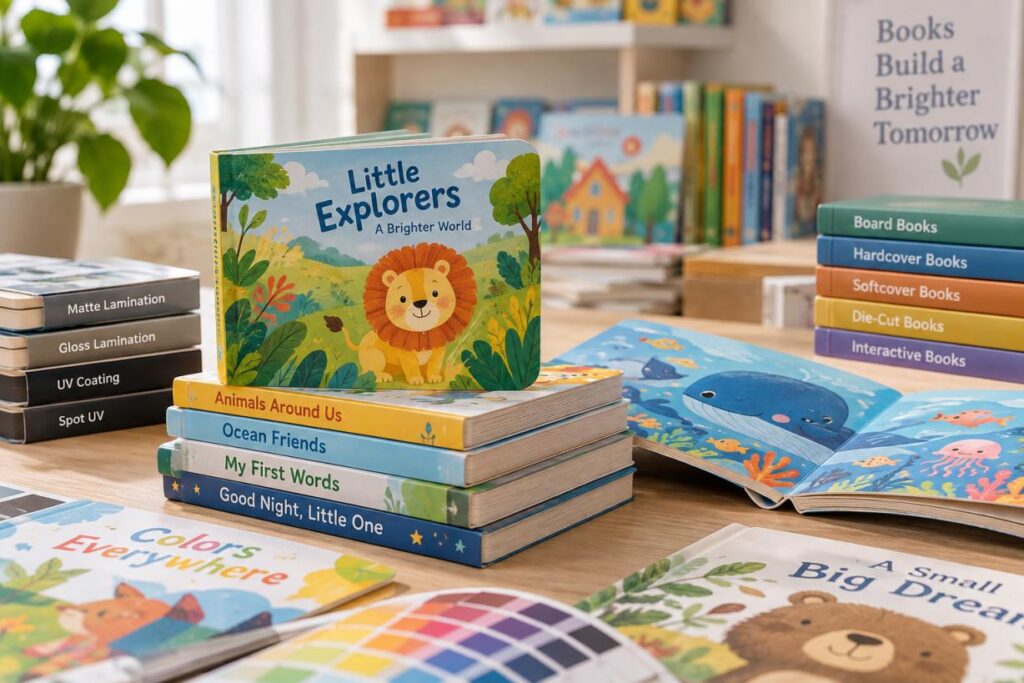
In OEM Children’s Book Printing, surface finishing should be selected as part of the book structure—not as a decorative step added after printing. A matte film may look premium but show scuffing on a dark cover. A heavy laminate may improve protection but create stiffness at a paperback spine. A UV coating may increase surface resistance, yet it still has to survive scoring, die-cutting and binding.
At CAIMEI, we therefore look at the complete system:
Paper → Ink → Protective Finish → Converting → Binding → Finished-Book Use
This is especially important for children’s books, which may experience frequent handling, fingerprints, abrasion, spills, bending and repeated opening.
Start With the Failure Risk, Not the Finish Name
Before specifying lamination or varnish for an OEM Children’s Book Printing project, identify what the surface actually needs to resist.
Common problems include:
• Scuffing and scratches on dark or matte covers
• Fingerprints and stains from frequent handling
• Curling after one-sided lamination
• Delamination around edges or high-ink-coverage areas
• Spine cracking after scoring and repeated opening
• Edge lifting after die-cutting or rounded-corner conversion
These failures are influenced by several variables simultaneously.
| Variable | Its Effect on the Finished Book |
| Paper GSM/caliper | Controls stiffness and dimensional stability |
| Coated/uncoated surface | Affects ink holdout and finish adhesion |
| Ink coverage | Heavy solids can increase finishing sensitivity |
| Film/coating type | Determines protection and surface appearance |
| Grain direction | Influences folding and spine behavior |
| Scoring | Reduces cracking around folds |
| Binding structure | Determines where mechanical stress occurs |
A thicker film is therefore not automatically a better specification.
Lamination and Varnish Protect the Book Differently
The main distinction is structural.
Lamination bonds a separate film over the printed sheet. It generally provides a stronger physical barrier against abrasion, dirt and occasional moisture.
Varnish or coating creates a thinner protective layer over the ink. It can improve rub resistance and appearance while retaining more of the original paper flexibility.
For OEM Children’s Book Printing, the practical comparison is:
| Finish | Protection | Visual Effect | Main Consideration |
| Gloss Lamination | High | Strong gloss and color saturation | Reflection |
| Matte Lamination | High | Low-glare premium surface | Visible scuffing |
| Anti-Scuff Matte | High | Matte | Higher material cost |
| Aqueous Varnish | Moderate | Natural to semi-gloss | Lower barrier than film |
| UV Coating | Moderate–High | High gloss | Post-press compatibility |
| Spot UV | Local only | High contrast | Decorative, not full protection |
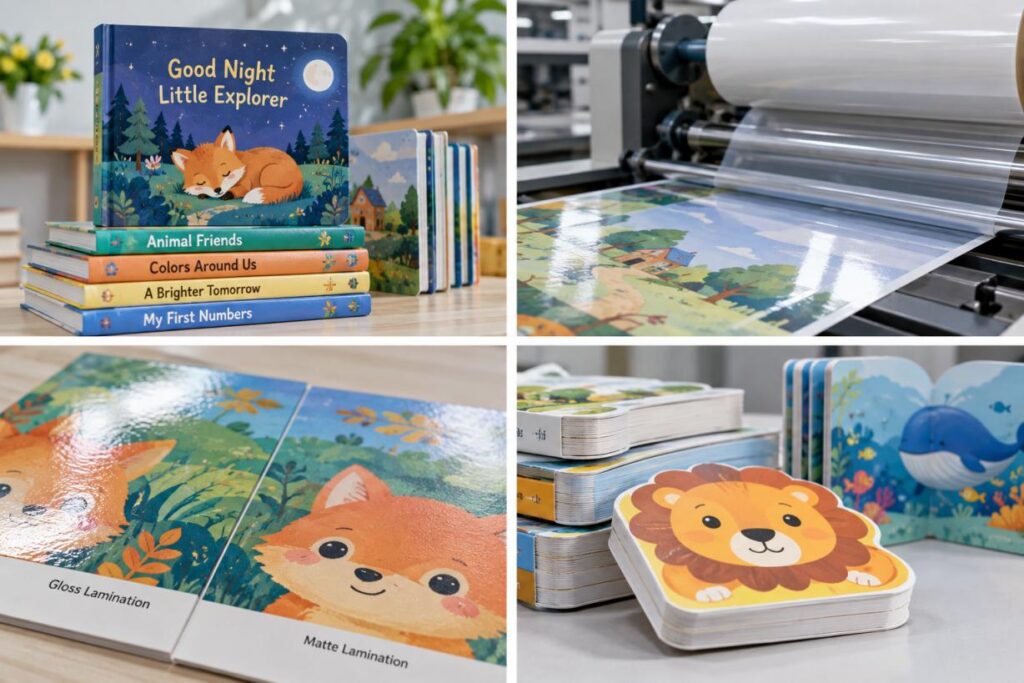
CAIMEI’s children’s book production options include glossy lamination, matt lamination, film lamination, UV coating and spot UV, together with embossing and hot stamping.
Matte Does Not Mean Scratch-Proof
This distinction matters for covers with black, navy, dark green or other large solid areas.
Standard matte film may make fine scratches more visible because of its low-gloss surface. Where shelf wear and transportation friction are major risks, an anti-scuff specification should be evaluated rather than simply writing “matte lamination” in the RFQ.
A finished physical proof is more useful than judging the effect from a digital rendering.
Match the Finish to the Book Construction
The same surface finish should not be applied automatically to every OEM Children’s Book Printing project.
Board Books
Board books face repeated handling, edge wear and contamination. Priorities usually include:
• Strong surface protection
• Easy cleaning
• Edge adhesion
• Compatibility with rounded corners
• Resistance after repeated page opening
Hardcover Picture Books
The cover normally carries most of the handling load. Lamination can provide good protection while spot UV, foil or embossing can be added selectively for visual differentiation.
Softcover Books
Flexibility becomes more important. A finish that is too rigid relative to the cover stock may create stress around scores and the spine.
Activity and Interactive Books
Die-cut, wipe-clean, pop-up, sound or lift-the-flap structures introduce additional interfaces between paper, coatings, plastic or electronic components.
CAIMEI supports coated, uncoated, laminated, waterproof, recycled, glossy, matte, textured and high-opacity paper options. For books intended for younger readers, its published guidance also lists heavier cardstock in the 200–350 gsm range as an option where greater durability is required.
Finishing Must Survive Binding and Converting
A good-looking press sheet does not prove that the finished book will perform correctly.
For CAIMEI OEM Children’s Book Printing, surface finishing needs to be checked against downstream operations such as:
• Scoring before folding;
• Perfect, sewing or hardcover binding;
• Saddle stitching;
• Board book binding;
• Spiral or Wire-O structures;
• Custom die-cutting;
• Rounded corners;
• Final packing and transport.
CAIMEI offers hardcover, softcover, spiral, perfect, sewing, Wire-O, comb, saddle-stitched and lay-flat structures, as well as custom die-cut shapes and rounded corners.
The critical point is the interface. Film adhesion may be acceptable on a flat sheet but fail around a sharply scored spine or exposed die-cut edge.
Verify the Finished Book, Not Only the Material Datasheet
Quality control should evaluate the complete paper + ink + finish + binding combination.
Useful checks include:
• Visual rub and scuff inspection;
• Coating or film adhesion;
• Fold and spine cracking;
• Edge lifting after die-cutting;
• Color appearance after lamination;
• Resistance to expected handling or cleaning;
• Comparison against the approved production sample.
ISO 2836:2021 provides methods for assessing the resistance of printed materials to various liquid and solid agents, solvents, varnishes and acids. It is useful technical background for print-resistance evaluation, although it does not establish consumer-product or food-contact safety requirements.
Children’s Book Compliance Starts With Product Classification
Do not specify EN 71, CPSIA or another children’s-product requirement simply because the product is called a children’s book.
For the U.S. market, CPSC distinguishes qualifying ordinary books from products with inherent play value, books designed or intended for children three years old or younger, and certain products containing non-paper components. These categories can have different testing implications.
For interactive OEM Children’s Book Printing, the buyer should therefore define:
• Target age;
• Destination market;
• Non-paper components;
• Sound, toy or interactive elements;
• Required test reports;
• Applicable customer or retailer standards.
Build the Finish Into the OEM RFQ
A professional RFQ should say more than “matte laminated children’s book.”
Specify:
• Finished size and page count;
• Cover and text paper;
• GSM or board thickness;
• Printing colors;
• Lamination/coating type;
• Anti-scuff requirement if needed;
• Binding method;
• Die-cut or rounded-corner requirements;
• Target age and market;
• Proofing requirements;
• Testing requirements;
• Packing method.
CAIMEI operates a dedicated children’s book production line within a stated 30,000+ m² production facility and supports both conventional storybooks and complex formats such as die-cut, wipe-clean, pop-up and sound books. Its current published lead-time guidance indicates approximately 15–25 days for prototypes and 15–20 days for small batches, with complex or larger projects requiring additional production time.
For a new OEM Children’s Book Printing project, the best finish is not necessarily the most expensive one. It is the finish that remains compatible with the paper, printing, binding, handling conditions and target-market requirements.
Publishers and brands can work with CAIMEI to review these variables before sampling and bulk production, reducing the risk of selecting a finish that looks good initially but performs poorly in the finished book.
FAQs
Q1. What OEM Children’s Book Printing services does CAIMEI provide?
CAIMEI supports OEM Children’s Book Printing for picture books, board books, hardcover books, softcover books and more complex formats such as die-cut, wipe-clean, pop-up and sound books.
Q2. What surface finishes can CAIMEI provide for children’s books?
Available options include gloss lamination, matte lamination, film lamination, UV coating, spot UV, embossing and hot stamping. The appropriate finish depends on the paper, binding structure and expected use.
Q3. Can CAIMEI help choose between matte and gloss lamination?
Yes. CAIMEI can evaluate the cover artwork, ink coverage, paper stock, book type and handling requirements before recommending a finish. Dark covers, for example, may require extra attention to scuff visibility.
Q4. Does CAIMEI offer different paper options for children’s books?
Yes. CAIMEI works with coated, uncoated, laminated, waterproof, recycled, glossy, matte, textured and high-opacity paper options for different OEM Children’s Book Printing requirements.
Q5. What paper weight can be used for durable children’s books?
CAIMEI indicates heavier cardstock in the 200–350 gsm range as an option for projects requiring additional stiffness and durability. Final selection should also consider book construction and binding.



NAME
text text text text. text text text text. text text text text. text text text text. text text text text. text text text text. text text text text. text text text t text xt. text text text text. text text text text. text text text t text
Contact Us
In This Article
Related Posts
Bulk Custom Book Printing in China for Publishers and Brands
September 30, 2026
Children’s Book Printing for Publishers: 2026 Interactive Book Trends
September 30, 2026
Bulk Journal Printing Quality Control: Binding Strength, Page Order and Trim Accuracy
September 29, 2026
Softcover Book Printing in China: Short Runs, Bulk Orders and Reprint Planning
September 29, 2026


