

Custom Children’s Books in Bulk with FSC Paper and Eco-Friendly Inks
Related Posts
Bulk Custom Book Printing in China for Publishers and Brands
September 30, 2026
Children’s Book Printing for Publishers: 2026 Interactive Book Trends
September 30, 2026
Bulk Journal Printing Quality Control: Binding Strength, Page Order and Trim Accuracy
September 29, 2026
Softcover Book Printing in China: Short Runs, Bulk Orders and Reprint Planning
September 29, 2026
Producing Custom Children’s Books in Bulk with FSC paper and environmentally responsible inks is not simply a material substitution project. In mass production, paper shade, opacity, ink holdout, drying behavior, coating, binding and batch consistency all interact.
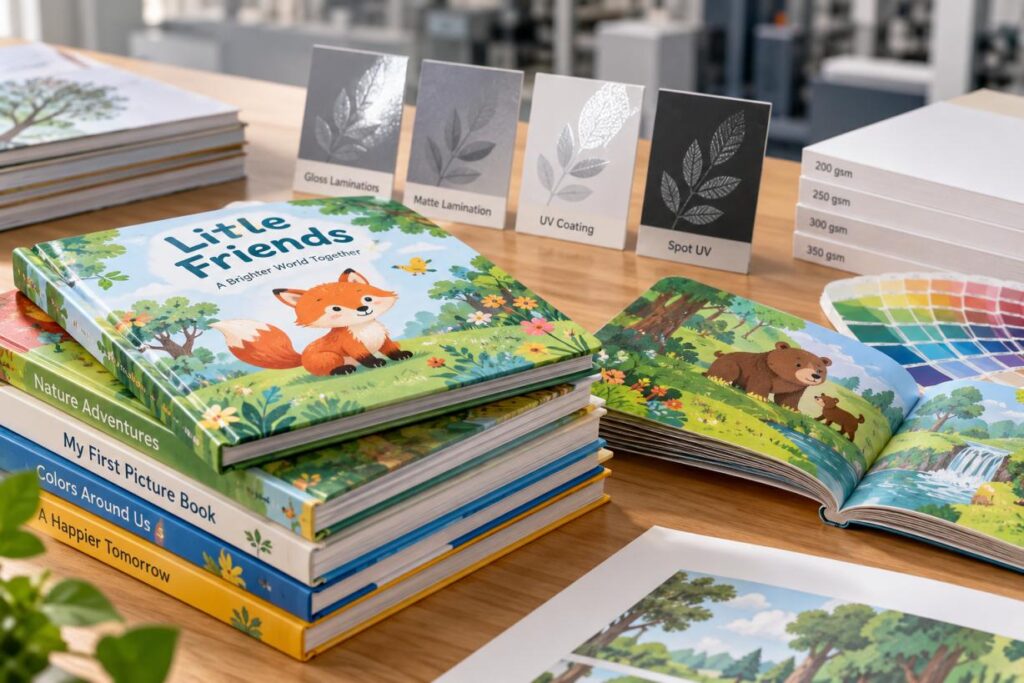
From CAIMEI’s production perspective, a stable children’s book specification should be built as a complete system:
Book Format → Paper → Ink → Color Standard → Printing Process → Finishing → Binding → Compliance → Bulk QC
This approach is especially important when producing Custom Children’s Books in Bulk for publishers, educational brands and children’s IP owners that require repeatable quality across thousands of copies.
FSC Paper Selection Starts with Print Performance
FSC certification addresses fiber sourcing and supply-chain traceability, but it does not automatically determine print quality.
For Large Scale Production, buyers should review FSC paper in detail and not just review the certification.
| Parameter | Why It Matters in Bulk Production |
| GSM | Heavy stocks cost more, but double up together and are better for binding. |
| Caliper | Thick books require larger spine width. |
| Opacity | Double Side printed books with text on both sides |
| Whiteness | Red and Golds are brighter on light papers |
| Surface Smoothness | Wrinkle resistant paper |
| Grain Direction | Affects folds and stability of binding |
| Moisture Stability | Artifact curls and has a large defective variation |
CAIMEI provides different types of high quality paper that are coated, uncoated, textured, recycled, glossy, matte and high opacity, but probably not all at the same time. For board-style books for young children, thick paper should be chosen according to the overall sturdiness and handling of the book.
FSC 100%, FSC Mix or FSC Recycled?
The right choice depends on the project rather than a simple “more recycled is better” rule.
| Paper Route | Main Advantage | Main Production Concern |
| FSC 100% | Consistent virgin-fiber structure | Cost and sourcing availability |
| FSC Mix | Balance of sourcing and print performance | Exact claim must be confirmed |
| FSC Recycled | Strong recycled-content positioning | Shade and surface variation require checking |
For illustration-heavy books, CAIMEI recommends evaluating the actual paper together with the approved color proof before bulk production.
Paper and Ink Must Be Qualified as a Pair
A common mistake in Custom Children’s Books in Bulk is approving artwork without locking the production paper.
Paper directly affects ink behavior.
Coated paper retains ink at its surface. This makes the printed media sharper and more saturated compared to uncoated paper which can absorb printing ink. This results in a media with softer details and more muted colors.
The production relationship is:
Paper shade → Ink absorption → Dot gain → Color density → Finishing result
This is why the same CMYK file can look different on two FSC paper grades.
At CAIMEI, color-sensitive projects should be evaluated using the actual production substrate, especially when illustrations contain:
• Large flat-color areas;
• Skin tones;
• Soft gradients;
• Dark backgrounds;
• Branded spot colors;
• Fine line artwork.
Eco-Friendly Ink Requires More Than a Marketing Label
Terms such as soy-based ink, vegetable-based ink, low-VOC ink and eco-friendly ink should not be treated as identical.
For professional Custom Children’s Books in Bulk, buyers should review:
• Ink vehicle composition;
• Pigment and additive documentation;
• Drying performance;
• Compatibility with coated or uncoated paper;
• Rub resistance;
• Downstream coating compatibility;
• Applicable chemical or heavy-metal requirements.
An environmentally positioned ink still has to deliver stable density, clean trapping and sufficient drying before lamination, varnishing or binding.
Offset vs. Digital for Custom Children’s Books in Bulk
CAIMEI supports different printing routes depending on quantity, color requirements and book construction.
| Production Factor | Digital Printing | Offset Printing |
| Short runs | More efficient | Higher setup cost |
| Large quantities | Unit cost may remain higher | Better cost efficiency |
| Variable content | Strong | Limited |
| Spot colors | More restricted | Better flexibility |
| Repeat runs | Requires profile control | Strong for standardized production |
| Paper range | Device-dependent | Broad commercial options |
For most medium- and large-volume Custom Children’s Books in Bulk, offset printing becomes attractive because plate and setup costs are distributed across more units.
However, quantity alone should not decide the process. CAIMEI evaluates:
Order volume + Paper + Color requirement + Finishing + Delivery schedule
Before confirming the production route.
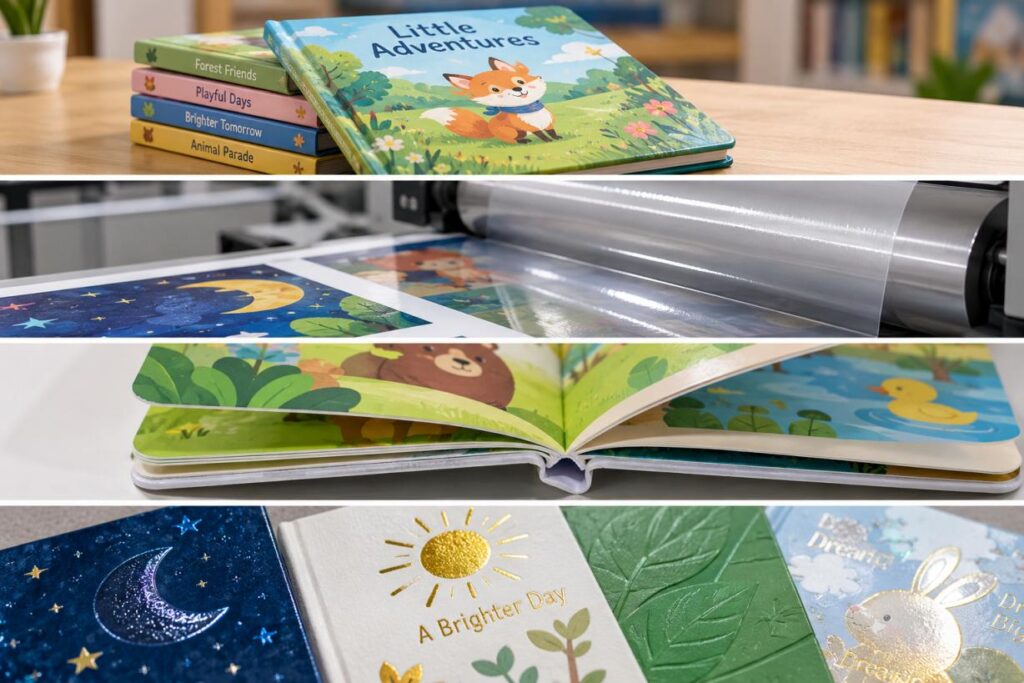
Finishing Is a Durability Decision, Not Just Decoration
Children’s books are frequently handled, stacked, opened and transported. Surface finishing therefore affects both appearance and service life.
Aqueous Varnish
Suitable when a project requires moderate surface protection with less reliance on film.
Film Lamination
Offers better protection against moisture, fingerprints, and abrasion, but has an additional layer of coating.
No Coating
Smoother paper feel is preserved during printing, but the surfaces can be less resistant to rubbing and contamination.
CAIMEI offers options including:
• Matte and gloss lamination;
• UV and spot UV;
• Embossing and debossing;
• Foil stamping;
• Die-cut structures;
• Textured finishing.
For sustainable Custom Children’s Books in Bulk, the best choice is not automatically the lowest-material option. A book that wears out too quickly can undermine both user experience and lifecycle efficiency.
Binding Must Match Page Count, Paper and Age Group
Binding should be engineered together with paper thickness and handling conditions.
CAIMEI can produce structures such as:
• Hardcover;
• Softcover;
• Perfect binding;
• Sewing binding;
• Saddle stitching;
• Spiral and Wire-O;
• Lay-flat construction;
• Interactive board books.
For example, increasing paper caliper changes total spine width. Switching from coated paper to a bulkier uncoated stock may therefore require adjustments to spine calculation, cover creasing and adhesive application.
For heavily handled children’s books, binding strength should be evaluated alongside:
Page count + Paper caliper + Opening angle + Adhesive system + Expected use frequency
How CAIMEI Controls Bulk Production Consistency
The challenge with Custom Children’s Books in Bulk is not producing one attractive sample. It is keeping thousands of copies within an agreed production standard.
Before mass production, a professional control plan should include:
• Final confirmation of paper specification;
• Approved color proof or production sample;
• Locked artwork and bleed settings;
• CMYK and Pantone definitions;
• Binding dummy when structure is complex;
• Approved finishing reference;
• Retained samples for reprints.
During production, operators should monitor color density, registration, folding accuracy, adhesive performance and finishing consistency.
CAIMEI’s children’s book production is supported by a 30,000+ m² manufacturing facility, allowing printing, binding and finishing requirements to be coordinated within one production workflow.
Storage and Packing Also Affect Finished Quality
Production control does not end at binding.
Paper-based products react to moisture and temperature. Incorrect storage can cause:
• Board warping;
• Page curling;
• Cover deformation;
• Blocking between coated surfaces;
• Carton compression during transport.
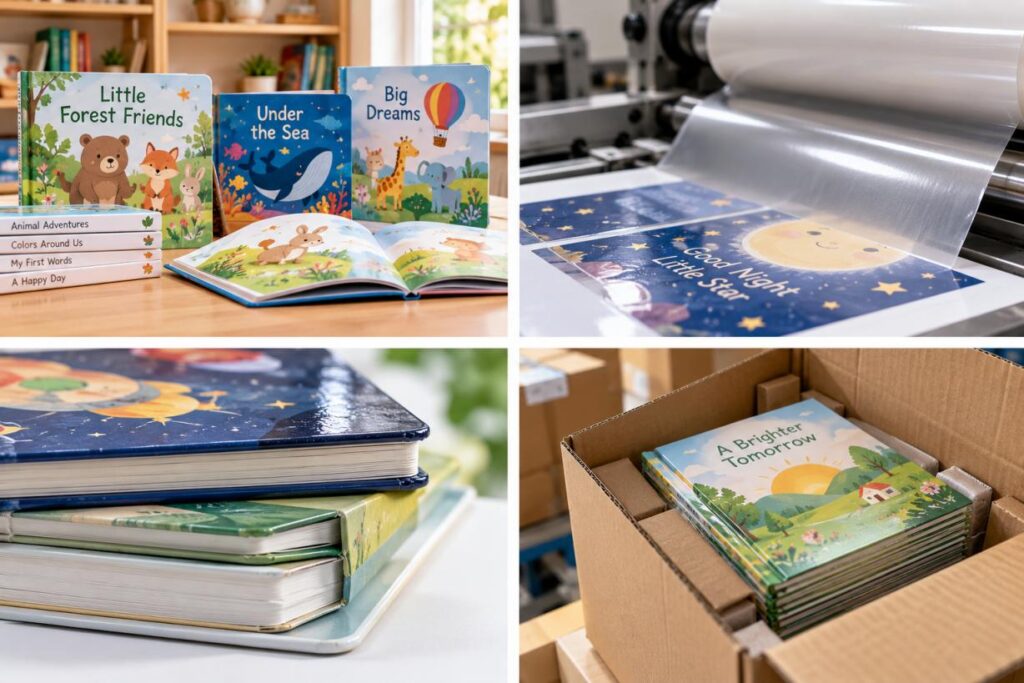
For export orders, CAIMEI can plan carton configuration, inner protection and packing according to book size, weight and shipping method.
Verify Compliance Before Final Approval
FSC documentation and children’s product safety are separate purchasing issues.
For each project, buyers should verify:
• Required FSC claim;
• Whether FSC labeling is required;
• Destination-market regulations;
• Ink and coating documentation;
• Whether added components change product classification;
• Testing requirements for sound, plastic, textile or tactile elements.
A standard paper picture book and an interactive book with toy-like components may not follow the same compliance path.
A Better Purchasing Checklist
Before confirming Custom Children’s Books in Bulk, define:
• Book size and page count;
• FSC paper category;
• GSM, caliper and opacity;
• Printing process;
• Ink and color requirements;
• Binding method;
• Coating or lamination;
• Proofing method;
• Compliance documents;
• Order quantity and MOQ;
• QC criteria;
• Packing and reprint standards.
For CAIMEI, sustainable children’s book production is not about adding an FSC logo or replacing one ink system. It is about matching material traceability, print performance, durability, color consistency and manufacturability in one controlled specification.
Publishers planning Custom Children’s Books in Bulk can review CAIMEI’s children’s book printing capabilities at HERE and discuss paper, binding, finishing, quantity and target-market requirements before final production.
FAQs
Q1. Can CAIMEI produce Custom Children’s Books in Bulk for publishers and educational brands?
Yes. CAIMEI provides children’s book printing for both small and large production orders and has a dedicated children’s book production line. Its website lists a 30,000+ m² production facility and large-scale printing capabilities for high-volume projects.
Q2. What paper options does CAIMEI offer for Custom Children’s Books in Bulk?
CAIMEI supports coated, uncoated, laminated, waterproof, recycled, glossy, matte, textured and high-opacity papers. The appropriate choice depends on illustration density, writing requirements, durability and target age group.
Q3. Can CAIMEI use FSC paper for children’s book projects?
FSC requirements should be confirmed when the project specification is prepared, including the required FSC claim, paper grade and labeling requirements. Buyers should also verify the applicable FSC documentation before mass production.
Q4. What paper weight is suitable for children’s board books?
CAIMEI recommends heavier cardstock for books intended for younger children, with its children’s book page listing 200–350 gsm as a suitable range for more durable constructions.
Q5. What binding options are available for Custom Children’s Books in Bulk?
CAIMEI offers hardcover, softcover, spiral, perfect binding, sewing binding, Wire-O, comb binding, saddle stitching and lay-flat structures. Binding should be matched to page count, paper caliper and expected handling frequency.



NAME
text text text text. text text text text. text text text text. text text text text. text text text text. text text text text. text text text text. text text text t text xt. text text text text. text text text text. text text text t text
Contact Us
In This Article
Related Posts
Bulk Custom Book Printing in China for Publishers and Brands
September 30, 2026
Children’s Book Printing for Publishers: 2026 Interactive Book Trends
September 30, 2026
Bulk Journal Printing Quality Control: Binding Strength, Page Order and Trim Accuracy
September 29, 2026
Softcover Book Printing in China: Short Runs, Bulk Orders and Reprint Planning
September 29, 2026


