

Bulk Bible Printing: Page Count, Trim Size and Spine Thickness Engineering Guide
Related Posts
Bulk Custom Book Printing in China for Publishers and Brands
September 30, 2026
Children’s Book Printing for Publishers: 2026 Interactive Book Trends
September 30, 2026
Bulk Journal Printing Quality Control: Binding Strength, Page Order and Trim Accuracy
September 29, 2026
Softcover Book Printing in China: Short Runs, Bulk Orders and Reprint Planning
September 29, 2026
For Bulk Bible Printing, page count is not an isolated publishing specification. It determines paper volume, text-block thickness, signature count, binding stress, cover spine width, finished weight and opening behavior.
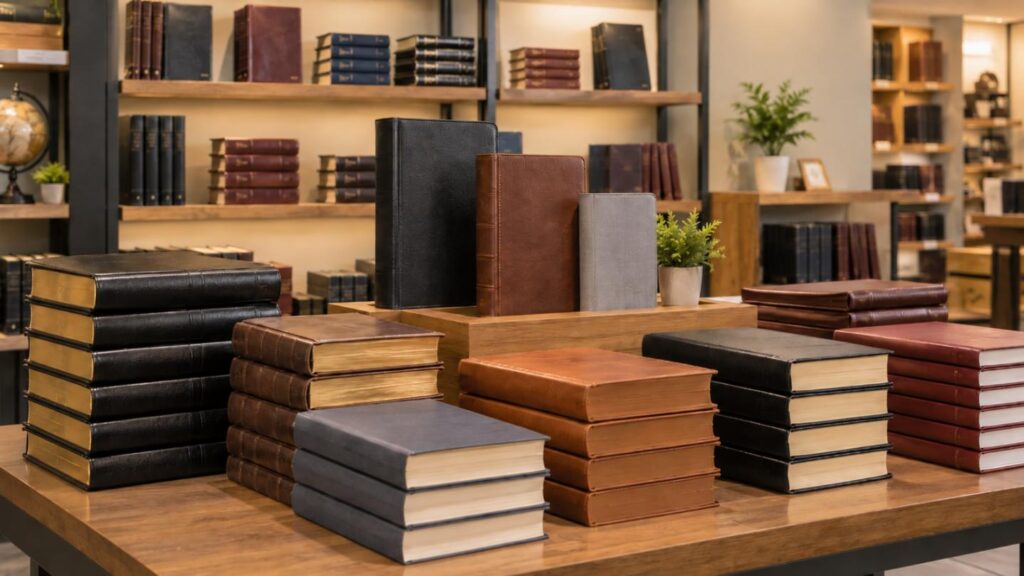
This is particularly important for 1,000–2,000+ page editions. At CAIMEI, we treat page count, trim size, paper caliper and binding structure as one engineering system rather than four separate purchasing choices.
Why Bible Thickness Cannot Be Predicted from Page Count Alone
Two Bibles with the same 1,500-page count may have different finished spine widths because the physical structure depends on:
• Actual paper caliper and bulk;
• Trim size and final pagination;
• Number and structure of signatures;
• Thread and adhesive buildup;
• Endpapers and spine lining;
• Compression during binding.
For Bulk Bible Printing, this means final cover dimensions should not be released before the text block has been technically confirmed.
GSM Is Not Paper Thickness
One common specification error is treating GSM as a direct measurement of thickness.
GSM measures mass per square meter. Caliper measures physical thickness.
A preliminary text-block calculation is:
Text-Block Thickness ≈ Page Count ÷ 2 × Paper Caliper
A 1,600-page Bible contains approximately 800 leaves. Even a very small caliper difference therefore accumulates across hundreds of sheets.
CAIMEI supports ultra-thin 28gsm to 45gsm Bible paper, as well as lightweight offset, high-opacity and writing-friendly stocks. Paper selection should therefore consider opacity, durability, folding behavior and print-through—not GSM alone.
Use Trim Size to Control Pagination Before Choosing Thinner Paper
When a Bible becomes too thick, moving immediately to thinner paper is not always the best engineering response.
Increasing trim size enlarges the usable type area:
Larger Text Area → More Words per Page → Fewer Pages → Lower Text-Block Thickness
However, the result depends on:
• Font size and leading;
• One- or two-column layout;
• Gutter and outside margins;
• Footnotes and cross-references;
• Concordances, maps and study notes.
Traditional Bible layouts often use compact 6–8 pt type and dual columns, while large-print editions may use 10 pt or larger type. Study editions require still more space for commentary and references.
Thin Paper vs. Larger Trim Size
| Engineering Route | Benefit | Main Limitation | Best Fit |
| Lower paper caliper | Keeps compact trim while reducing thickness | Opacity and handling become more demanding | Pocket / compact Bible |
| Larger trim size | Reduces pagination without extremely thin paper | Lower portability | Standard / study Bible |
| Smaller type area margins | Improves page efficiency | Gutter readability may suffer | Carefully optimized layouts |
| Smaller font | Can reduce page count significantly | Reading comfort decreases | Only when audience permits |
In professional Bulk Bible Printing, the goal is not the thinnest possible book. It is the best balance between readability, portability, opacity and binding durability.
Page Count Must Match Signature and Binding Architecture
Once pagination and paper are fixed, the next engineering issue is the signature plan.
Bible pages are printed, folded into sections, gathered and then bound. In a high-page-count book, fold thickness, thread and compression accumulate around the spine. Poor signature planning can create a rounded or overly bulky spine even when the theoretical paper calculation looks correct.
Perfect Binding vs. Smyth-Sewn Binding
| Factor | Perfect Binding | Smyth-Sewn Binding |
| Page connection | Adhesive | Sewn signatures |
| Opening behavior | Depends strongly on adhesive and spine design | Better flexibility |
| Production complexity | Lower | Higher |
| Repeated reading | Requires application-specific validation | Well suited to frequent opening |
| High-page editions | Possible with correct structure | Common choice for premium Bibles |
CAIMEI provides perfect, sewing, hardcover, softcover, leather, flexi and other binding structures. Its Bible range includes Smyth-sewn and 180° lay-flat Smyth-sewn constructions for editions requiring frequent opening.
Gutter Width Becomes More Important as the Bible Gets Thicker
A thick Bible creates a deeper inner curve when opened. If the gutter is too narrow, text near the spine becomes difficult to read even when the printed page itself is accurate.
During Bulk Bible Printing planning, gutter requirements should therefore be reviewed together with:
• Finished text-block thickness;
• Binding flexibility;
• Paper stiffness;
• Page dimensions;
• Type size.
This is why making a compact Bible smaller without recalculating its gutter can solve a portability problem while creating a readability problem.
Control Spine Variation During Mass Production
A correct design calculation must also survive production.
For large-volume Bulk Bible Printing, important process controls include paper conditioning, folding accuracy, gathering sequence, sewing tension, adhesive quantity and spine compression.
Ultra-thin paper adds another challenge: ink density must remain sufficient for clear text without excessive show-through.
CAIMEI states that its Bible operation uses dedicated production lines, thin-paper handling control, in-house prepress verification and multi-stage inspection from printing through binding. Its website lists annual Bible production of more than 1.4 million units and a 30,000+ m² production facility, supporting both large and repeat orders.
Approve a Physical Dummy Before Releasing the Cover
Spreadsheet calculations are useful, but they should not be the final authority for a complex Bible.
Before mass production, verify:
• Final pagination and trim size;
• Exact production paper;
• Actual text-block thickness;
• Opening and gutter behavior;
• Signature and sewing structure;
• Finished spine dimensions;
• Cover template alignment.
A blank paper dummy or bound sample is especially valuable when the project combines ultra-thin paper, high page count and a flexible or hardcover structure.
CAIMEI reports a normal mass-production period of 15–25 working days after sample and artwork confirmation, excluding international shipping.

Lock the Engineering Specification Before Requesting a Quote
A useful Bulk Bible Printing RFQ should define the final trim size, confirmed page count, interior paper, printing colors, binding structure, cover material, finishing requirements and order quantity.
The sequence matters:
Pagination → Paper → Caliper → Trim Size → Signature Plan → Binding → Physical Sample → Final Spine → Cover Approval
Changing paper or page count after cover approval can force spine artwork and case dimensions to be revised.
For publishers preparing high-page, multilingual, study or compact Bible editions, CAIMEI can review the page count, paper choice, trim size and binding structure as one production system. Its current Bible printing capabilities include 28gsm-45gsm thin paper, multilingual layout support, Smyth-sewn structures, premium cover finishing and dedicated high-volume production.
For your next Bulk Bible Printing project, you can send CAIMEI the final page count, trim size, paper preference, binding structure and planned quantity first. This allows the physical construction to be evaluated before the project moves into mass production.
FAQs
Q1. What paper options does CAIMEI offer for Bulk Bible Printing?
CAIMEI offers ultra-thin 28gsm to 45gsm Bible paper, lightweight offset paper for high-page-count editions, writing-friendly stocks for journaling Bibles, high-opacity paper and other paper options.
Q2. Can CAIMEI handle high-page-count Bulk Bible Printing projects?
Yes. CAIMEI operates dedicated Bible printing production lines designed for high-page-count, repeat and large-volume orders. Its website lists annual Bible production of more than 1.4 million units.
Q3. Does CAIMEI provide Smyth-sewn Bible binding?
Yes. CAIMEI offers sewn binding and produces Bible configurations using Smyth-sewn, lay-flat Smyth-sewn and 180° lay-flat Smyth-sewn structures, depending on the project requirements.
Q4. Can CAIMEI print multilingual Bible editions?
Yes. CAIMEI supports multilingual and complex layouts, including English, Chinese and bilingual editions. Its Bible portfolio also includes multilingual OEM/ODM projects.
Q5. How does CAIMEI manage show-through on thin Bible paper?
CAIMEI states that its thin-paper workflow controls ink density, opacity and show-through, which are particularly important when printing on 28–45gsm Bible paper.



NAME
text text text text. text text text text. text text text text. text text text text. text text text text. text text text text. text text text text. text text text t text xt. text text text text. text text text text. text text text t text
Contact Us
In This Article
Related Posts
Bulk Custom Book Printing in China for Publishers and Brands
September 30, 2026
Children’s Book Printing for Publishers: 2026 Interactive Book Trends
September 30, 2026
Bulk Journal Printing Quality Control: Binding Strength, Page Order and Trim Accuracy
September 29, 2026
Softcover Book Printing in China: Short Runs, Bulk Orders and Reprint Planning
September 29, 2026


