

How to Calculate Hardcover Book Spine Width

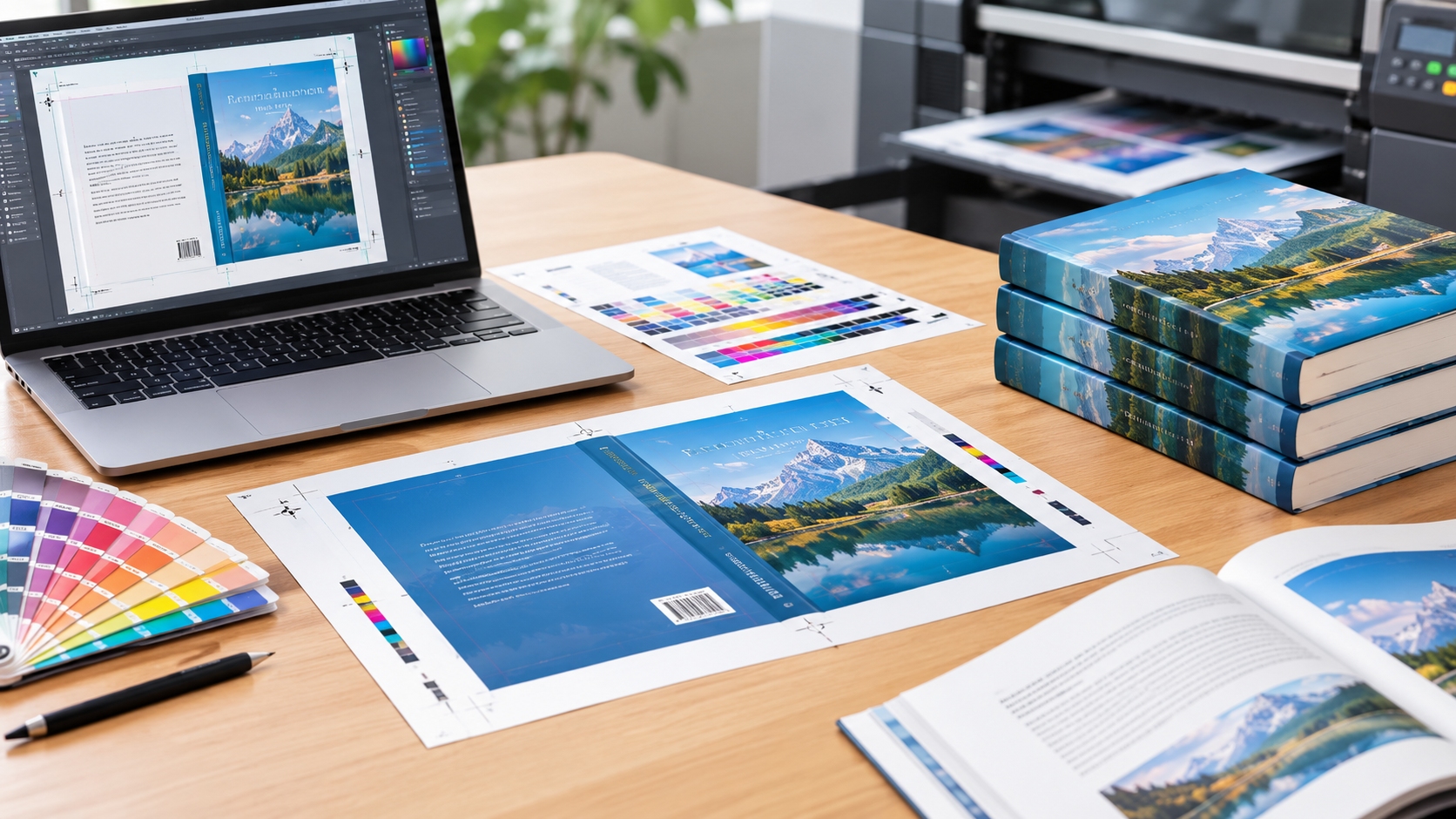

Hardcover book spine width is estimated by finding the thickness of the book block (inner pages) by dividing the number of pages by two and multiplying by the thickness of one paper leaf. The printer needs to then figure out the final dimensions of the case based on the actual construction of the binding.
That distinction matters. Book-block thickness, finished book thickness, and the area of your cover image for the spine are similar metrics which cannot be used interchangeably.
Use the calculation for planning purposes in the early stages. Use manufacturer’s template for production artwork based on final specifications.
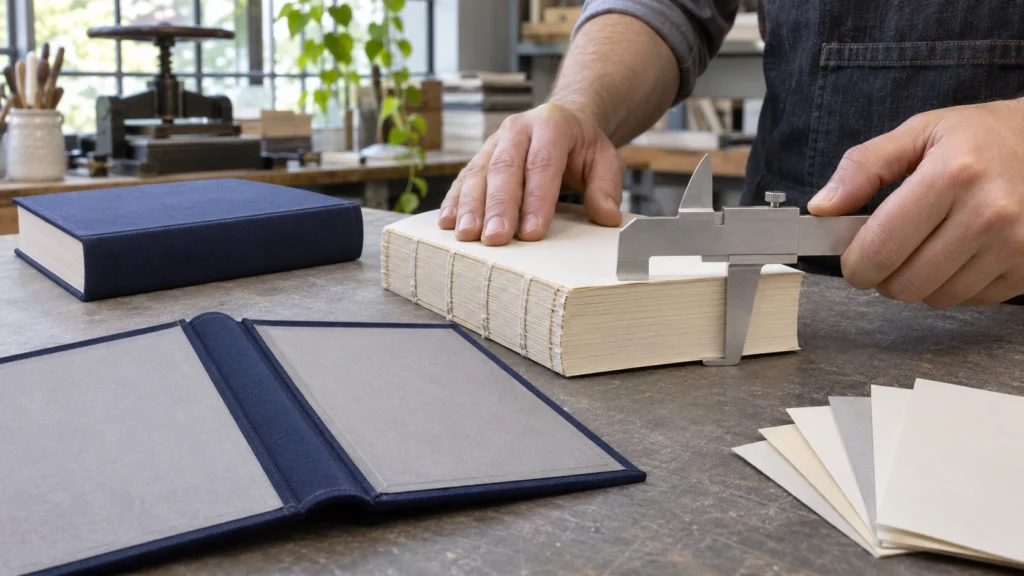
Understand Which Spine Measurement You Need
“Spine width” can mean different things during a publishing project.
A designer needs the spine area defined in the cover template. A packaging supplier may need the overall thickness of the closed book. A printer also considers the thickness and behavior of the assembled book block.
Clarify the measurement before exchanging dimensions.
| Measurement | What it describes | Main use |
|---|---|---|
| Interior paper thickness | Combined thickness of the text leaves | Preliminary calculation |
| Finished book-block thickness | Assembled interior, including relevant structural elements | Binding development |
| Case spine dimension | Spine construction specified by the manufacturer | Hardcover production |
| Artwork spine area | Region marked on the cover template | Design placement |
| Overall closed-book thickness | External thickness of the finished book | Packaging and fit |
For custom hardcover book printing, request the production template rather than calculating the artwork spine from an external measurement alone.
Step 1: Confirm the Final Page Count
The front side of a leaf is the top page. The typical interior leaf number in a book is 120.
The conversion is simply:
Leaf number = Interior page number / 2
Count intentional blanks as pages. Point to endpapers, inserts, foldouts, and various sections of the paper.
Do not staple the front and back boards of the hard cover to the interior paginations.
If the layout is still under development, call out your calculation as provisional. A pagination revision, even as small as it may be, can also have an impact on the cover sizes, especially in conjunction with a paper change.
Step 2: Obtain the Actual Paper Caliper
Caliper in terms of paper thickness. Inquire from the printer about the thickness of the stock and verify the units.
GSM is a measure of weight per unit area, and not thickness. Two stocks having the same GSM can take different calipers due to the difference in composition, coating and manufacturing.
Try not to choose a thickness from a different online table and use it as the factory’s thickness.
Also be able to tell the difference between the thickness of a leaf versus the factor of a page on a calculator. If there is a per-leaf value, multiplying this by the total number of pages will double the paper estimate.
Step 3: Calculate the Interior Paper Thickness
Use this preliminary formula:
Interior paper thickness = (page count ÷ 2) × paper caliper per leaf
Suppose a hypothetical book has 240 interior pages and paper measuring 0.10 mm per leaf:
240 ÷ 2 × 0.10 mm = 12.0 mm
That is the estimated thickness of the interior paper alone. It is not automatically the finished hardcover artwork spine width.
The following example shows why stock selection matters.
| Interior pages | Hypothetical caliper per leaf | Estimated paper thickness |
|---|---|---|
| 240 | 0.08 mm | 9.6 mm |
| 240 | 0.10 mm | 12.0 mm |
| 240 | 0.12 mm | 14.4 mm |
These calipers demonstrate the arithmetic. They are not specifications for particular paper grades.
Step 4: Calculate Mixed Stocks Separately
Some books combine text paper with heavier illustration sections or other bound-in materials.
Calculate each stock separately, then add the results.
For example:
- 224 pages on 0.10 mm paper: 112 leaves × 0.10 mm = 11.2 mm.
- 16 pages on 0.15 mm paper: 8 leaves × 0.15 mm = 1.2 mm.
- Combined interior paper estimate: 12.4 mm.
Explain the section arrangement to the printer. The same total page count can produce different thicknesses when materials change.
Identify endpapers separately and let the manufacturer account for their specific construction.
Step 5: Let the Printer Account for Binding
This collection of pages is not as free-flowing as the paper it is made of.
The construction type has a significant impact on the final appearance of the book, including folding, stitching, gluing, lining the spine, compressing the book, and others. Sewed areas can cause more thickness in the area around the spine, known as sewing swell.
The project of square-back structures and rounded structures needs to be planned in a different way too.
Use an instruction that doesn’t apply to all hardcovers as a universal rule, e.g. do not use “add 3 mm” or “add two board thicknesses” for all hardcovers. This ‘shortcut’ is not a valid way to set up the right cover geometry from one manufacturing system to another.
Request that the finished size be verified with the printer for the agreed on construction.
Step 6: Use the Hardcover Cover Template
A hardcover cover file needs more than two cover panels and a calculated spine.
The template may include hinges or joints, board positions, wraparound areas, and production allowances. A dust jacket requires its own layout.
Keep these regions separate. Adding hinge space into the spine artwork area can shift the title or create incorrect panel dimensions.
A hardcover book with a slipcase also needs coordinated external dimensions. Confirm the slipcase fit using a representative finished book rather than the paper-thickness estimate.
Check the Sample Before Approving Artwork
Where thickness or fit is important, request a structural dummy using the proposed materials.
Compare the dummy with the template and specifications. Check opening behavior, cover alignment, and accessory fit. Ask the printer to explain any sample substitutions.
A template from perfect-bound paperback printing should not be reused for a hardcover edition, even when the interior files are identical.
After changes to paper, pagination, or binding, request confirmation that the existing template remains valid.
Frequently Asked Questions
Can page count alone determine hardcover spine width?
No. Paper thickness and the complete binding construction also affect the dimensions.
Is GSM the same as paper caliper?
No. GSM measures weight per area; caliper measures thickness.
Should I multiply paper caliper by pages or leaves?
Use leaves when the caliper describes one physical leaf. Confirm the basis of any supplied calculator factor.
Should endpapers be included?
Account for them, but describe them separately so the printer can apply the correct construction method.
Can I measure an existing book as a reference?
Yes, but it only provides a reference. Different paper and binding can produce different dimensions at the same page count.
Does sewn binding change the calculation?
It can affect assembled spine thickness and shape. The printer should account for the actual sewing and finishing process.
Should hinge allowances be added to the artwork spine?
Follow the template. Hinges and spine areas are normally identified separately and should not be combined arbitrarily.
When is the spine dimension ready for final design?
After pagination, paper, and construction are confirmed and the printer supplies the corresponding production template.
Share on Social:


