

What Is the Best Board Thickness for Hardcover Books?



The recommended thickness of the board in hardcover books is determined by the finished size, the weight of the book, the cover materials, and the intended use of the book. It is a good starting point to compare 2 mm, 2.5 mm and 3 mm board, but it is important to test with a sample and the printer to verify the selection.
The thickness of the board will generally produce a more substantial cover. This also increases the case size and weighs down. To publishers, the aim is to get a cover that holds the book easily and not too much lump.
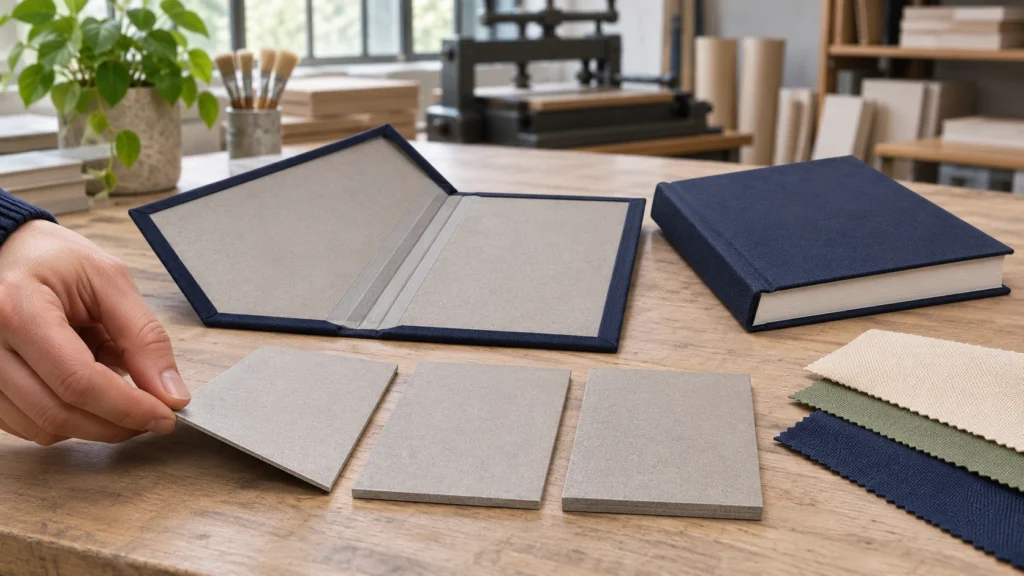
What Does Hardcover Board Thickness Mean?
The rigid material of the front and back covers is called hardcover board. It is normally wrapped in printed paper, cloth or other covering material.
The thickness is independent of the thickness of the inside paper, book-block thickness, and finished spine width.
If it says 2.5 mm board it needs to inform whether it is a bare board before covering, or a covered board. The wrapped materials and adhesives are part of the complete construction.
Also check the board grade. Thickness is not the only parameter that defines stiffness, density, surface quality and dimensional stability.
Compare Common Thickness Options
Treat the following table as a discussion guide rather than a universal sizing rule. Different board grades can perform differently at the same thickness.
| Board option | Potential reason to consider it | Main point to check |
|---|---|---|
| 2 mm | A relatively lighter, less bulky case | Whether rigidity suits the cover dimensions |
| 2.5 mm | A middle option for comparing weight and firmness | Finished handling and overall construction |
| 3 mm | A more substantial case for demanding formats | Added weight, joint design, and packaging fit |
Do not select a thickness from the table without considering the complete book. A compact novel and a wide-format art book place different demands on their covers.
Start with the Finished Cover Dimensions
Cover size is one of the first questions to settle.
A larger panel spans a wider area and may need a different board specification to achieve the desired firmness. Landscape formats deserve particular attention because of their proportions and handling.
For custom hardcover book printing, give the manufacturer the finished page dimensions, orientation, page count, and interior stock.
Ask it to recommend a board grade and explain the choice. Request alternatives where weight or cost is a concern.
Consider the Weight of the Book Block
Don’t judge a book by its cover, except in this case, judge a book by its pages.
The weight of a short illustrated book on heavy co-rated paper is greater than the weight of a longer text book on light paper. The cover, hinges and end papers must play together.
But, thick boards cannot fix poor page attachment and poor joints.
Give the printer instructions for how the user will use the book, whether by carrying it around or using it at a reading desk or as a large illustrated book. The aforementioned uses help to define the balance between support and handling.
Board Quality Matters Alongside Thickness
It is possible to feel a difference between two boards that are 2.5 mm thick.
They can be composed of different materials, have different densities and consistencies, and be of different stiffer. Surface condition also plays a role in the way that the covering material lays down on the board.
Request a recommended board specification and wrapped sample when appearance is important. Examine the finished covers to ensure they are at least flat and corners are properly formed.
Don’t use the terms “high-density board” or “premium grayboard” as a full specification. Inquire from the supplier what material he or she will use.
Match the Board to the Covering Material
Printed paper, cloth and the other coverings have an impact on the final case.
Manufacturing needs to coordinate thickness of the board with the flexibility of the materials, application of adhesive, corner treatment and turn-in. Further considerations arise in the decorative processes.
For instance, the depth and appearance should be agreed upon for embossing. It’s not just thicker, it’s not better.
Test foil, embossing or debossing on sample materials. There is no single sheet of material that can illustrate all aspects of an assembled cover.
| Construction detail | Why it needs review |
|---|---|
| Covering material | Changes surface feel and finished dimensions |
| Hinges and joints | Affect opening and movement |
| Corners and turn-ins | Influence appearance and edge finishing |
| Endpaper attachment | Connects the case and book block |
| Decoration | Requires suitable materials and process settings |
| Accessories | Must fit the completed construction |
Check Opening Comfort, Not Just Firmness
A hardcover should not be so stiff that it is hard to open.
Thickness of the board is just one component of that. Spacing of joints, spine construction, lining, and relationship between case and book block are also important.
Open the sample close to the front, middle and back. Watch how the covers move and if there are any endpapers, check them for signs of strain.
If the sample is not forced flat, it should not be forced unless it is the construction agreed upon by both parties. Do not judge until you are given and understand the intended opening behavior by the manufacturer.
Calculate the Effect on Weight and Packaging
Moving from 2 mm to 3 mm increases bare-board thickness by 50%. It does not make the complete book 50% heavier.
The actual weight change depends on board density, panel area, and the rest of the publication. Request finished-book and packed-shipment estimates rather than guessing.
For a hardcover book with a slipcase, confirm the fit after board and covering materials are finalized.
A thicker case may also change carton capacity or protective packing requirements.
Compare Costs Using Identical Specifications
Ask for two suitable board options while keeping the other requirements unchanged.
Compare manufacturing price, finished weight, packing, and transport. A small difference per book can become meaningful across a bulk order.
If a rigid cover is not essential to the publication, compare the complete format with perfect-bound paperback printing. That is a broader product decision, separate from choosing between hardcover board thicknesses.
Approve a Representative Physical Sample
The best sample will be the one that matches the size, material, book-block thickness and case construction that is proposed.
Document the board approved grade and thickness along with the production specification. Know if there are any substitutions that have been made in the sample and agree on how these substitutions impact the review.
If the board thickness does not change after the approval, please ask if the cover template, joints, packaging or slipcase require changes. Maintain subject matter link with product.
Frequently Asked Questions
Is 2.5 mm board suitable for every hardcover?
No. It is one option to evaluate against the book’s dimensions, weight, materials, and intended use.
Does thicker board always mean better quality?
No. Board quality, case construction, binding, and finishing all contribute to the result.
Can 2 mm board work for a hardcover book?
Yes, where the selected grade and complete construction provide the required performance. Confirm through sampling.
Should large books automatically use 3 mm board?
Avoid an automatic rule. Ask the manufacturer to assess the format and propose a suitable construction.
Is board thickness the same as spine width?
No. Board thickness describes the cover material; spine dimensions depend on the assembled book and case design.
Can thicker boards prevent shipping damage?
They may provide additional rigidity, but suitable cartons, corner protection, and load restraint remain necessary.
Will changing board thickness affect the artwork?
It may affect the case template and wrap allowances. Request confirmation before using existing cover files.
What should appear in the final specification?
Record board grade, thickness, cover materials, case dimensions, binding construction, and the approved sample reference.
Share on Social:


