

Why Do Hardcover Book Spines Crack?

Hardcover book spines can crack when the cover material, hinges, or binding cannot flex properly during opening. Common contributors include unsuitable materials, incorrect grain direction, restrictive hinge construction, adhesive problems, and excessive opening force.
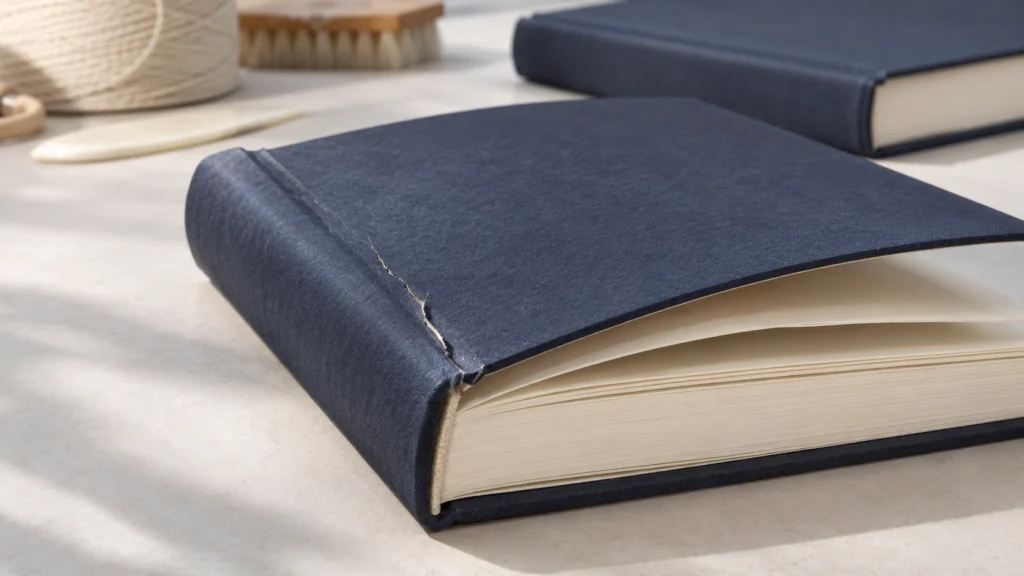
But “a cracked spine” can describe several different defects. A white line on a printed cover is different from a torn endpaper or a book block pulling away from its case.
For publishers, identifying exactly what failed is the first step toward preventing the problem in the next production run.
Is the Crack Cosmetic or Structural?
Start by examining the book gently under good lighting. Check the outside spine, both cover joints, and the inside hinges.
| Visible symptom | What may be affected | What to investigate |
|---|---|---|
| Fine white line on a printed surface | Ink, coating, or underlying paper | Material flexibility and finishing |
| Film lifting near a joint | Lamination or adhesion | Surface compatibility and processing |
| Split beside the spine | Cover wrap or joint construction | Hinge clearance and material strength |
| Torn paper inside the cover | Endpaper or inner hinge | Opening stress and attachment |
| Loose sections or detached pages | Book block binding | Adhesive, sewing, and reinforcement |
Appearance alone rarely confirms the cause. Record where the damage begins and whether it appears on first opening or after repeated use.
1. The Cover Material Cannot Handle Repeated Flexing
The spine and joints move whenever a hardcover opens. A covering material that looks excellent on a flat sample may behave differently after wrapping and binding.
Printed paper, cloth, coated materials, and decorative finishes have different working characteristics. Their suitability depends on the complete construction.
Heavy ink coverage can make a pale fracture line particularly noticeable. Choosing a lighter design may disguise the symptom, but it does not correct a material failure.
For custom hardcover book printing, request a finished sample using the proposed covering material and finish.
2. Grain Direction Creates Unnecessary Resistance
Paper fibers have a predominant direction, called grain. In the conventional construction of books, the grain direction of the paper matches that of the spine, which aids the ease of bending when opening the book.
Opening can also put pressure on the binding when the text paper resists the movement.
Endpapers and paper components are another area that should be considered, particularly with regard to grain direction. But it’s only a part of the diagnosis. The wrong grain can’t help the poor adhesive or poorly formed joints.
Inquire with the printer about the grain direction before production, especially if you are discussing alternative sheet layouts, paper substitutions, etc.
3. The Hinges Restrict Movement
The boards open at the external joints next to the spine. They should be sized to match the thickness of the board, covering material and construction of the binding.
If the area is not free of movement, the forces on opening may be focused along a single line. The hinge material or the inside hinge may then become damaged.
The hinge size is not one-size-fits-all for hardcover books. Use the case template that has been approved by the printer for the book specification.
The sample needs to open easily in the desired range without the need to flatten it.
4. Adhesive or Binding Preparation Is Unsuitable
Several bonded elements exist in one hardcover each having their own requirements. Performance can be affected by the selection and use of the adhesive, as well as surface preparation and drying/curing conditions.
If the spine is stiff, this does not necessarily mean that the glue is incorrect. Likewise, there is no sure way to increase the bond by adding more adhesive.
The printer should check the part to be printed and look at the production process. Tension and reinforcement may also be necessary for sewn books.
While sewing can aid in durability, it will not correct all cover, hinge, and endpaper problems.
5. The Case Does Not Match the Finished Book Block
Paper thickness, page count, binding method, and endpaper construction affect the finished book.
If the case is made around an outdated specification, the assembled book may fit poorly or experience unnecessary tension.
This often becomes relevant after a late stock substitution. The replacement paper may have the same grammage but different bulk.
Confirm the finished dimensions before approving case production. For a hardcover book with a slipcase, verify the slipcase fit too. Readers should be able to remove the book without pulling hard on its spine.
6. Handling and Storage Add Stress
The hardcover can be damaged in forcing if the construction of the hardcover do not support this opening angle.
Opening and closing a book repeatedly by the top of the spine can also cause damage to the covering or attachment.
Storage conditions are also important. Paper and bonded materials are susceptible to humidity changes, dampness and heat. Store in a cool, dry place, out of direct sunlight and water.
A new book should be explored, not “fixed” with excessive force being applied to bending it back.
How Publishers Can Prevent Spine Cracking
The best prevention combines suitable specifications with physical inspection.
| Production stage | Action | Purpose |
|---|---|---|
| Specification | Define use, size, paper, and binding | Match construction to handling |
| Material selection | Review actual stocks and finishes | Assess flexibility and compatibility |
| Sampling | Approve a representative bound sample | Check movement and fit |
| Production inspection | Examine copies from different cartons | Identify inconsistent defects |
| Packing | Protect corners and prevent movement | Reduce transport stress |
Compare binding options according to use. A reference book, illustrated gift edition, and novel may need different solutions. If you also publish perfect-bound paperback books, evaluate them separately; their cover attachment and opening behavior differ.
Agree on a practical inspection method with the manufacturer. Record the opening procedure, sample quantity, and unacceptable damage rather than relying on “good binding” as the entire requirement.
Frequently Asked Questions
Is a cracking sound always a defect?
No. Sound alone does not establish damage. Check for visible fractures, loose pages, torn hinges, or separation.
Why does a white line appear near the spine?
It may indicate a fracture in the printed surface or underlying material. Inspection is needed to identify the affected layer.
Does lamination prevent spine cracking?
Not necessarily. Lamination adds a surface layer, but the material combination must still tolerate the required movement.
Are cloth hardcovers immune to cracking?
No. Cloth has different characteristics from printed paper, but joints, endpapers, and attachments can still fail.
Will thicker cover boards solve the problem?
Not automatically. Thicker boards change the construction requirements and may require corresponding adjustments to the joints.
Can a cracked hardcover spine be repaired?
Some damage can be repaired, depending on its location and severity. Valuable books are best assessed by a qualified book conservator.
Should publishers reject an entire shipment?
First establish the defect’s severity and extent. Inspect representative copies and discuss corrective action against the agreed quality requirements.
What should I send the printer when reporting damage?
Provide photographs, a short opening video, carton identification, affected quantities, and a description of when the defect appeared.
Technical reference check: paper grain guidance and hardcover hinge and finishing considerations.
Share on Social:


