

How to Choose the Best Trim Size for Hardcover Books?
The trim size of a hardcover book will vary according to its contents, its readership, its page layout, its production and distribution costs. Always select a format that is appropriate for the reading experience, and, before deciding on your dimensions, consult your printer to test your paper efficiency, binding and packaging.
Images are larger in a bigger book. A smaller size might be more comfortable to hold. There is no right or wrong, none of them are necessarily better.
The publishers’ wish is to identify a size that allows the content to be utilized easily, and that the full version can be produced and marketed.
What Does Hardcover Trim Size Mean?
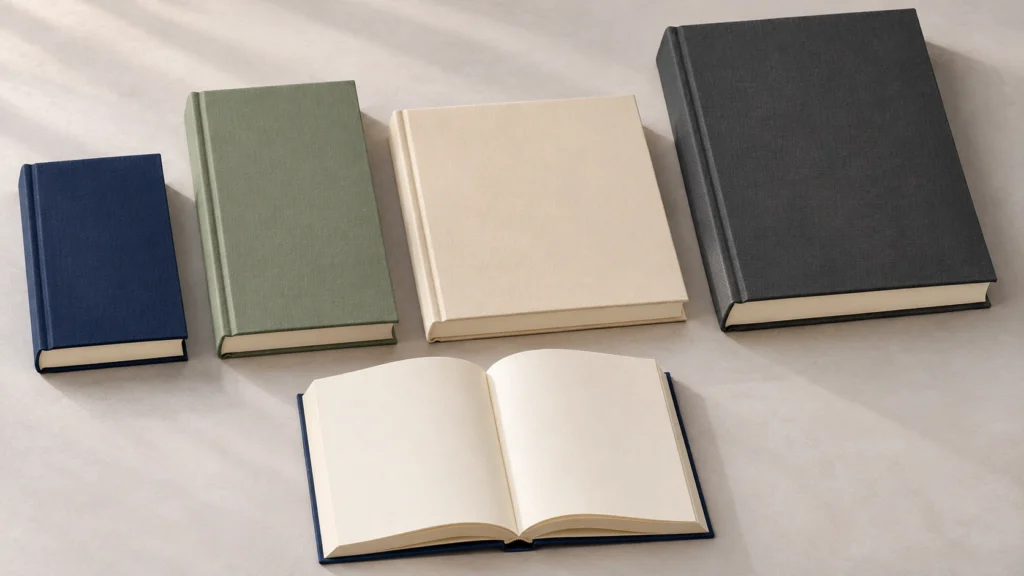
Trim size is typically the final book block width and height after cutting.
This is important for hardcover books because the cover boards will typically extend past the margins of the book. The external dimensions are the actual size of the finished product, which is larger than the page trim size.
When ordering a 6 × 9″ hardcover, be sure to specify whether it is soft trimmed or hard trimmed. Finished dimensions should be used for packaging, slipcases and warehouse records.
Always use width x height and use a unit of measurement.
Start with the Book’s Main Purpose
Before comparing sizes, think about how someone will actually read the book.
Will they hold it during a commute? Place it on a desk? Share illustrations with a child? Display photography across a wide spread?
Those situations lead to different decisions.
| Book type | Illustrative starting size | Main consideration |
|---|---|---|
| Novel or memoir | 5.5 × 8.5 or 6 × 9 inches | Comfortable handling and readable text |
| Illustrated nonfiction | 7 × 10 inches | Balance between text and images |
| Photography or art book | 9 × 12 inches | Image presentation and finished weight |
| Children’s picture book | 8 × 8 or 8.5 × 11 inches | Illustration shape and shared reading |
| Workbook or reference title | 8.5 × 11 inches | Writing space and page navigation |
These are starting points, not universal standards. Your printer’s equipment and your distribution channel may favor different formats.
Match the Page Shape to the Content
The width and height have other implications than looks. The relationship between their relationship and the content determines their naturalness.
For lengthy text, one of the portrait formats may be suitable. Illustrated stories can work well in a square format. Wide photographs, drawings or panoramic artwork can fit into landscape books.
The catch? If an image is cropped into another page shape, it may require a lot of cropping.
Try out a few sample spreads before investing. Use a chapter opening, a dense text page and your most challenging image.
For custom hardcover book printing, share these sample layouts with the printer while discussing dimensions. It is easier to adjust the format before the entire manuscript is typeset.
Check Readability Before Reducing the Size
A smaller book will look good in a mockup. However, when the entire manuscript is fitted, the compromises might become evident.
A page count becomes a goal to reach, but it can be difficult to read if the text is shrunk or the line spacing is tightened or margins reduced in order to meet that goal.
Rather, use a comfortable type size and spacing for comparison. Pay attention to length of lines, paragraph density, captions and space around the binding.
Print sample pages on the actual size. Any page can be read easily with a screen preview when zooming.
Test the initial behavior of the book as well. Even if the layout appears to be spacious, the text that’s too near the gutter can be hard to read.
Compare Trim Size and Page Count Together
Changing trim size often changes page count.
A larger page may accommodate more text, but that does not guarantee a cheaper finished book. It also uses larger pages and may affect paper layout, cover dimensions, weight, and packing.
Likewise, a smaller trim size can require more pages, producing a thicker book block.
| Format decision | Possible benefit | Potential tradeoff |
|---|---|---|
| Smaller pages | Easier handling | More pages and greater thickness |
| Larger pages | More room for content | Larger case and shipping footprint |
| Wider pages | More layout flexibility | Longer text lines without redesign |
| Custom proportions | Distinctive presentation | Fewer efficient production options |
Ask for quotations based on realistic page counts for each format. Comparing two sizes with an identical page count may not reflect the actual editions you would produce.
Ask the Printer About Paper Efficiency
It is not always the most efficient size for every printing press to be a familiar bookstore size.
Multiple pages can be printed on a single larger sheet. It is affected by trim dimensions, bleed, folding, grain direction, and equipment limitations.
Adjustments of the dimensions may help maximize material use and result in a better fit. It may change just a bit in some instances.
Get two or three local printers and find out from the printer why the prices differ. Do not select dimensions based on cost, the final layout should still be reader friendly.
Include Binding, Packaging, and Delivery
The book does not stop at the trimmed pages.
A large, heavy hardcover needs an appropriate binding and case construction. A collector’s edition also requires enough space for its protective packaging.
If you are producing a hardcover book with a slipcase, establish the finished book dimensions before approving the slipcase fit.
Check individual packaging, carton quantities, packed weight, and storage requirements. A format that works beautifully on a display table may be awkward for routine fulfillment.
For editions also available as perfect-bound paperback books, confirm whether sharing a trim size supports your layout and production plans.
Approve a Physical Dummy
If you need to use this paper and plan to construct such a thing, request a dummy prior to final approval.
Keep it, open it and set it next to similar books. Test the fit, balance, thickness and handling of the shelves.
A blank dummy can’t tell you if your print is good, but it can let you know that your “compact” book feels bulky or that your “large” book is an impressive size, but isn’t comfortable to hold.
Frequently Asked Questions
What is the best trim size for a hardcover novel?
There is no single best size. Begin with formats such as 5.5 × 8.5 or 6 × 9 inches, then test readability and thickness.
Is hardcover trim size the same as cover size?
Usually not. Trim size generally refers to the pages; the hardcover case commonly extends beyond them.
Are standard sizes always cheaper?
No. Production efficiency depends on the printer’s sheets, equipment, materials, and the complete specification.
Can I order a custom hardcover size?
Often, yes. Ask about manufacturing limits, minimum quantities, binding suitability, and packaging implications.
Does a larger trim size reduce page count?
It can, but the result depends on typography, margins, illustrations, and layout choices.
Which size works best for illustrated books?
Choose proportions that suit the artwork and intended reading experience. Test image cropping before finalizing.
Should I use inches or millimeters?
Either is acceptable if clearly stated. Keep one agreed measurement system throughout the specification and approval files.
When should publishers finalize trim size?
Finalize it before completing typesetting and cover artwork. Confirm it again with the printer before approving production templates.
Share on Social:


