

Why Do Board Book Pages Peel Apart?


Board book pages can “chip off,” as the bond between the layers can be broken, the paperboard can separate or a protective surface film can become loose. These can be improper adhesive, application, bonding pressure, dryness, moisture, and damage near cuts.
The first step is to determine just what has parted. A sheet lifted from the board that is transparent and loose is different from an illustrated sheet.
That’s something that publishers care about. Unless all peeling issues are treated as “weak glue”, the wrong corrective action will be taken.
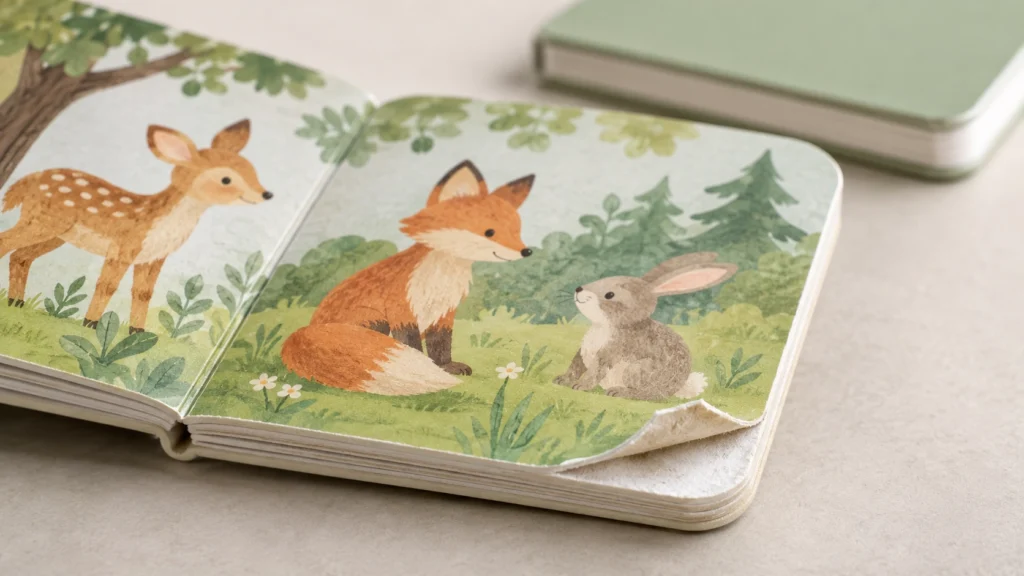
Identify Which Layer Is Peeling
A board book leaf contains bonded layers. Depending on the construction, these may include mounted printed cardstock, a separate board core, adhesive, and protective film.
Examine an affected copy under good lighting without pulling the layers further apart.
| Visible problem | Possible failure location | What to investigate |
|---|---|---|
| Transparent film lifts | Surface lamination | Film adhesion and processing |
| Printed sheet lifts from the leaf | Mounting bond | Adhesive coverage and compatibility |
| Fuzzy paper fibers separate | Within the paperboard | Material strength and moisture |
| Separation begins at a corner | Cut edge or local bond | Trimming quality and edge adhesion |
| Several leaves show bubbles | Bonded surface | Contact, drying, and material condition |
Photographs help document the symptom, but they rarely establish the cause alone. The printer may need physical samples and production records.
1. The Adhesive Does Not Suit the Materials
In board book production, different materials of varying surface and absorbency are used. The adhesive has to be compatible with the real layers to be joined.
Bonding results can vary with the change of paper coating or board stock even though the new material may appear to be similar to the original.
That is why it is important to review material substitutions. There is no guarantee that the surface behavior will match if the grammage is matched.
For children’s board book printing, ask the manufacturer to confirm the proposed layer construction and how substitutions are approved.
An adhesive recommendation should come from the manufacturer’s validated process.
2. Adhesive Coverage Is Uneven
A bond needs appropriate adhesive coverage across the intended area.
Missed sections or inconsistent application can leave weak spots that become visible after trimming or handling. Edges may reveal the problem first because they are exposed.
However, adding more adhesive is not automatically the solution. Excess application can introduce moisture or processing difficulties.
The manufacturer should review coverage, coating weight, equipment condition, and line settings against the adhesive’s requirements.
Publishers should document where separation begins rather than prescribing an unverified machine adjustment.
3. Bonding Conditions Are Not Controlled
Bringing layers together is only part of the process. They also need suitable contact, pressure, and time for the selected materials and adhesive.
Insufficient contact can leave unbonded areas. Incorrect drying conditions may prevent the assembly from reaching the required performance before later operations.
Avoid setting a universal waiting period such as “all board books need 24 hours.” Different adhesive systems and constructions have different requirements.
Ask how the printer confirms that mounted sheets are ready for cutting, assembly, and packing.
4. Moisture Affects the Leaf
Paper-based materials respond to moisture.
Damp storage, liquid exposure, or unsuitable production conditions can contribute to swelling, distortion, and separation. A book that appears sound when packed may behave differently after exposure to adverse conditions.
Protective film does not make the complete book waterproof. Cut edges, joints, and other exposed areas remain relevant.
Review storage and shipping conditions alongside production records. If damage appears after delivery, compare affected copies with retained factory samples before deciding where the failure began.
5. Cutting Exposes or Damages Weak Edges
Rounded corners and shaped outlines create exposed edges through the bonded construction.
Rough cutting, crushed areas, or already weak bonds may leave layers vulnerable to lifting. Repeated handling can make a small defect more obvious.
Check whether peeling consistently occurs at the same corner or shape. That pattern may help the manufacturer focus its investigation.
For touch-and-feel board books, inspect the edges around inserts and openings too. Additional components introduce more interfaces to evaluate.
6. Surface Film Separates Independently
Sometimes the board layers remain firmly bonded while the surface film peels.
This requires a separate investigation into the film, printed surface, adhesive system, and lamination process. Reworking the mounting bond will not necessarily address it.
Record whether the lifting layer is clear, printed, or fibrous. That simple observation can save considerable back-and-forth with the supplier.
Do not attempt household repairs on inspection samples. Altering them can hide evidence needed to diagnose the original defect.
How Publishers Can Prevent Peeling
Prevention starts with a defined construction and representative samples.
| Project stage | Publisher’s action | Purpose |
|---|---|---|
| Quotation | Specify materials, finish, and construction | Establish a comparable product |
| Sampling | Request production-representative materials | Evaluate the proposed combination |
| Approval | Record edges, bonding, and handling expectations | Create an inspection reference |
| Production | Agree on representative sampling | Check consistency across the run |
| Delivery | Inspect cartons and selected copies | Document arrival condition |
A PDF proof checks artwork. A printed press sheet checks another part of production. Neither demonstrates the bonding of the finished book.
Approve a bound sample and identify any processes it does not represent. For companion children’s hardcover picture books, establish separate inspection criteria because their interior construction differs.
What to Do When Peeling Appears
Set aside affected copies and retain examples in their original condition. Record carton identification, quantities inspected, photographs, storage conditions, and when the problem became visible.
Agree with the printer on further sampling and corrective action. Loose layers on products intended for young children require prompt assessment before distribution.
Frequently Asked Questions
Is peeling always caused by poor glue?
No. Material failure, moisture, surface-film adhesion, cutting, and processing conditions can also contribute.
Can thicker pages prevent separation?
Not automatically. Thickness does not establish bond strength or material compatibility.
Are laminated board books waterproof?
No. Surface protection does not seal every edge, joint, or opening against liquid.
Why does peeling start at rounded corners?
Corners expose the leaf’s layers and experience handling. Inspect both the cut quality and the underlying bond.
Can a sample pass while production copies fail?
Yes. Samples may use different processes, and production variation can occur. Confirm what the sample represents.
Should publishers perform peel tests?
Agree on a suitable method with the manufacturer or testing provider. Uncontrolled pulling does not establish normal-use performance.
Can damaged copies be repaired for sale?
Do not assume so. Any proposed rework needs evaluation for consistency, durability, and suitability for the intended reader.
What should a defect report include?
Include clear images, physical samples, inspected and affected quantities, carton details, and the circumstances in which separation appeared.
Separate technical reference check: board book construction and adhesive-manufacturer guidance on paper lamination, edge lift, and drying balance. PrintNinja.com
Share on Social:


