

Bulk Tarot Card Printing Paper Guide: Black Core, Blue Core or Art Paper?
Related Posts
Bulk Custom Book Printing in China for Publishers and Brands
September 30, 2026
Children’s Book Printing for Publishers: 2026 Interactive Book Trends
September 30, 2026
Bulk Journal Printing Quality Control: Binding Strength, Page Order and Trim Accuracy
September 29, 2026
Softcover Book Printing in China: Short Runs, Bulk Orders and Reprint Planning
September 29, 2026
The choice of paper stock to be printed on has technical implications related to cost effective Bulk Tarot Card Printing. Color reproduction is just one of the many factors influenced by the choice of paper stock. Others include the final height of a deck of playing cards, the edge of a card, packaging dimensions and cost.
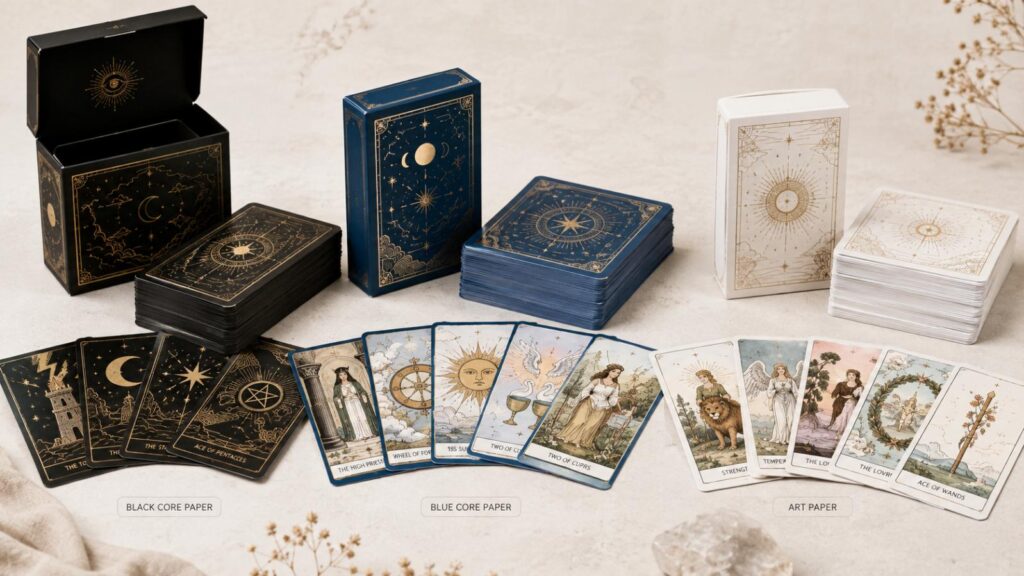
When considering a premium natural stock, Black Core Stocks provide high opacity and frequent handling, therefore are appropriate for premium decks. Blue Core Stocks provide a practical balance of performance to cost. Art Paper does not allow for a finishing flexibility that Art Paper offers, making it a suitable choice for decorative and promotional projects.
The right choice depends on the deck’s intended use, target price, card count, finish, and retail positioning.
Why Paper Choice Matters in Bulk Tarot Card Printing
Two tarot decks with the same artwork can be distinguished by the stocks they are printed on, even if the artwork is identical. For professional bulk tarot card printing, the paper should be evaluated as a complete structure rather than grammage alone.
The significant elements are:
•Core construction: It can influence opacity and stiffness.
•Paper density: It can affect the thickness, weight, and most importantly, the overall handling of the paper.
•Surface coating: It can affect the ink reproduction and also the overall adhesion of the finish.
•Flexibility and spring-back: It describes how the card maintains its original structure and springs back to its original shape and structure.
•Edge integrity: It describes the paper resisting splitting and wearing.
•Batch stability: Consecutive large or identical orders can be maintained without a performance drop using batch stability.
A 310 gsm dense card stock has more weight and density and would be stiffer than a 350 gsm art paper. Clients generally need to verify the both caliper measurements and the grammage.
Black Core Paper: Premium Opacity and Handling
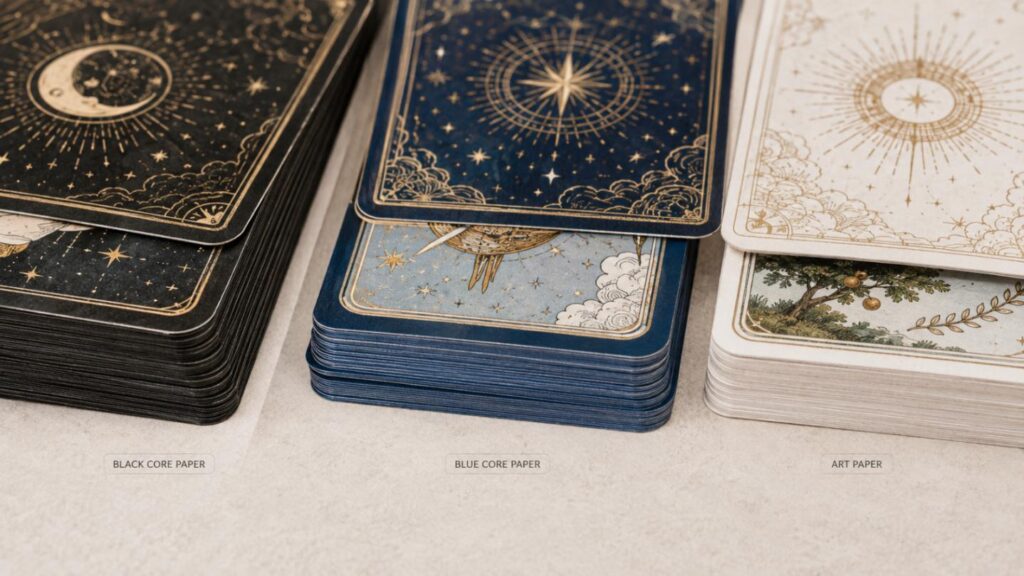
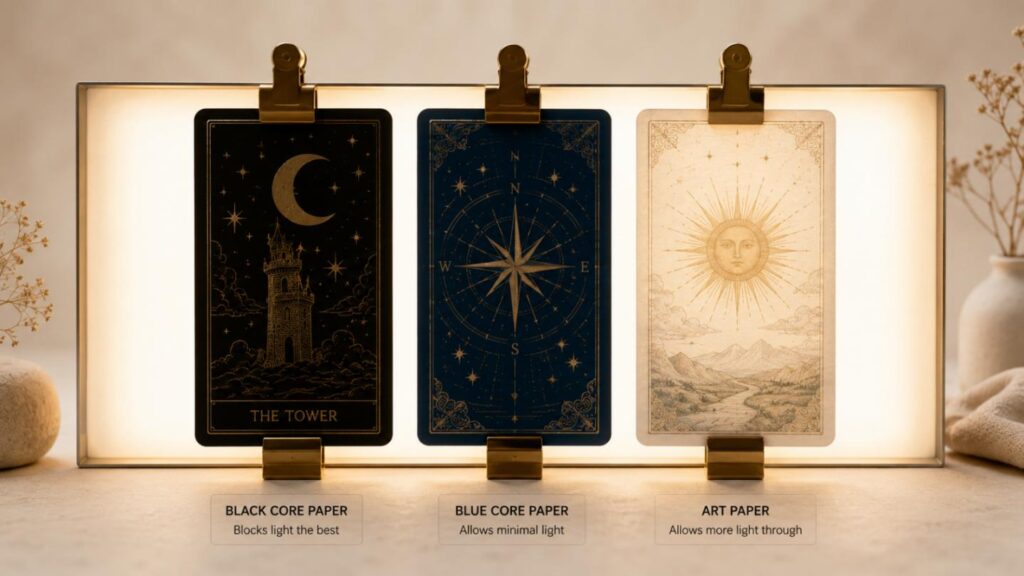
Black core paper has a dark internal layer placed in the center between the two outer layers that are printable. This center layer reduces light transmission preventing the artwork from showing through on the opposite side.
Key Advantages
Black core stock is commonly used in premium Bulk Tarot Card Printing because it provides:
•Excellent opacity
•Stable stiffness and spring-back
•Reliable performance during repeated shuffling
•Better resistance to bending
•A professional card-game feel
•Improved privacy for card backs
It is well suited to:
•Professional reading decks
•Collector and limited-edition tarot cards
•Kickstarter and crowdfunding products
•Premium oracle card sets
•Decks packed in rigid or magnetic boxes
Technical Limitations
Black core paper normally has a higher material cost. Accurate die-cutting is also important because the dark core may remain slightly visible along the edges.
A black core stock used in a 78-card tarot deck can add unnecessary thickness and negatively impact shuffle comfort due to a deeper box or larger insert being required.
Blue Core Paper: Balanced Performance and Cost
Blue core paper has a layered structure like some art papers but uses a blue-gray color for its internal layer.
It offers a more opaque appearance than many other standard art papers while it is still less expensive than higher-quality black core art stock.
Key Advantages
Blue core paper is usually used in bulk commercial tarot card printing due to its cost vs. benefits ratio which includes:
•Good to very good opaque appearance
•Moderate-to-high stiffness
•Consistent normal use in standard applications
•Practical material cost
•Compatibility with varnish, lamination, and linen finishes
Typical applications include:
•Standard retail tarot decks
•Oracle and affirmation cards
•Bookstore and gift-shop products
•Branded spiritual card collections
•Medium- and large-volume production
Points to Verify
The term “blue core” does not represent one single defined standard specification. Paper density, stiffness, white point, surface quality, opacity may differ across mills and suppliers.
A physical sample should therefore be tested for:
•Light transmission
•Edge wear
•Bending recovery
•Shuffle smoothness
•Surface scratch resistance
Art Paper: Strong Color and Finish Flexibility
Art paper is a component of smooth coated printing stocks. It is ideally suited for printing finely detailed images. Compared to card stock paper, it may not have an opaque core.
Art paper remains in demand for bulk tarot card printing in part due to its availability, strong color rendering, and the application of decorative processes.
Main Benefits
•Sharp reproduction of detailed illustrations
•Rich CMYK color output
•Multiple options for weight and thickness
•Good compatibility with spot UV and foil
•Flexible price
•Easy to adapt for custom sized cards
Art paper is suitable for:
•Meditation and prompt cards
•Custom printing of tarot cards
•Multiple edition printing
•Art-focused card collections
•Premium deck printing with embellished finishes for gifting
Practical Limitations
Art paper that is not laminated can more easily get scratched, as well as moisture damaged. Thin art paper also can allow light to pass through. Conversely, very heavy paper may become overly rigid after lamination.
Its shuffle response and spring-back are generally more dependent on thickness and surface treatment than professional black or blue core stocks.
Black Core vs. Blue Core vs. Art Paper
| Comparison Factor | Black Core Paper | Blue Core Paper | Art Paper |
| Opacity | Excellent | Good to very good | Depends on thickness |
| Stiffness | High and stable | Moderate to high | Variable |
| Shuffle Response | Professional | Suitable for regular use | Finish-dependent |
| Color Reproduction | Very good | Very good | Excellent |
| Edge Durability | High | Moderate to high | Requires protection |
| Cost Level | Higher | Medium | Low to medium |
| Best Positioning | Premium or collector | Commercial retail | Artistic or budget-focused |
| Special-Finish Compatibility | Broad | Broad | Very broad |
For Bulk Tarot Card Printing, material names should not be used as the only purchasing standard. Buyers should also confirm grammage, caliper, opacity, stiffness, coating, and finished-deck samples.
Recommended Paper Weight by Application
| Deck Type | Paper Reference | Recommended Use |
| Promotional deck | 250–300 gsm art paper | Events, samples, giveaways |
| Standard retail deck | 300–350 gsm art or blue core | Online and bookstore sales |
| Premium reading deck | 310–350 gsm black core | Frequent professional use |
| Collector deck | 350–400 gsm specialty stock | Limited editions and gift sets |
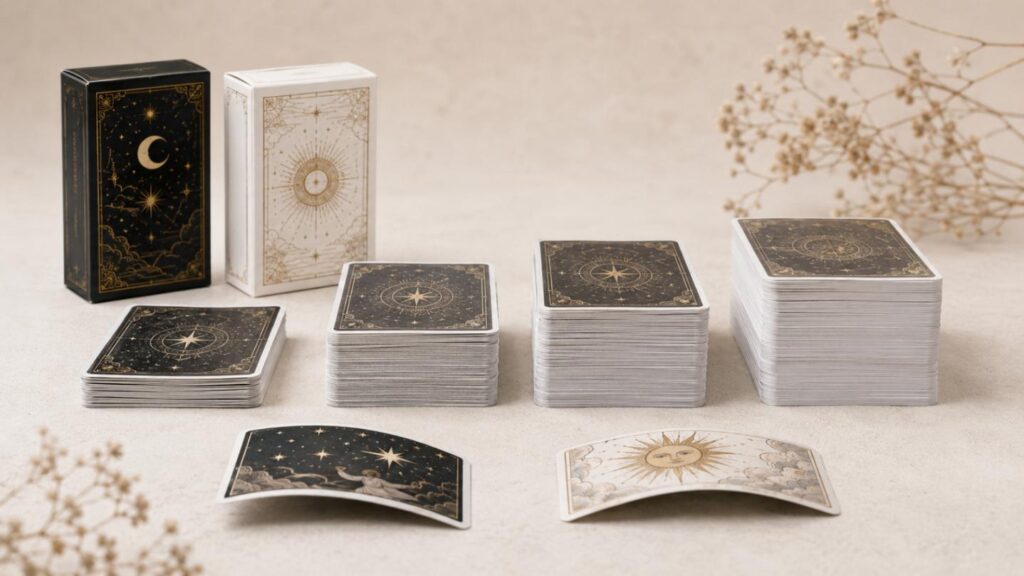
Higher grammage does not always produce a better deck. A standard 78-card set can become difficult to hold when thick paper, double-sided lamination, and decorative edge treatments are combined.
Paper selection should account for:
•Finished card size
•Total card quantity
•Lamination thickness
•User hand size
•Box depth
•Insert or guidebook dimensions
How Surface Finishes Affect Performance
Surface treatment changes friction, durability, color, and shuffle control.
| Finish | Visual Result | Handling Effect |
| Matte Lamination | Low glare | Controlled and smooth |
| Gloss Lamination | Bright, saturated color | Faster and more slippery |
| Soft-Touch Lamination | Velvety premium surface | Comfortable but mark-sensitive |
| Linen Finish | Fine embossed texture | Improved grip |
| Varnish | Natural printed appearance | Lightweight protection |
| Holographic Film | Reflective decorative effect | May reduce artwork clarity |
Foil stamping, spot UV, gilded edges, glow-in-the-dark ink, and holographic effects should be tested on the intended stock before mass production. Excessive finishing can increase stiffness or create uneven card surfaces.
Bulk Tarot Card Printing Process
Black core paper is a great choice of paper for tarot cards. It holds up over the long term and frequent shuffling and also provides premium positioning. Blue core paper provides positioning for price contexts, but not as good as black core paper. Art paper provides trade and merchandise at an affordable price.
Before a Bulk Tarot Card Printing order can be finalized, a pre-production sample request is needed for the actual paper, printing method, lamination, corner radius, packaging structure and design. A pre-production sample with all printing is a more valuable pre-production sample than a single sheet.
Final Selection: Match the Paper to the Deck
Tarot card papers can vary in price and quality. Black core papers offer premium positioning and quality while still offering price context. Art papers offer trade and merchandise at an affordable price. Blue core papers position for price contexts, but not as good as black core papers.
The final specification needs to correspond to card count, deck size, handling frequency, packaging design, target audience, and retail price.
CAIMEI provides volume orders of Tarot cards in numerous, customized card stocks, sizes, surface treatments, guidebooks, and packaging. CAIMEI can examine what would work best in a practical paper configuration prior to production of a sample for your order quantity and market positioning.
FAQs
Q1. What options does CAIMEI provide for Bulk Tarot Card Printing?
CAIMEI has many options for tarot card paper stocks. These include: black core, blue core, art paper (glossy, matte), holographic, and other specialty materials. The appropriate stock can be selected according to opacity, stiffness, artwork requirements, budget, and intended use.
Q2. Which paper would you suggest for a deluxe tarot deck?
CAIMEI recommends using black core paper for premium tarot decks as it has good opacity, stiffness, spring back, and performs well even after repeated shuffles. CAIMEI can help clients see how the available paper weights and finishes compare before production.
Q3. Can CAIMEI make samples before the bulk order?
Yes. A pre-production sample can be made to confirm paper options, printing colors, card thickness, lamination, corner radius, special finishes, and packaging structure before the full Bulk Tarot Card Printing order is placed.
Q4. What sizes of cards can CAIMEI make?
CAIMEI can process standard sizes of tarot cards as well as custom card sizes. The size of the card should be decided based on the artwork layout and the number of cards printed, as well as the preference of the handler, the size of the guidebook, and the final size of the packaging.
Q5. What different printing methods do you have for custom tarot cards?
CAIMEI has full color offset and digital printing available for custom tarot cards. Offset printing is suitable for larger orders of consistent color and cost, while digital printing may be used for prototypes or small quantity production.



NAME
text text text text. text text text text. text text text text. text text text text. text text text text. text text text text. text text text text. text text text t text xt. text text text text. text text text text. text text text t text
Contact Us
In This Article
Related Posts
Bulk Custom Book Printing in China for Publishers and Brands
September 30, 2026
Children’s Book Printing for Publishers: 2026 Interactive Book Trends
September 30, 2026
Bulk Journal Printing Quality Control: Binding Strength, Page Order and Trim Accuracy
September 29, 2026
Softcover Book Printing in China: Short Runs, Bulk Orders and Reprint Planning
September 29, 2026


