

OEM Wall Calendar Printing Finishes: Foil Stamping, Spot UV, Embossing or Lamination?
Related Posts
Bulk Custom Book Printing in China for Publishers and Brands
September 30, 2026
Children’s Book Printing for Publishers: 2026 Interactive Book Trends
September 30, 2026
Bulk Journal Printing Quality Control: Binding Strength, Page Order and Trim Accuracy
September 29, 2026
Softcover Book Printing in China: Short Runs, Bulk Orders and Reprint Planning
September 29, 2026
A wall calendar has a large surface area and remains exposed for an entire year. As such, wall calendars provide a unique opportunity for brand exposure from a corporate perspective to brand promotion for retail, publishing, and customer gift-giving purposes. Packaging paper and artwork create a basic framework. However, finishing processes determine the feel, reflectivity, resistance to handling, and presentation of key brand elements.

OEM Wall Calendar Printing incorporates finishing processes, which allow for creative and unique wall calendar branding opportunities.
What Are Finishes in OEM Wall Calendar Printing?
A printing finish is a secondary process applied after the main CMYK or spot-color printing stage. Depending on the project, the finish may provide:
•Surface protection
•Metallic or glossy visual contrast
•Raised or recessed texture
•Improved scratch resistance
•Stronger logo recognition
•A more premium cover presentation
Finishes are commonly applied to calendar covers, company logos, year numbers, product images, slogans, divider pages, and promotional messages.
However, a finishing process should be evaluated as part of the complete OEM Wall Calendar Printing structure. The manufacturer must consider:
•Coated or uncoated paper
•Cover and inner-page paper weight
•Ink density and drying performance
•Spiral or Wire-O binding position
•Hanging hole and hanger location
•Trim, bleed, folding, and safe areas
•Packaging and shipment conditions
Comparison of Common Wall Calendar Finishes
| Finish | Primary Effect | Best Application | Durability Contribution | Cost Level |
| Foil Stamping | Metallic or colored reflective detail | Logos, titles and year numbers | Low to medium | Medium to high |
| Spot UV | Localized high-gloss contrast | Images, logos and graphic patterns | Medium | Medium |
| Embossing/Debossing | Raised or recessed texture | Logos and premium cover designs | Low | Medium to high |
| Lamination | Full-surface film protection | Covers and frequently handled pages | High | Low to medium |
The following description explains the difference between processes:
- Decorative Foil Stamping emphasizes a reflective metallic focal point to a finished printed page.
- Decorative UV Spot UV focuses the decorative effect with a finished glossy UV topcoat to a finished printed page.
- Embossing and debossing add physical depth and dimension to a printed page.
- Lamination adds a protective coating and a finished decorative printed page.
Foil Stamping for Luxury Product Branding
Foil stamping is a specialized process that adds a decorative, reflective finish to a printed page by transferring a thin metallic film. Our customers’ preferred choices of thin metallic films are in the decorative metallic colors of gold or silver, or in the decorative metallic colors of rose gold or copper. A final choice in metallic foil stamping films is made in the custom color request range of metallic foil stamping.
With the fine art of the process of foil stamping, we offer superior product branding services for the luxury product branding industry.
Suitable Applications
Foil stamping is ideal for:
•Corporate logos
•Calendar year numbers
•Cover titles
•Anniversary editions
•Holiday gift calendars
When design theory incorporates the use of foil stamping with a small degree of selective coverage rather than overall extensive coverage, it can be successfully leveraged to
Technical Considerations
Foil stamps need a specific die and artwork layer. For consistency in OEM Wall Calendar Printing:
•Supply foil areas in vector graphics.
•Avoid excessively small text and very thin lines.
•Foil should stay away from trim lines and binding holes.
•Test adhesion for foil dropping over lamination.
•Large solid areas should be reviewed through physical sampling.
Spot UV for Controlled Gloss Contrast
Spot UV is a transparent coating applied to specific areas and then cured by ultraviolet light. Unlike a full surface gloss lamination, a spot UV coating only highlights specific elements of the design.
Where Spot UV Works Best
Typical applications include:
•Brand logos
•Product photos
•Cover headlines
•Texture patterns
•Graphic backgrounds
•Messages from selected campaigns
Spot UV is often used in conjunction with matte lamination. Unlike a full surface gloss lamination, a matte background absorbs light, while the spot UV coating reflects light, creating a clear contrast without changing the printed color.
Limitations to Consider
Spot UV should not be used for controlled writable grids on OEM Wall Calendar Printing because glossy coatings can lead to poor adhesion of ink or graphite. Spot UV should also be avoided over folding lines or flexible regions where cracking is likely to occur.

Embossing and Debossing for Tactile Branding
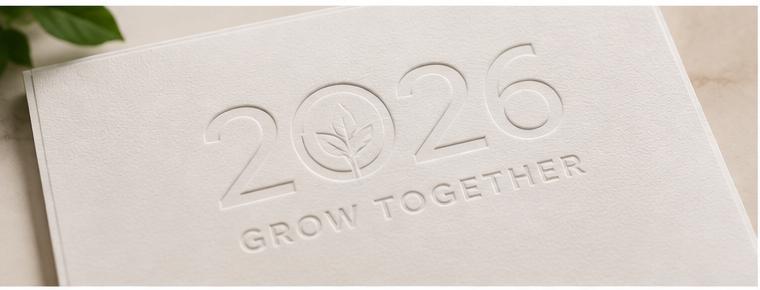
In printing, debossing presses a design below the surface, while embossing raises a design above the paper surface. Both of these processes give the tactile sensation that cannot be reproduced by standard printing techniques.
Best Uses
Embossing and debossing are suitable for:
•Minimalist corporate covers
•Premium logos
•Brand symbols
•Geometric patterns
•Anniversary calendars
•High-end customer gifts
They can be used without ink for a subtle blind-embossed effect or combined with foil stamping for greater visual impact.
Paper and Structural Requirements
Paper stiffness is critical. Lightweight calendar pages may distort or show heavy marks on the reverse side. Cover stock around 200–300gsm is generally more suitable, although the exact specification depends on paper composition, design area, and required embossing depth.
Embossed areas should remain clear of:
•Spiral punching
•Wire-O binding holes
•Hanging holes
•Trim lines
•Narrow edges
•Folded calendar sections
A production sample is recommended because digital proofs cannot accurately represent depth, pressure, or tactile quality.
Lamination for Protection and Long-Term Handling
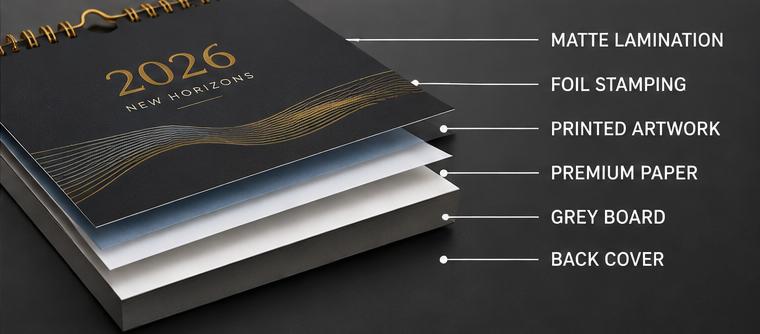
Lamination is an affordable way to easily protect provided surfaces. It is the finishing choice most convenient to the OEM Wall Calendar Printing, particularly covers exposed to packaging, shipping, dust, fingerprints, and aggregated page turning. Lamination is also a very practical finishing choice.
| Lamination Type | Appearance | Main Benefit | Recommended Use |
| Matte | Smooth and Has A Little Glare | Professional Look | Corporate Calendars |
| Gloss | Bright And Has A Lot Of Glare | Vibrant Colors | Product Related Calendars |
| Soft-Touch | Has A Velvety Surface | High Quality Feel | Executive Gift Calendars |
Main Benefits
Lamination can:
•Improve overall durability
•Increase scratch and scuff resistance
•Lessen surface fingerprints
•Protect dark ink coverage
•Increase cover stability
•Lessen transport resistance
•Provide support for later spot UV or foil decoration
Potential disadvantages include increased cost due to the need for additional materials, reduced natural paper texture, and lower recyclability when plastic-based films are used
Which Finish Should You Choose?
| Project Requirement | Recommended Finish |
| Premium corporate gift | Matte lamination with foil stamping |
| Strong photographic presentation | Gloss lamination or spot UV |
| Minimalist luxury cover | Embossing or debossing |
| Frequent handling | Matte or gloss lamination |
| High logo visibility | Foil stamping or spot UV |
| Tactile brand experience | Embossing with soft-touch lamination |
| Cost-controlled promotion | Standard CMYK with basic lamination |
There isn’t a single finishing option for every OEM Wall Calendar Printing project. The final design choice should include:
•Position of the brand
•Complexity of the design
•Size of the calendar
•Type of paper and thickness
•Quantity in order
•Target unit cost
•Required durability
•Packaging and shipping method
Can Multiple Finishes Be Combined?
Many compatible processes can be added to cover designs to create a structured cover design:
•Matte lamination + spot UV: Logos and images get a low glare background.
•Matte lamination + Foil Stamping: Add a protective finish with foil stamping.
•Embossing + Foil Stamping: Add a reflective finish with foil stamping.
•Soft-touch lamination + Debossing: Provide a soft but textured finish with debossing.
More operations do not always produce a great product. In regard to professional OEM Wall Calendar Printing, each finish should complement the design hierarchy rather than segment it.
Plan Your OEM Wall Calendar Printing Project with CAIMEI
As part of the OEM Wall Calendar Printing project, we assess your artwork and select the appropriate paper, produce samples, print and finish the calendar, bind it to your specifications, package it in the shipping box, and finally conduct the final inspection.
FAQs
Q1. What OEM Wall Calendar Printing services does CAIMEI offer?
CAIMEI offers comprehensive services for wall calendars. These include artwork review, material selection, color printing, finishing, binding, sampling, packaging, quality inspection, and bulk production.
Q2. Which finishes can CAIMEI apply to wall calendars?
CAIMEI is able to provide matte or gloss lamination, soft-touch lamination, foil stamping, spot UV, embossing, debossing, die-cutting, and other decorative processes based on the calendar design and paper specification.
Q3. Can CAIMEI combine multiple finishes on one calendar cover?
CAIMEI is able to offer a variety of finishes in combinations on calendar covers. Examples of such combinations include matte lamination with spot UV, matte lamination with foil stamping, and embossing with foil stamping.
Q4. What paper options are available for OEM Wall Calendar Printing?
Papers that can be used are gloss art paper, matte art paper, uncoated paper, textured paper, cardstock, and specialty paper. Paper weight can generally be selected according to the cover structure, monthly pages, and finishing requirements.
Q5. What binding styles can CAIMEI provide?
CAIMEI is able to offer a variety of structures such as spiral binding, Wire-O binding, ring binding, perfect binding, and other structures. Spiral and Wire-O binding are commonly selected for smooth page turning and practical wall display.



NAME
text text text text. text text text text. text text text text. text text text text. text text text text. text text text text. text text text text. text text text t text xt. text text text text. text text text text. text text text t text
Contact Us
In This Article
Related Posts
Bulk Custom Book Printing in China for Publishers and Brands
September 30, 2026
Children’s Book Printing for Publishers: 2026 Interactive Book Trends
September 30, 2026
Bulk Journal Printing Quality Control: Binding Strength, Page Order and Trim Accuracy
September 29, 2026
Softcover Book Printing in China: Short Runs, Bulk Orders and Reprint Planning
September 29, 2026


