

Custom Softcover Bible Printing: Cover Material Options for Flexible and Durable Bibles
Related Posts
Bulk Custom Book Printing in China for Publishers and Brands
September 30, 2026
Children’s Book Printing for Publishers: 2026 Interactive Book Trends
September 30, 2026
Bulk Journal Printing Quality Control: Binding Strength, Page Order and Trim Accuracy
September 29, 2026
Softcover Book Printing in China: Short Runs, Bulk Orders and Reprint Planning
September 29, 2026
In Custom Softcover Bible Printing, cover selection is a structural decision rather than a cosmetic one. A softcover Bible may combine more than a thousand thin pages with a flexible spine, frequent opening, edge decoration, and daily handling. If the cover material, book block, and binding are specified independently, premature cracking, peeling, poor opening, or foil failure can follow.
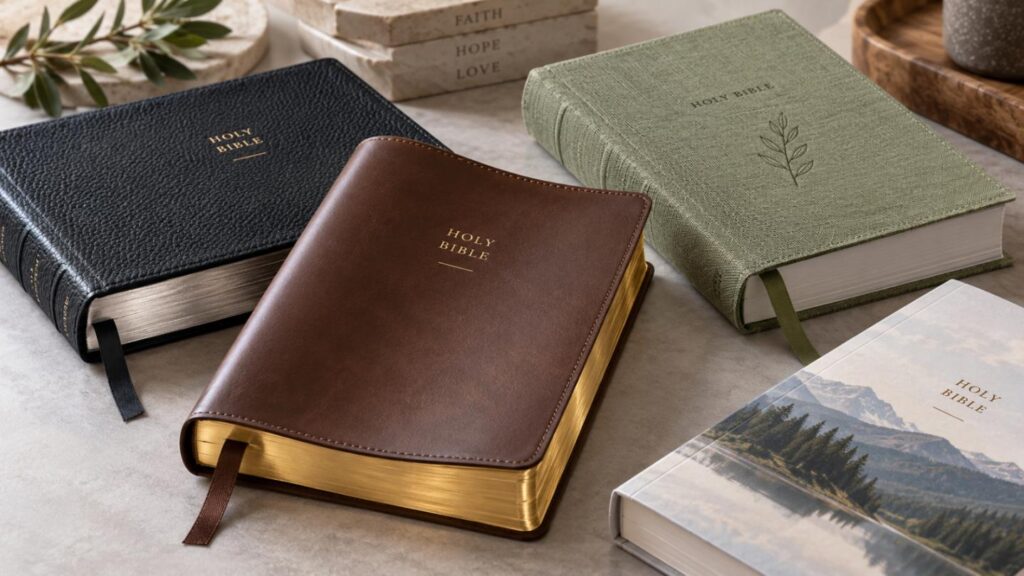
At CAIMEI, we approach Custom Softcover Bible Printing as a complete book system: paper GSM → page count → book-block thickness → binding → cover construction → finishing. CAIMEI currently supports 28 gsm to 45 gsm ultra-thin Bible paper, softcover and flexi structures, sewing and perfect binding, and Bible-specific finishing options.
Why Softcover Bible Covers Fail Around the Spine
The most highly stressed areas are usually the hinge, spine transition, corners, and fore-edge. Common failures include:
• Coating cracks after repeated opening;
• PU or PVC separates from its textile backing;
• Corners abrade during transport and daily use;
• Foil breaks across a deep-grain surface;
• The finished Bible feels stiffer than the approved cover sample.
The cause is not necessarily “poor cover material.”
A 1,500-page study Bible produces a different hinge load from a lightweight outreach Bible. Increasing cover thickness may improve body and protection, but excessive stiffness can increase bending resistance and make the Bible less comfortable to open.
This is why Custom Softcover Bible Printing should start with the finished book specification, not with a cover swatch.
Evaluate Flexibility, Abrasion and Structural Support Separately
“Soft” and “durable” are not measurable specifications. Buyers should evaluate several properties together.
| Parameter | Engineering Function | Possible Failure |
| Cover caliper | Controls stiffness and bend radius | Poor opening if too stiff |
| Backing strength | Supports hinge and edges | Tearing or deformation |
| Flex resistance | Handles repeated bending | Spine cracking |
| Abrasion resistance | Protects exposed surface | Worn corners and grain |
| Coating adhesion | Bonds surface layer to backing | Peeling/delamination |
| Surface texture | Affects touch and decoration | Irregular foil transfer |
For coated PU or PVC fabrics, ISO 7854 provides methods for assessing damage caused by repeated flexing, while ISO 5470-1 covers abrasion resistance using a Taber abrader. They measure different failure mechanisms and should not be treated as interchangeable durability claims.
PU, PVC, Cloth and Laminated Paper Solve Different Problems
There is no single best material for every Custom Softcover Bible Printing project.
| Cover System | Main Advantage | Key Engineering Concern | Suitable Direction |
| PU synthetic leather | Flexible, leather-like hand feel | Hydrolysis, coating adhesion, flex life | Study and gift editions |
| PVC synthetic leather | Cost-effective surface durability | Formulation, plasticizer and compliance | High-volume editions |
| Cloth/fabric | Strong textile backing | Staining and edge finishing | Traditional/premium editions |
| Laminated paper | Lightweight, printable, economical | Lower repeated-flex capability | Outreach editions |
Material grade is often more important than the generic material name. A thicker PU is not automatically more durable, and an economical laminated cover may be technically preferable when weight and distribution cost matter more than luxury feel.
Match the Cover to Paper GSM and Book-Block Weight
CAIMEI uses 28 gsm to 45 gsm Bible paper for high-page-count projects and highlights control of ink density, opacity, and show-through when printing on thin stock.
Thin paper keeps a Bible compact, but page count still influences the final spine and hinge load.
For Custom Softcover Bible Printing, we normally evaluate:
Compact and Travel Bibles
Priorities:
• Minimum finished weight
• Flexible opening
• Abrasion resistance
• Thin cover construction
Study Bibles
Priorities:
• Heavier book-block support
• Reinforced hinge areas
• Repeated opening
• Durable sewn construction where appropriate
Outreach Bibles
Priorities:
• Controlled unit cost
• Low weight
• Efficient mass production
• Practical laminated or synthetic covers
Gift Editions
Priorities:
• Tactile surface
• Fine foil or embossing
• Gilded edges
• Premium opening behavior
The cover specification therefore follows the use scenario and book block, not the other way around.
Binding Determines How the Cover Behaves
CAIMEI provides softcover, flexi, perfect-bound and sewn binding options, while several Bible configurations use Smyth-sewn structures for frequent opening.
For high-use Bibles, sewing can improve page retention and opening performance. Perfect binding can remain practical for cost-sensitive editions when page count, paper properties, adhesive system, and expected service life are compatible.
A flexible PU cover attached to an overly rigid spine will not deliver a truly flexible Bible.
Deep-Grain Covers Need Different Foil Parameters
Cover texture directly affects decoration.
Smooth materials generally provide a more uniform contact surface for small lettering. Deep-grain PU may create a richer leather-like appearance, but recessed texture can reduce foil definition.
Before mass production, Custom Softcover Bible Printing should validate:
• Foil type and adhesion;
• Stamping temperature;
• Applied pressure;
• Dwell time;
• Fine-line definition;
• Embossing/debossing depth;
• Cracking after repeated opening.
CAIMEI supports hot stamping, embossing, lamination and gold/silver edge treatments, allowing cover and finishing compatibility to be evaluated within the complete Bible production process.
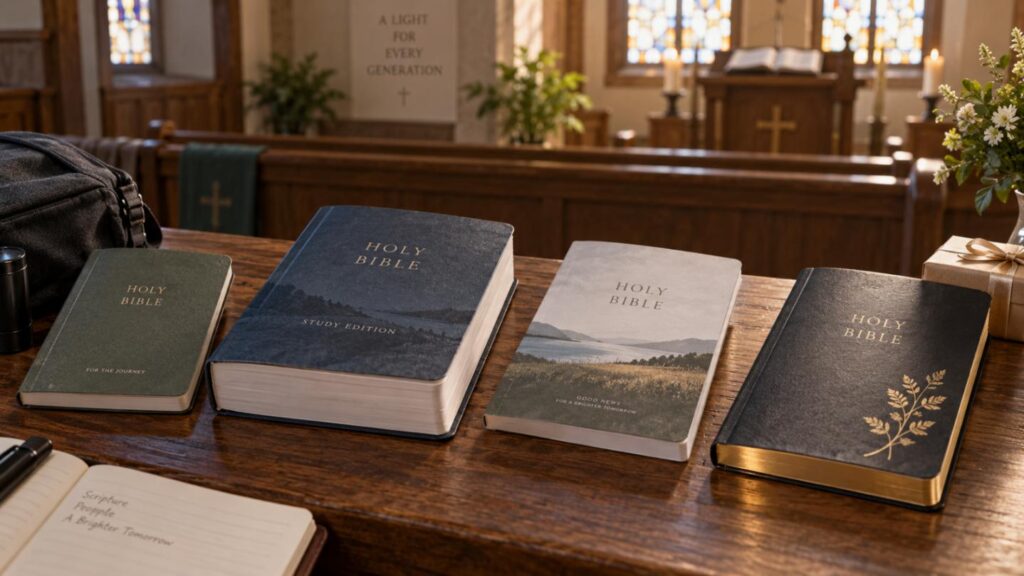
Test the Finished Bible, Not Only the Material
A cover swatch cannot reproduce the mechanical conditions of a bound Bible.
Final sample approval should check:
• Spine and hinge geometry;
• Opening resistance;
• Page retention;
• Cover-to-book-block attachment;
• Repeated flexing;
• Corner and edge abrasion;
• Foil adhesion after bending;
• Color and grain consistency.
Heat, humidity, stacked transport, and long-term handling should also be considered for editions distributed across different climates.
Build the RFQ Around the Complete Bible System
A professional Custom Softcover Bible Printing RFQ should include:
• Trim size and page count;
• Bible paper GSM;
• Printing colors and red-letter requirements;
• Binding structure;
• Cover material, backing and thickness;
• Surface grain and color;
• Foil, embossing and edge treatment;
• Target quantity;
• Required material or compliance documentation;
• Approved bound sample requirements.
CAIMEI operates a dedicated Bible production line and reports more than 1.4 million Bible units of annual production within a 30,000+ m² production facility. Its Bible capability includes 28–45 gsm thin-paper control, multilingual layouts, repeated-edition consistency, multiple binding systems, and decorative finishing.
For a new Custom Softcover Bible Printing project, the most useful starting point is to provide CAIMEI with the page count, finished size, Bible paper, binding preference, cover concept, expected use, and order quantity. From there, the cover can be evaluated as part of the complete Bible structure rather than as an isolated material choice.
FAQs
Q1. What cover materials can CAIMEI use for Custom Softcover Bible Printing?
CAIMEI can support different softcover concepts based on the Bible format and positioning, including synthetic leather-style covers, flexible covers and printed softcover constructions. The final material should be selected according to page count, book-block weight, required flexibility, finishing and target cost.
Q2. Can CAIMEI print Bibles on ultra-thin Bible paper?
Yes. CAIMEI supports thin Bible paper applications, including 28 gsm to 45 gsm options for high-page-count Bible projects. Paper selection should also consider opacity, show-through, book thickness and finished weight.
Q3. Does CAIMEI provide Smyth-sewn binding for softcover Bibles?
CAIMEI supports sewn Bible binding options, including structures suitable for editions that require repeated opening and improved page retention. The appropriate structure depends on page count, paper properties and intended use.
Q4. Can CAIMEI produce both softcover and flexi-bound Bibles?
Yes. CAIMEI supports softcover and flexible Bible constructions. Buyers should provide the desired feel, cover thickness, Bible size and usage scenario so the cover system can be matched to the book block.
Q5. Can CAIMEI add foil stamping or embossing to softcover Bibles?
Yes. Custom finishing can include hot foil stamping and embossing. Surface grain, coating type, foil type, pressure and stamping temperature should be tested together before mass production.



NAME
text text text text. text text text text. text text text text. text text text text. text text text text. text text text text. text text text text. text text text t text xt. text text text text. text text text text. text text text t text
Contact Us
In This Article
Related Posts
Bulk Custom Book Printing in China for Publishers and Brands
September 30, 2026
Children’s Book Printing for Publishers: 2026 Interactive Book Trends
September 30, 2026
Bulk Journal Printing Quality Control: Binding Strength, Page Order and Trim Accuracy
September 29, 2026
Softcover Book Printing in China: Short Runs, Bulk Orders and Reprint Planning
September 29, 2026


