

Board Book vs Hardcover Picture Book: What Should Publishers Choose?
Parents, publishers, authors and book printing companies regularly compare a board book vs a hardcover picture book when deciding on the book type to use for kids. While both types of books are colorful and robustly bound, they vary with their material, page layout, durability, target audience, printing expenses and reading experience.
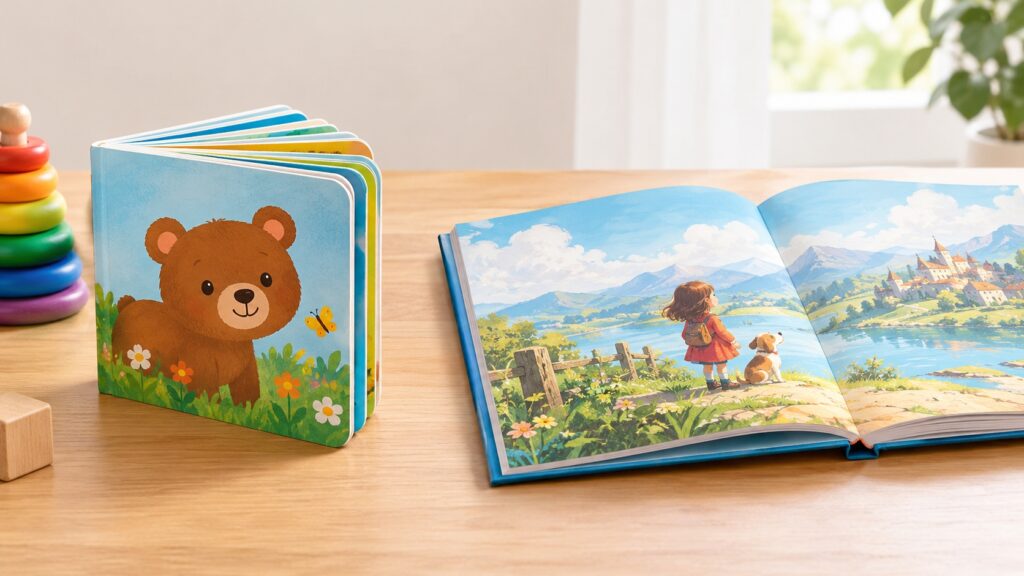
Board books are created especially for babies and youngsters with not yet developed motor skills. Hardcover picture books, on the other hand, can be designed in a more flexible manner in order to tell a story and illustrate in a more detailed way, so they can be used for a larger audience of children.
Awareness of the differences will guide the author/publisher to choose the best format for their audience, budget, and publishing objectives. This guide covers the basics of board books vs hardcover picture books, their characteristics, benefits, prices, and uses.
1. What Is a Board Book?
A board book is a children’s book that is composed of pages of thick and stiff paperboard. Board Books are made from thick paperboards which are very hard for little ones to rip by accident, unlike the thin paper pages in a traditional book.
Most board books are rounded, have small size and are bound in a sturdy manner. Their pages are designed to withstand frequent handling by babies and toddlers.
Key Features of Board Books
- Thick pages: Rigid paperboard provides greater resistance to tearing and bending than standard book paper.
- Compact design: Many board books are small and lightweight enough for babies to hold.
- Simple content: They commonly feature short sentences, basic vocabulary, familiar objects, and large illustrations.
- Rounded corners: Rounded edges can help reduce sharp-corner contact during everyday use.
- Durable construction: Board pages and reinforced binding are designed for repeated handling.
Board books are particularly popular for children aged 0–3 years, although the appropriate age depends on the book’s content and design.
Common examples include alphabet books, counting books, animal books, first-word books, and interactive books introducing colors, shapes, and everyday routines.
2. What Is a Hardcover Picture Book?
Hardcover picture book: Children’s book with a stiff cardboard cover that is commonly paperboard with printed cover material. Unlike a board book, most of the pages inside a paper-lined book are not made of hard, thick board.
A hardcover picture book can handle more words, more complex illustrations, more length and more complex page layouts. They are also covered with durable covers that shield the pages from damage on storage and multiple reading.
Key Features of Hardcover Picture Books
- Rigid protective cover: The hardcover helps protect the book and maintain its shape.
- Flexible interior pages: Standard paper pages support detailed illustrations, longer stories, and varied layouts.
- Greater storytelling capacity: Hardcover picture books can include multiple paragraphs, character development, and more complex themes.
- Premium presentation: Hard covers, endpapers, foil stamping, and specialty finishes can create a high-quality appearance.
- Multiple binding options: Depending on the design, publishers can choose suitable case-binding and related production methods.
Hardcover picture books are commonly designed for preschool and school-age children, often from around 3 years old onward. However, age suitability ultimately depends on the story, page design, and intended reader.
3. Board Book vs Hardcover Picture Book: Key Differences
The most important difference is the interior page construction. Board books use thick paperboard pages throughout the book, while hardcover picture books generally combine a rigid cover with flexible paper pages.
The following table summarizes their main differences.
| Feature | Board Book | Hardcover Picture Book |
|---|---|---|
| Interior pages | Thick, rigid paperboard | Thin or medium-weight paper |
| Cover | Usually a board-based cover | Rigid case-bound cover |
| Typical audience | Babies and toddlers | Preschoolers and older children |
| Durability | Designed for frequent handling by very young children | Durable cover, but interior pages can tear |
| Story length | Usually short and simple | Can support longer, more detailed stories |
| Illustrations | Bold, simple, easy-to-recognize visuals | Simple or highly detailed illustrations |
| Page count | Often fewer pages | Wider range of page counts |
| Reading experience | Sensory exploration and early learning | Storytelling, reading development, and imaginative play |
| Printing considerations | Thick boards require specialized assembly | More flexibility in interior paper and finishing |
| Common uses | First words, counting, colors, shapes | Fairy tales, educational stories, picture books |
Neither format is universally better. The right choice depends on the reader’s age, the content, the desired reading experience, and the publishing budget.
4. Durability: Which Book Lasts Longer?
Durability is one of the biggest considerations when comparing board books and hardcover picture books.
Board Book Durability
Board books are designed to withstand frequent page turning, grabbing, and everyday handling by babies and toddlers. Their thick pages are less likely to tear than ordinary paper pages.
However, board books are not indestructible. Excessive bending, moisture, chewing, or rough handling can damage the paperboard, printed surfaces, and binding. Their durability also depends on board thickness, adhesive quality, lamination, and manufacturing standards.
Hardcover Picture Book Durability
Hardcover picture books benefit from a protective rigid cover, which helps prevent damage to the book’s exterior. However, their interior paper pages may crease, tear, or become detached if handled roughly.
These books are often a good choice for supervised reading, bedtime stories, libraries, and family collections where children can turn pages more carefully.
Which is more durable? For babies and toddlers who are still learning to handle books, board books are generally the more practical choice. For older children who can turn paper pages carefully, hardcover picture books offer an effective balance of durability and storytelling flexibility.
5. Printing Costs: Board Book vs Hardcover Picture Book
Printing costs are important for self-publishing authors, children’s book publishers, educational brands, and businesses producing custom books.
The cost difference depends on several factors, including order quantity, book dimensions, page count, materials, color printing, binding, and finishing.
Board Book Printing Costs
Board books often require specialized production because each interior spread is constructed from thick paperboard. Printing, mounting, folding, edge finishing, and assembly can increase manufacturing complexity.
Factors affecting board book printing costs include:
- Paperboard thickness and quality.
- Book size and number of pages.
- Full-color printing and surface lamination.
- Rounded corners and special shapes.
- Binding and assembly requirements.
- Order quantity and packaging specifications.
Board books can have relatively high unit costs for small print runs because their production involves specialized materials and processes.
Hardcover Picture Book Printing Costs
Hardcover picture books typically use conventional printed interior sheets and a separately manufactured rigid cover. This structure gives publishers more flexibility in selecting interior paper weights and finishes.
Production costs depend on:
- Interior paper type and thickness.
- Cover board and wrapping materials.
- Page count and book dimensions.
- Color reproduction and image quality.
- Case binding and spine construction.
- Special finishes such as foil stamping or embossing.
For some specifications, hardcover picture books may cost less per copy than board books. However, premium paper, complex illustrations, and specialty cover finishes can significantly increase their price.
How to Reduce Children’s Book Printing Costs
To manage production costs, publishers should finalize the page count, trim size, paper specifications, and binding style before requesting quotations.
Ordering larger quantities may reduce the unit cost, although it increases the upfront investment and inventory requirements. Comparing quotations from several qualified children’s book printers can also help identify the best balance between quality and price.
Always compare quotations using the same specifications rather than relying on unit price alone.
6. Which Format Is Better for Different Age Groups?
The target reader should be the starting point when choosing between a board book and a hardcover picture book.
Babies: Approximately 0–12 Months
Board books are often a practical option because their thick pages are easier for adults to turn with babies and are generally more resistant to accidental tearing.
High-contrast images, simple shapes, familiar faces, and short labels can support early visual exploration.
Toddlers: Approximately 1–3 Years
Board books remain popular for toddlers who are learning to identify objects, recognize words, and participate in reading routines.
Books about animals, transportation, food, numbers, and daily activities are especially suitable for this stage.
Preschoolers: Approximately 3–5 Years
Both formats can work well for preschoolers.
Board books are useful for short interactive activities, while hardcover picture books are often better suited to longer stories, imaginative adventures, and richer illustrations.
School-Age Children: Approximately 5 Years and Older
Hardcover picture books can support more advanced vocabulary, complex narratives, educational subjects, and detailed artwork.
Some older children also enjoy board books, especially when the format supports a specific activity or collection.
These age ranges are general guidelines rather than strict rules. A child’s interests, reading abilities, and handling skills should also influence the decision.
7. Design and Illustration Considerations
The book format affects more than durability. It also influences illustration style, page layout, and the overall reading experience.
Designing a Board Book
Board book designs typically benefit from:
- Large illustrations and easily recognizable objects.
- Minimal text and short sentences.
- Strong visual contrast.
- Clear layouts with limited clutter.
- Consistent colors and recognizable characters.
- Thick pages that accommodate the chosen construction method.
Because board books have rigid pages, designers should consider how images cross the center fold and how the final assembled book will display each spread.
Designing a Hardcover Picture Book
Hardcover picture books provide greater possibilities for detailed illustrations and different formats of storytelling.
The full-page illustrations, double page spreads, extended text, decorative end papers and well planned page turns will be available to designers.
The appropriate interior paper should be chosen for the artwork. For instance, a coated paper can impart rich color and detail to the reproduction, while an uncoated paper will provide a more tactile reading experience.
In both cases, designers need to adhere to a printer’s instructions for bleed, safe margins, color profiles, spine size and binding margins.
8. How to Choose the Right Book Printing Format
Here are some things to think about before selecting a format.
1. To Whom is the product being sold?
When the book is for young babies and toddlers, board books are typically better options. Hardcover picture books might provide more creative flexibility, if your audience is preschool or school-age children.
2. What is the number of contents in the book?
Board books are suitable for short texts and simple learning concepts. Hardcover picture books are better for longer stories or more educational information.
3. How much money will be available?
Ask for quotes that cover the number of pages, size, material and quantity. There are certain processes that may be necessary for board books and high quality hardcover specifications may cost more.
4. What is your desired reading experience?
Be sure to select board books for tactile exploration and frequent handling by very young children. For immersive reading and storytelling, detailed illustration, and a traditional gift-book presentation, select hardcover picture books.
5. How will books be made available for sale or distribution?
Profitability is influenced by retail pricing, shipping weights, packaging, storage, and expected order volumes. A 24-page board book and a picture book (hardcover) with 240 pages will have different distribution needs.
9. Frequently Asked Questions
Are board books better than hardcover books for toddlers?
Board books are generally more suitable for younger toddlers because their rigid pages resist tearing better than ordinary paper pages. However, adult supervision is still important, especially when children put books in their mouths.
Can a hardcover picture book be converted into a board book?
Yes. A publisher can adapt the content and artwork into a board book edition. However, the design may need adjustments to accommodate thick pages, a different page count, altered dimensions, and specialized binding requirements.
Are board books more expensive to print?
They can be. Board books can be more expensive to manufacture because they must be produced with heavier materials and special techniques. The actual prices are based on the specification, order quantity and the capabilities of the manufacturer.
How many pages should a board book have?
Board books commonly have relatively few pages compared with conventional picture books. The appropriate page count depends on the printer’s available structures, the intended age group, and the desired thickness. Confirm the printer’s requirements before finalizing the manuscript.
Which format is better for self-publishing children’s books?
Board books are a good choice for material for babies and toddlers. Authors who want to tell longer stories or when the picture is very detailed may be better suited to hardcover picture books. Before making up their mind, self-publishing companies should check the production costs, minimum order quantity, retail price and shipping fees.
Yes. Depending on the printer the board may be laminated on one side, have special finishes, foil embellishment, rounded corners, and custom shapes. The appropriateness of each finish will vary based on design, production, safety and budget.
Conclusion
Board book vs hardcover picture book: The type of book depends on the age of the audience, content, durability, design and production budget.
Board books are perfect for younger kids, babies and toddlers who require stability and fun, easy-to-understand material. Hardcover picture books provide more versatility for longer tales, advanced illustrations and high-quality presentation.
Choosing the right format early on in the creation of a children’s book project can help authors, publishers, and businesses to design and manage the project, control printing costs, and make the book a better reading experience. Prior to manufacture, check with the book printer for specifications, binding, minimum order quantity and final unit cost.
Share on Social:


