

How Thick Should Board Book Pages Be?
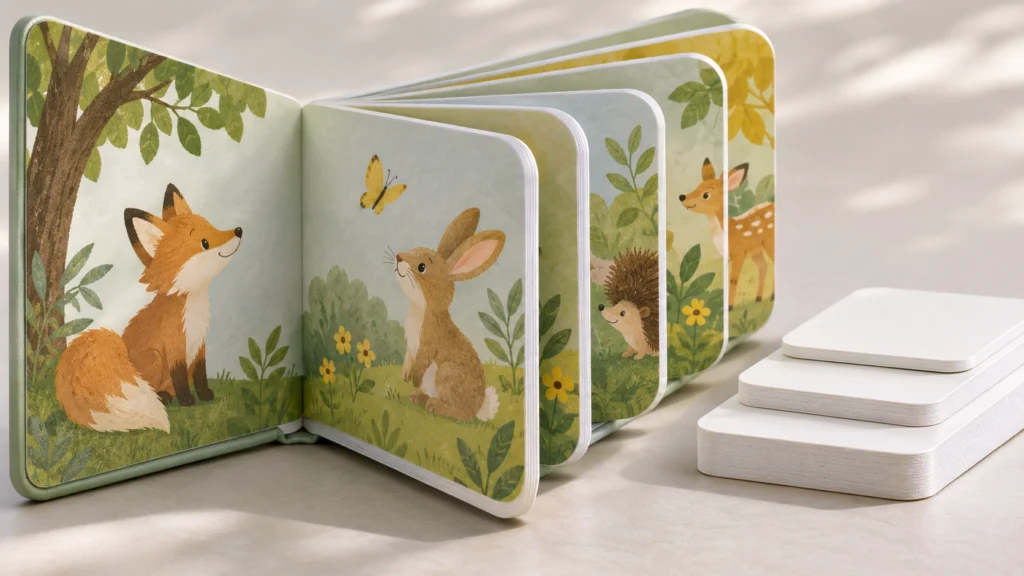
A finished board book leaf around 1 mm thick is a useful starting point for discussion, while some constructions use approximately 1.5–2 mm. There is no single thickness that suits every title. The right specification depends on the book’s size, page count, materials, binding, and intended use.
The key word is finished. A printer might describe the paper before mounting, the internal board, or the complete assembled leaf. Those measurements are not interchangeable.
For publishers, choosing board book page thickness means balancing rigidity, comfortable handling, weight, and reliable construction—not simply ordering the thickest option.
First, Understand Pages, Leaves, and Board Thickness
A page is one printed side. A leaf has two sides.
When someone describes a board book as having “1 mm pages,” they usually mean the thickness of each physical leaf. However, quotation language varies, so confirm the meaning.
| Specification | What it describes | What publishers should confirm |
|---|---|---|
| Page count | Number of printed surfaces | Whether covers are included |
| Paper grammage | Mass per square meter, expressed in gsm | Stock used in each layer |
| Core thickness | Thickness of an internal board layer | Whether printed layers are additional |
| Finished leaf thickness | Complete assembled leaf | Measurement after mounting and finishing |
| Total book thickness | Complete closed book | Whether a separate case is included |
A clear specification might read: “Target finished interior leaf thickness: approximately 1 mm, subject to approval of the production-material dummy.”
That is more useful than “extra-thick pages.”
What Thickness Options Should Publishers Compare?
Different manufacturers use different constructions. Some bond printed cardstock layers together; others incorporate an additional board core.
As a result, the same nominal thickness can produce different stiffness, weight, and edge characteristics.
| Illustrative finished leaf thickness | What to evaluate | Potential tradeoff |
|---|---|---|
| Around 1 mm | Handling, rigidity, and compactness | May feel less substantial in larger formats |
| Around 1.5 mm | Additional rigidity and page separation | Greater total thickness |
| Around 2 mm | Whether the construction serves a specific need | More bulk and potentially more weight |
These are sampling options, not universal quality grades. Confirm that the quoted measurement refers to the complete leaf rather than the core alone.
Why Thicker Pages Are Not Always Better
When part of a thick leaf, it can feel comforting to hold. You can multiply it throughout the book and that can get unwieldy.
Thicker may impact book opening, spine size and dimensions, and book packing and carrying. It is also unable to replace poor bonding and poor edge finishes.
A short title for the first words may have large leaves without difficulty, for instance. A longer story that is also constructed in the same fashion may become unnecessarily bulky.
Discuss with them what the additional thickness does. If it is just “it feels premium”, check full samples prior to purchase.
Match Thickness to Trim Size and Page Count
Page dimensions influence how a leaf behaves. A large leaf offers more leverage when handled, so a construction that feels rigid in a small format may feel different when enlarged.
Page count also changes the complete object.
As a simplified illustration, ten leaves at 1 mm contribute approximately 10 mm of material thickness. Ten leaves at 1.5 mm contribute approximately 15 mm. Neither figure is a final spine calculation; covers, joints, and assembly must also be considered.
Approve the complete book rather than selecting thickness from a loose swatch.
If the content needs many pages, compare children’s hardcover picture books as a separate format with flexible interior paper.
Why GSM Does Not Tell You Finished Thickness
The mass per area is called grammage. Thickness measures distance.
Different stocks with the same gsm can have varying differences in bulk, density, and stiffness. Assembled leaf is further impacted by mounting, adhesive, pressing and surface finishing.
So a specification like two layers of 350 gsm cardstock is not necessarily a guarantee of the final thickness.
Specify material material and finished caliper. Question how the printer measures it and what it’s within?
Don’t use any generic gsm to mm conversion to green this for production.
Check Bonding, Edges, and Page Movement
Durability depends on the complete construction.
Inspect the sample for lifting layers, exposed adhesive, uneven edges, cracking near folds, and leaves that stick together. Rounded corners should be consistently cut and smoothly finished.
Turn every leaf gently. The book should move as intended without requiring excessive force.
Thickness alone does not establish suitability for young children. Materials, surface treatments, attachments, and applicable product requirements need separate review.
When comparing a board book with custom hardcover book printing, distinguish interior leaf thickness from cover-board thickness. They serve different functions.
Approve a Representative Physical Dummy
A PDF cannot demonstrate rigidity, weight, or page-turning behavior.
Request a dummy made with the proposed materials, page count, and dimensions. If substitutes are used, record what remains unverified.
Check the sample closed and open. Examine its balance, thickness, binding, and packing fit. For a collection supplied in a hardcover book with a slipcase format, confirm the actual enclosed book dimensions before approving the case.
Retain an approved sample and document the construction. Material substitutions should trigger a review, even when the replacement has the same grammage.
Frequently Asked Questions
Is 1 mm thick enough for board book pages?
It can be suitable for some constructions. Evaluate the finished leaf in the intended book size and page count before approving it.
Are 2 mm leaves better quality?
Not automatically. Quality also depends on bonding, materials, trimming, binding, and consistency.
Does page thickness include lamination?
It should when specified as finished leaf thickness. Ask the printer to confirm exactly which layers the measurement includes.
Should covers and interior leaves have identical thickness?
Not necessarily. Self-cover and separately cased board books use different arrangements. Specify each component clearly.
Can thicker pages prevent bending?
They may increase rigidity, but material properties and construction also matter. No ordinary board book is indestructible.
How should publishers measure a sample?
Ask the printer for its measurement method. A suitable thickness gauge or caliper should measure representative areas without excessively compressing the leaf.
Will thicker leaves increase shipping costs?
They can change finished weight and packed volume. Request updated carton dimensions and gross weights for comparison.
What should appear in the final purchase specification?
Include finished leaf thickness, layer construction, materials, trim size, page count, cover style, finish, agreed tolerances, and the approved sample reference.
Separate technical reference check: manufacturers offer different mounted-card and board-core constructions, which explains the variation in quoted thicknesses.
Share on Social:


