

Wipe-Clean vs Waterproof Children’s Books
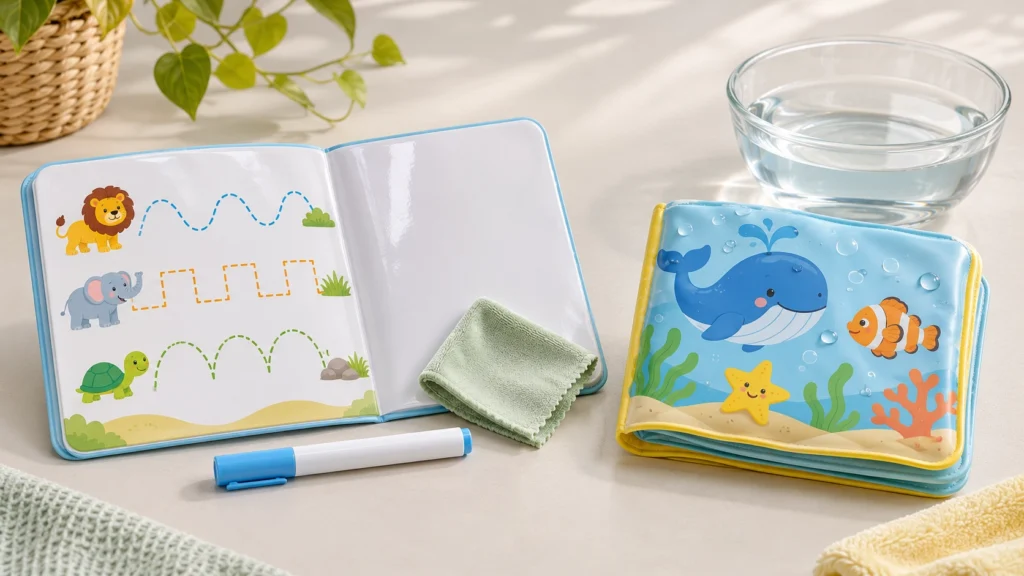
The surfaces of wipe-clean children’s books are treated for cleaning under certain conditions. Waterproof children’s books can be used to resist a certain amount of water exposure. These features may be combined, but do not necessarily occur together.
A laminated activity book can stand up to the wiping but is weak on the edges of the paper. A book that is washable, but not suitable for erasable markers.
The choice between them begins with the activity they are used for, whether it is repeated writing, occasional cleaning or reading in wet environments.
What Does Wipe-Clean Mean?
Wipe-clean refers to a cleaning ability, rather than to a specific material or structure.
In activity publishing, it usually means the pages which can be cleaned with a similar erasable marker and reused. Other products just imply that the dirt can be wiped off using a certain technique.
Before ordering quotations, be sure to understand what they mean.
You can’t just slap a nice shiny cover on a book and expect it to be a successful tracing book. It should be compatible with the chosen marker and not stain beyond acceptable limits and should not be removed by repeated cleaning without the printed information being removed.
What Does Waterproof Mean?
The term “waterproof” should identify the performance of the product under specified conditions.
Examples of construction are appropriate synthetics or pliable plastic sheets with closed edges. There are aspects of material, printing, seams, and binding that impact the finished product.
Waterproof does not equate with machine washable, dishwasher safe, disinfectant resistant, or hot water. There must be a new supporting specification/assessment for each claim.
Depending on the words alone, publishers should specify the way in which the book will be used, cleaned and dried.
The Main Differences
The distinction becomes clearer when you compare the required behavior.
| Comparison | Wipe-clean books | Waterproof books |
|---|---|---|
| Main purpose | Surface cleaning or reusable activities | Resistance to specified water exposure |
| Typical applications | Tracing, drawing, matching, and learning tasks | Wet-environment reading and washable formats |
| Key performance check | Cleaning effectiveness and surface durability | Water exposure performance of the complete book |
| Vulnerable areas | Edges, folds, binding, and damaged coating | Seams, openings, attachments, and printing |
| Marker compatibility | Essential for writing activities | Must be verified separately |
The categories are not mutually exclusive. A product can offer both capabilities when its complete construction supports them.
Choose Materials Around the Intended Use
A coated paper page, laminated board leaf, and synthetic sheet can look similar in a photograph but behave differently during cleaning.
Surface treatment may protect the printed face while leaving absorbent edges exposed. Scratches or lifting film can also change performance.
For interactive board book printing, specify whether cleaning applies only to the surface or whether the entire book must tolerate water exposure.
Do not assume thick leaves provide better water resistance. Thickness and moisture performance are different properties.
Ask the printer to identify the proposed materials, finish, binding, and limitations.
Test Markers and Cleaning Together
In the case of activity books that are reusable, the marker and page make up one working system.
Test the exact marker that is provided. Determine if the lines are visible, dry as desired, eradicating as desired, and leaving unacceptable ghosting.
Also evaluate marks left for different periods. A line that has been erased immediately could be different than one that is left overnight.
Clean using the cleaning method for instructions. If a damp cloth is required for cleaning, define “damp” in the test procedure and the use of other cleaning products allowed.
Do not use an untested marker following approval of book.
Check the Complete Book
A successful test on a loose sheet does not establish the performance of the finished edition.
Binding holes, exposed edges, glued joints, and attached components can introduce different weaknesses.
For touch-and-feel board books, cleaning may affect inserts differently from the surrounding page. Assess the combined product, including how moisture dries around attached materials.
Similarly, an electronic module introduces another set of requirements. Water-resistant pages do not establish water resistance for electronics.
If the project is intended for ordinary dry reading, children’s hardcover picture books may provide the appropriate construction without a water-related claim.
What Should Publishers Test?
Agree on the intended exposure, cleaning method, sample quantity, and acceptance criteria before approving production.
| Test area | What to evaluate |
|---|---|
| Marker performance | Visibility, erasing, staining, and ghosting |
| Repeated cleaning | Surface wear and print retention |
| Water exposure | Swelling, distortion, separation, or leakage |
| Edges and binding | Lifting layers, weakened joints, and trapped moisture |
| Drying | Remaining moisture and changes after drying |
| Complete assembly | Attachment security and continued functionality |
Keep test records and representative samples. If a proposed sample uses substitute materials, identify what remains unverified.
These practical checks complement any applicable formal product assessments; they do not replace them.
Compare Costs on Equivalent Specifications
Both labels do not set up the cheaper option.
An easy laminating activity book might not need as much work as a sealed bath book. Specialty surfaces, however, such as included markers, attachments, packaging and testing can alter the comparison.
Ask for a detailed quote of materials, printing and finishing, assembly, accessories, samples, and delivery.
Specify cleaning requirement in the specification. Otherwise, suppliers might set prices for products that are different from each other, depending on their performance requirements.
Write Clear Product Claims
Specific instructions are more beneficial than generalised promises.
Use the provided marker to “Wipe with a damp cloth” conveys a specific use. Clear conditions must be provided for the use of the term “Waterproof and washable”.
Avoid suggesting resistance to soaking, detergents, heat or repeated washing, unless the finished product has been tested for resistance.
Complete these claims with approved construction, then consider any material or component substitution prior to production.
Frequently Asked Questions
Are wipe-clean books waterproof?
Not necessarily. Their surfaces may tolerate cleaning while exposed paper edges or binding remain vulnerable to water.
Can children write on waterproof books?
Only if the surface and marker are compatible. Waterproof performance does not establish erasability.
Does lamination make a board book waterproof?
No. Lamination can protect a surface without sealing the edges, joints, or complete assembly.
Can waterproof books be washed with soap?
Follow the verified cleaning instructions. Water resistance alone does not establish compatibility with soap or other cleaners.
Why do wipe-clean pages retain marks?
Possible reasons include incompatible markers, surface wear, prolonged contact, or unsuitable cleaning. Test the approved combination.
Which format suits reusable learning activities?
A tested wipe-clean surface with a compatible marker is a useful starting point. Choose the construction around the activity.
Which format suits bath-time reading?
Use a construction specifically evaluated for the intended wet environment, with clear cleaning and drying instructions.
What should publishers approve before ordering?
Approve the complete sample, materials, accessories, cleaning method, performance criteria, instructions, and relevant assessment documentation.
Share on Social:


