

Top 10 Custom Card Printing Companies for Game Publishers

A card game can look excellent on a screen and feel disappointing at the table. Cards may stick together, bend too easily, or reveal artwork through the back. Even a small cutting variation becomes noticeable when every card shares the same border.
Game publishers comparing custom card printing companies can consider CAIMEI, MakePlayingCards, WJPC, Panda Game Manufacturing, LongPack Games, Cartamundi, Shuffled Ink, QinPrinting, PrintNinja, and The Game Crafter.
This editorial shortlist covers different production models, from bulk manufacturing to print-on-demand. It is not an audited ranking. The right choice depends on your game, quantity, components, and publishing schedule.
Compare Production Models First
A prototype supplier and a bulk manufacturer solve different problems. Decide which stage you are buying for before requesting quotations.
| Company | Published service direction | First discussion point |
|---|---|---|
| CAIMEI | Custom cards and printed packaging | Deck specifications and presentation |
| MakePlayingCards | Prototypes through production | Stock and online configuration |
| WJPC | Playing cards, game cards, and TCGs | Card handling and finishes |
| Panda Game Manufacturing | Complete tabletop game manufacturing | Cards within the full game |
| LongPack Games | Card and board game manufacturing | Components and assembly |
| Cartamundi | Playing cards and game manufacturing | Project scope and production fit |
| Shuffled Ink | Custom card games and decks | Materials and proofing |
| QinPrinting | Game cards, packaging, and instructions | Printed-component specifications |
| PrintNinja | Coordinated custom card game printing | Order management and delivery |
| The Game Crafter | Print-on-demand games and components | Prototypes and smaller orders |
1. CAIMEI
CAIMEI offers custom card printing with different sizes, materials, finishes, and packaging options.
Consider it when evaluating decks alongside printed boxes and supporting materials. Give the factory a complete card list, including duplicate quantities and back designs. Ask how counting and packing will be checked. A deck with attractive printing but one missing action card is still an unusable game.
2. MakePlayingCards
MakePlayingCards, often called MPC, provides an online customization platform covering prototypes through production.
Its published options include different card stocks, surfaces, sizes, and packaging. Publishers can use it to explore physical configurations before committing to a larger run. Confirm whether the selected prototype materials will also be available for the intended production order.
3. WJPC
WJPC specializes in custom playing cards, game cards, and trading card games.
It is relevant when shuffling, opacity, and surface feel are central to gameplay. Request samples of the proposed stock and finish together. “Linen” describes a texture, but it does not tell you everything about stiffness, coating, or how the cards handle after repeated play.
4. Panda Game Manufacturing
Panda manufactures tabletop games containing cards, boards, boxes, and other components.
Include it when the deck is part of a larger game requiring coordinated production and assembly. Provide a component list rather than requesting cards in isolation. Discuss packaging space, instructions, and assembly checks early, particularly when several language editions share some components.
5. LongPack Games
LongPack Games offers tabletop manufacturing and lists card games within its portfolio.
It gives publishers another option for projects combining cards with additional components. Ask for samples resembling your game and confirm who manages assembly. Different deck sizes, inserts, tokens, and rulebooks should be considered as one finished product.
6. Cartamundi
Cartamundi provides playing-card and game manufacturing services, including trading-card game solutions.
Publishers can explore it for specialist card production and broader game programs. Explain the commercial scope clearly: deck quantities, artwork variations, finishes, and expected reprints. Ask which production arrangement suits the project rather than assuming every facility offers identical options.
7. Shuffled Ink
Shuffled Ink offers custom card games alongside playing cards and other custom decks.
It belongs on a shortlist for publishers comparing dedicated card-printing services. Discuss the proofing process and sample materials before placing an order. Check artwork readability at actual card size, especially when players need to read icons and instructions across a table.
8. QinPrinting
QinPrinting offers game-card printing, custom boxes, and instruction booklets.
It is worth evaluating for printed game sets requiring coordinated artwork. Provide separate specifications for cards, packaging, and instructions. For a product such as a custom printed playing-card deck, confirm whether every face is unique and how the finished deck will be ordered.
9. PrintNinja
PrintNinja coordinates custom card-game printing through specialized production partners.
Its service model differs from buying directly from a single factory. Clarify the responsibilities for file review, physical proofs, inspection, and shipping. Publishers should know who approves production and who handles corrective action if delivered goods differ from agreed references.
10. The Game Crafter
The Game Crafter provides print-on-demand games and components, including custom cards.
It is useful to evaluate for prototypes, review copies, and smaller production requirements. Compare its materials and unit economics with bulk manufacturing when demand grows. A successful playtest copy establishes the game’s function, but it does not automatically approve another supplier’s production quality.
What Should Publishers Test Before Production?
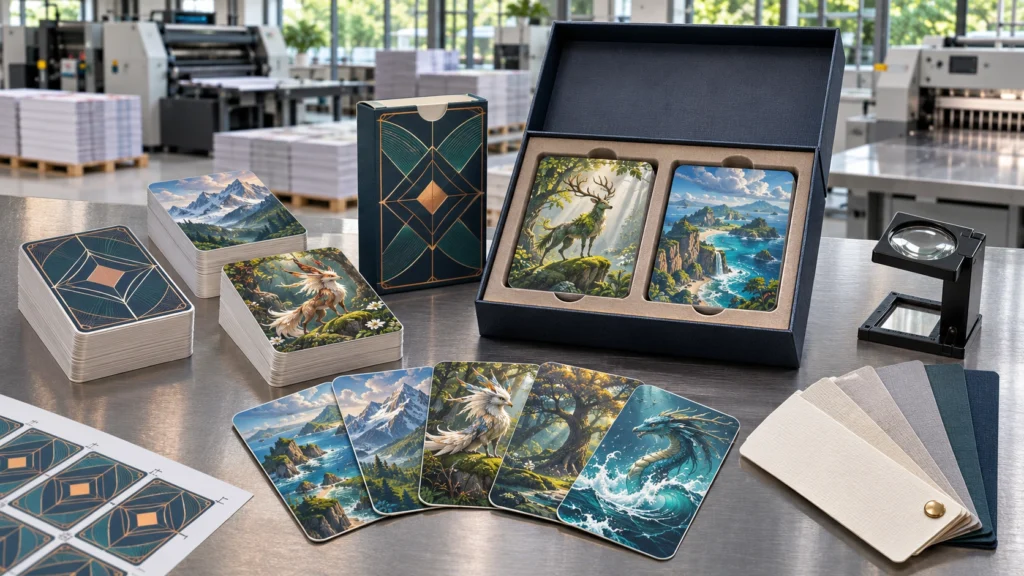
Handle the samples as players would. Shuffle them, deal them, stack them, and place them inside the proposed packaging.
| Check | What to inspect |
|---|---|
| Opacity | Whether card faces are visible through the back |
| Handling | Shuffling, sliding, grip, and stiffness |
| Cutting | Size consistency, corners, and border appearance |
| Printing | Small text, icons, dark areas, and shared backs |
| Collation | Correct card identities, quantities, and sequence |
| Packaging | Fit with instructions, inserts, and intended sleeves |
An oversized format, such as a custom deck with a guidebook, also needs a comfortable handling test. More artwork space can mean a deck that is harder to shuffle.
Frequently Asked Questions
Share on Social:


