

Custom Children’s Book Printing Manufacturer Solutions for Interactive Sound Books
Related Posts
Bulk Custom Book Printing in China for Publishers and Brands
September 30, 2026
Children’s Book Printing for Publishers: 2026 Interactive Book Trends
September 30, 2026
Bulk Journal Printing Quality Control: Binding Strength, Page Order and Trim Accuracy
September 29, 2026

Softcover Book Printing in China: Short Runs, Bulk Orders and Reprint Planning
September 29, 2026
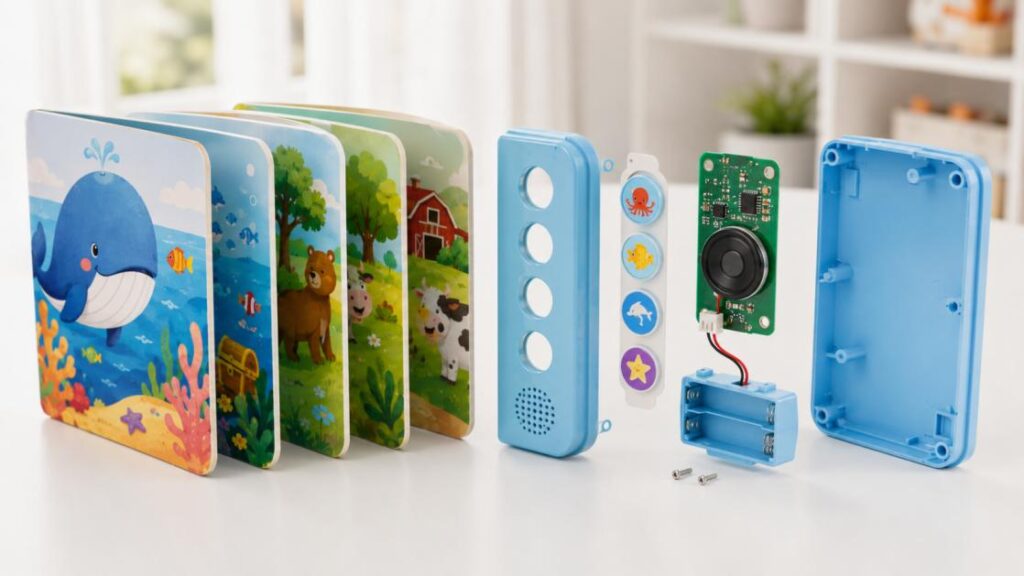
Commercial sound books require a higher level of design and elaboration than typical children’s picture books. They consist of printed board pages, electronic sound modules, activation or stimulus buttons, speakers, a sound module with batteries encased in a protective covering, and precise assembly. The specification is derived from the age range, the number of unique sounds, the duration of the sounds, the format of the book, and the market segment within which the sound book is intended for sale.
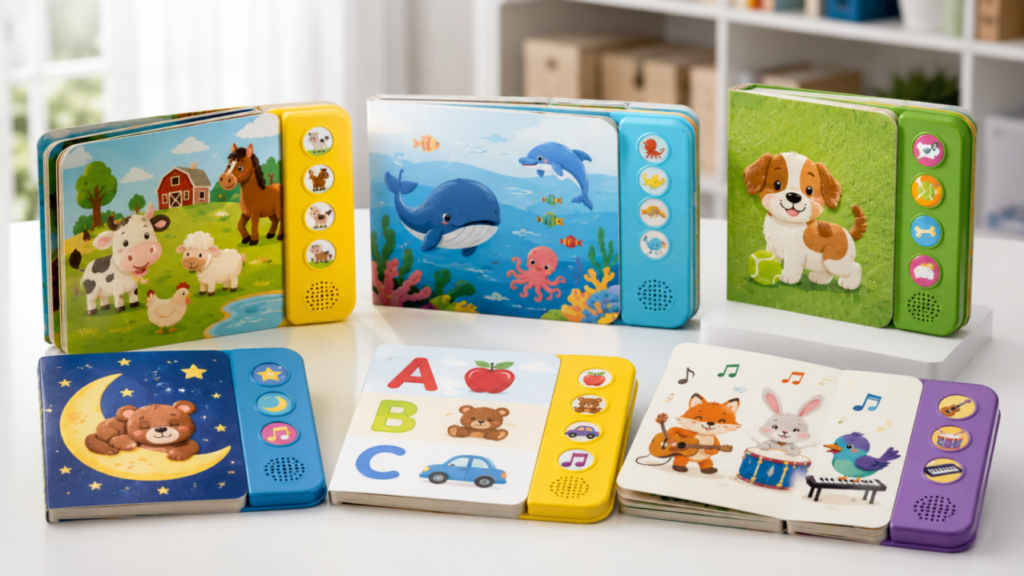
An established Custom Children’s Book Printing Manufacturing company has to manage the printed substrate, structural design, audio programming, material selection, module assembly, and functional testing. The best way to provide customers with a precise, practical, and productive sound book is to integrate these elements early in the process.
What Is an Interactive Children‘s Sound Book?
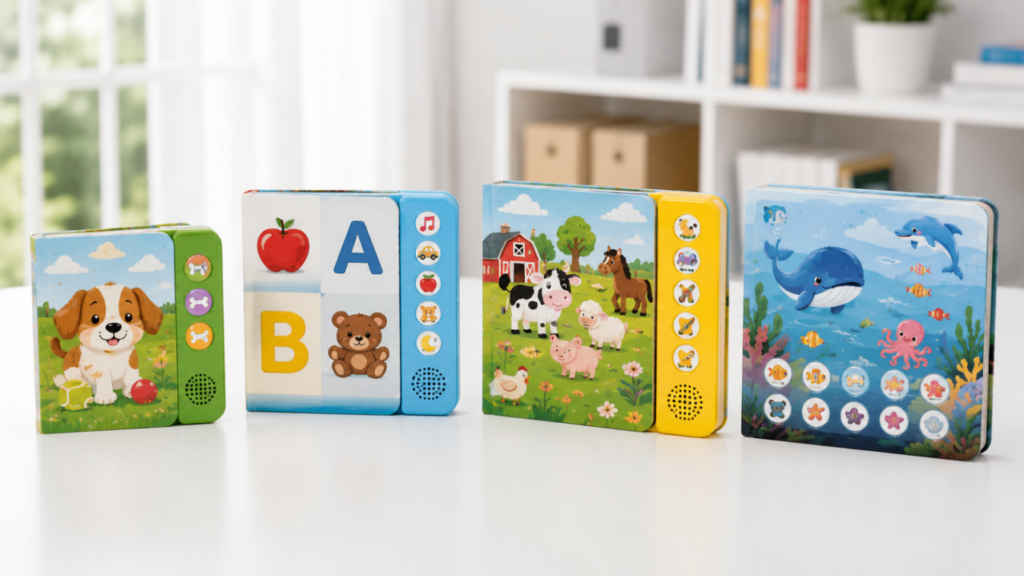
An interactive children’s sound book combines printed illustrations and text with an electronic audio module. When a child presses a button or designated area, the book plays music, animal sounds, vocabulary, narration, pronunciation, or educational instructions.
Common formats include:
•Animal sound books
•Alphabet and phonics books
•Bilingual learning books
•Nursery rhyme books
•Musical storybooks
•Religious sound books
•Touch-and-sound board books
•Multi-button educational books
A Custom Children’s Book Printing Manufacturer should evaluate both the educational content and the physical structure before selecting the sound-module configuration.
Components of an Interactive Sound Book
Final design/ construction of the book involves consideration of weight, material cost, manufacturing time, and the book’s durability.
| Component | Main Function | Key Specifications |
| Printed book block | Contains text and illustrations | Size (height/width/depth), number of pages, thickness, finish |
| Sound module | Contains music/ sounds | Number of files, duration, volume, clarity |
| Activation buttons | Play individual sounds | Number, position, pressure sensitivity |
| Speaker | Voice amplification | Output level, clarity, position of installation |
| Battery compartment | Powers the module | Battery type, runtime, replacement method |
| Protective housing | Covers electronics | Strength, thickness, internal dimensions |
| PCB and wiring | Connected buttons and sounds | Stability, insulation, accuracy of assembly |
These components cannot be specified individually. If the user interface is upgraded, the size of the PCB will also be increased along with the wiring, size of the side panel, and thickness of the book structure. A Children’s Book Printing Manufacturer must assess this situation during structural development.
Choosing the Right Sound Module Configuration
Number of Sound Buttons
The number of buttons should be appropriate for the learning objective and available space in the book.
•1–3 buttons: Suitable for short stories, simple music, or a single recorded message.
•4–6 buttons: Common for animal recognition, basic vocabulary, and bilingual learning.
•8–12 buttons: Suitable for alphabet, numbers, instruments, and categorized educational content.
•More than 12 buttons: Supports complex learning programs but requires more accurate wiring, die-cutting, and assembly.
Too many buttons of a small size can make icons difficult to identify and increase the risk of pressing the incorrect area.
Audio Length and File Preparation
Prior to module programming, audio files must be finalized. Buyers must check the following:
•Individual sound duration
•Total audio storage time
•Required file format
•Consistent volume between tracks
•Background-noise removal
•Pronunciation accuracy
•Playback sequence
•Looping or repeat functions
•Language and voice requirements
For file names, a clear naming convention is important. Each audio file should be labeled with a number that corresponds to a button, and with an icon or location that indicates where
Button Activation Methods
| Activation Method | Main Advantage | Typical Application |
| Side-panel buttons | Clear layout and centralized module | Multi-button educational books |
| Page-integrated buttons | Strong interaction with illustrations | Animal and vocabulary books |
| Touch sensors | Intuitive operation | Premium interactive books |
| Sound dot buttons | Simple and compact structure | Toddler and bilingual books |
Board Structure and Paper Selection
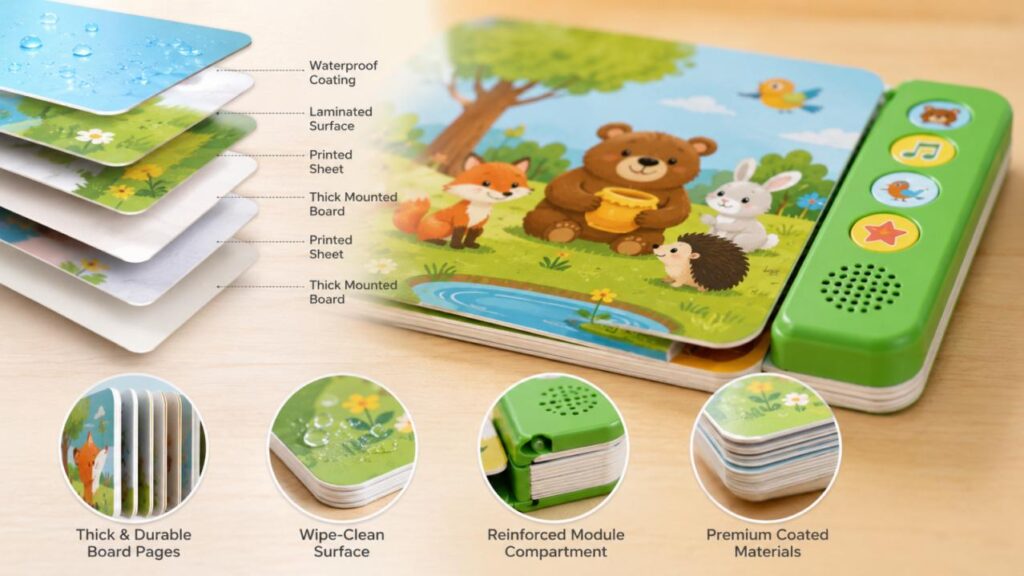
Sound books usually need a stronger structure than conventional picture books because the book block must support the electronic module.
Common material options include:
•Greyboard or whiteboard cores
•Coated printed paper
•Matte or glossy lamination
•Waterproof or wipe-resistant surfaces
•Rounded page corners
•Thick mounted board pages
•Reinforced module compartments
| Book Element | Common Choice | Design Consideration |
| Page structure | Mounted board pages | Improves resistance to tearing and bending |
| Surface | Matte or glossy lamination | Protects printing from stains and handling |
| Corners | Rounded corners | Reduces sharp exposed edges |
| Cover | Hardcover or thick board cover | Protects the module and internal wiring |
| Book size | Handheld or large-format | Affects button layout and usability |
Board that is too thin may bend around the sound module. Excessively thick pages increase weight and may make the book difficult for younger children to handle. A Custom Children’s Book Printing Manufacturer should balance page thickness with module size, page count, and target age.
Child Safety and Market Requirements
Material and construction requirements depend on the destination market and recommended age group. They should be confirmed before sampling rather than after production.
Important considerations include:
•Non-toxic printing inks
•Child-appropriate adhesives
•Rounded edges and corners
•A secure battery compartment
•Restricted access to small electronic components
•Stable buttons and speaker installation
•Tear-resistant pages
•Protected and insulated wiring
•Hearing-appropriate audio levels
•Age grading and market-specific testing
Manufacturers should not assume that one specification satisfies every destination. Buyers should identify the required children’s product, battery, electronic, and material tests for the intended sales region.
Printing and Color Requirements
Although interactive sound books are predominantly audio-based, they still contain significant visual components. Therefore, the quality of the print must be viewed equally to the quality of the sound. Illustrations must be converted carefully into printable CMYK values. Large solid color areas of specific colors, skin tones, gradients, and various print media may also require printed proofing.
The alignment of button icons with the corresponding sounds must also be maintained. Other forms of misalignment among icons, internal switches, and audio files may also cause inconsistent behaviors among books, including unresponsive buttons and incorrect sound mapping.
Before mass production, customers must approve the following prints:
•Illustrations
•Color prints
•White structural dummies
•Functional sound samples
Manufacturing of Interactive Sound Books
The overall production process for books usually includes the following steps:
- Review of content and artwork
- Confirmation of book size and layout
- Specification of sound modules
- Audio programming and editing
- Structural engineering and layout of buttons
- Production of White structural dummies
- Printing and lamination
- Board mounting and Die-cutting
- Installation of sound modules
- Binding and final assembly
- Testing of buttons, sounds and appearance
- Packaging and shipment inspection
The interactive sound books production process requires the simultaneous planning of printed materials and synchronous assembly. Mismisalignment among icons, internal switches, and audio files can create inconsistent behaviors among books, including unresponsive buttons and incorrect sound mapping.
The Most Common Challenges
| Production Challenge | Possible Cause | Practical Solution |
| Sound book cannot be triggered consistently | Variation in the placement of the contact or the die cut | Design for tolerances and assembly positioning, particularly die-cuts |
| Audio is unsatisfactory | Inadequate source file or speaker selection | Standardize audio and test speaker output |
| Sound book pages do not close flat | Module is too thick for the structure | Reserve module space during engineering |
| Book pages do not line up with the adjacent pages | Poor page layout | Design for page layout |
| Sound does not match the picture | Mismatch in file or button numbering | Assign a button number to file and check the speaker output |
| Battery drains too quickly | Excessive standby power consumption | Review module programming and battery capacity |
| Module becomes lose | Weak positioning method | Add mechanical positioning for inspection |
| Sound is monotonous | Variation in a sound source | Change in sound source |
| Sound does not match the picture | Variation in a sound source | Change in sound source |
Developing a Dependable Interactive Sound Book
Producing an interactive sound book requires a set of organized decisions regarding audio and button construction, electronic modules, safety, assembly control, printing, board construction, book format, audio files, sound quantity, target age, destination market, order volume, and testing requirements. On approval of the final sample, customers are expected to state the target age, sound quantity, book format, destination market, order volume, and testing requirements before approving the final sample.
As a long-standing Custom Children‘s Book Printing Manufacturer, CAIMEI provides support from artwork and sample module construction to printing, assembly, functional testing, and large-scale production of the interactive sound book. Share your book size, page count, audio files, button layout, target market, order quantity, and test requests with CAIMEI to create a practical interactive
FAQs
Q1. What types of interactive sound books can CAIMEI manufacture?
CAIMEI can manufacture animal sound books, bilingual learning books, phonics books, nursery rhyme books, musical storybooks, religious sound books, touch-and-sound books, multi-button educational board books, and more. Book size, page structure, audio content, button layout, and packaging can be adjusted according to preference.
Yes. CAIMEI can modify the specifications of the sound modules according to the number of audio tracks, the total playback time, the number of buttons, the dimensions of the book, and the required functions. The options may include side panel buttons, integrated page buttons, sound dots, playback of music and narration, vocabulary, and animal sounds.
Q3. What files does CAIMEI need to quote a sound book project?
The completed book size and number of pages should be provided. In addition, artwork, the target age, audio files, button mapping, language, the estimated quantity, chosen packaging, and the intended destination market should be indicated. Complete information allows CAIMEI to understand the structure, module configuration, and production cost of the sound book.
Q4. Can CAIMEI produce bilingual or multilingual sound books?
Yes. CAIMEI can offer bilingual or multilingual sound books. Buyers must provide recorded and approved audio files for each language, along with a clear list of file names and button mapping. The sound books must contain the audio pronunciation of the required vocabulary, and the order, volume, and functionality of the sound books must be determined during testing.
Q5. What paper and board materials are available?
Options may include: coated paper, mounted board (greyboard or whiteboard), laminated paper, waterproof or wipe-resistant surfaces, high-opacity paper, recycled paper, and textured cover materials. The final choice will be based on the book thickness, page quantity, target age, sound module structure, and required functionality.



NAME
text text text text. text text text text. text text text text. text text text text. text text text text. text text text text. text text text text. text text text t text xt. text text text text. text text text text. text text text t text
Contact Us
Related Posts
Bulk Custom Book Printing in China for Publishers and Brands
September 30, 2026
Children’s Book Printing for Publishers: 2026 Interactive Book Trends
September 30, 2026
Bulk Journal Printing Quality Control: Binding Strength, Page Order and Trim Accuracy
September 29, 2026
Softcover Book Printing in China: Short Runs, Bulk Orders and Reprint Planning
September 29, 2026


