

Custom Book Edge Printing Techniques: Sprayed, Printed, Gilded or Marbled Edges?
Related Posts
Bulk Custom Book Printing in China for Publishers and Brands
September 30, 2026
Children’s Book Printing for Publishers: 2026 Interactive Book Trends
September 30, 2026
Bulk Journal Printing Quality Control: Binding Strength, Page Order and Trim Accuracy
September 29, 2026
Softcover Book Printing in China: Short Runs, Bulk Orders and Reprint Planning
September 29, 2026
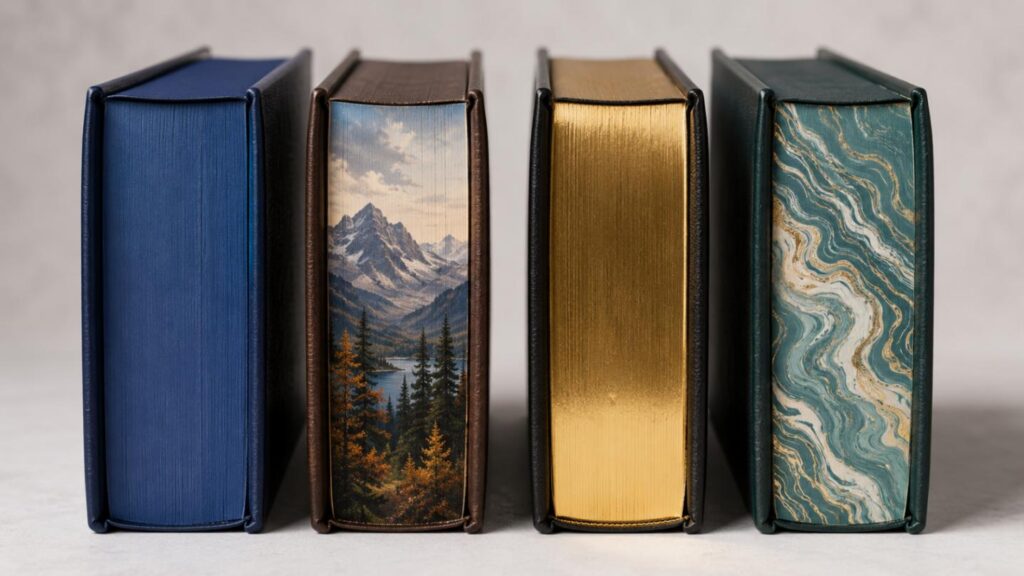
Custom Book Edge Printing refers to the decorative treatments applied along the exposed edges of a book block. The application of sprayed edges results in either solid or gradated colors, and printed edges replicate detailed artwork. The application of gilded edges results in a metallic finish, and the application of marbled edges results in flowing, organic patterns. The correct selection for the abovementioned considerations (artwork, paper, quantity, budget, durability, positioning, etc.) would ultimately depend on the signing authority.
Why Book Edges Have Become Part of Book Design
Traditional book design focused mainly on the cover, spine, endpapers, and interior pages. Collector’s editions, gift books, and premium journals have expanded that design area to the book block.
Custom Book Edge Printing can connect the cover with the interior concept, distinguish volumes in a series, or add a decorative feature visible while the book is closed. Each technique differs in image capability, consistency, production time, and cost.
What Is Custom Book Edge Printing?
Custom Book Edge Printing refers to coloring, printing, or decorating the exposed edges of a trimmed book block:
•Fore edge: opposite the spine
•Head edge: the top edge
•Tail edge: the bottom edge
•Three-sided edges: all three exposed edges
A typical process includes printing and folding, collating or sewing, trimming, compressing the book block, applying the finish, drying, inspection, and final binding. The sequence varies by binding style, paper, and finishing method.
Four Main Custom Book Edge Printing Techniques
Sprayed Book Edges
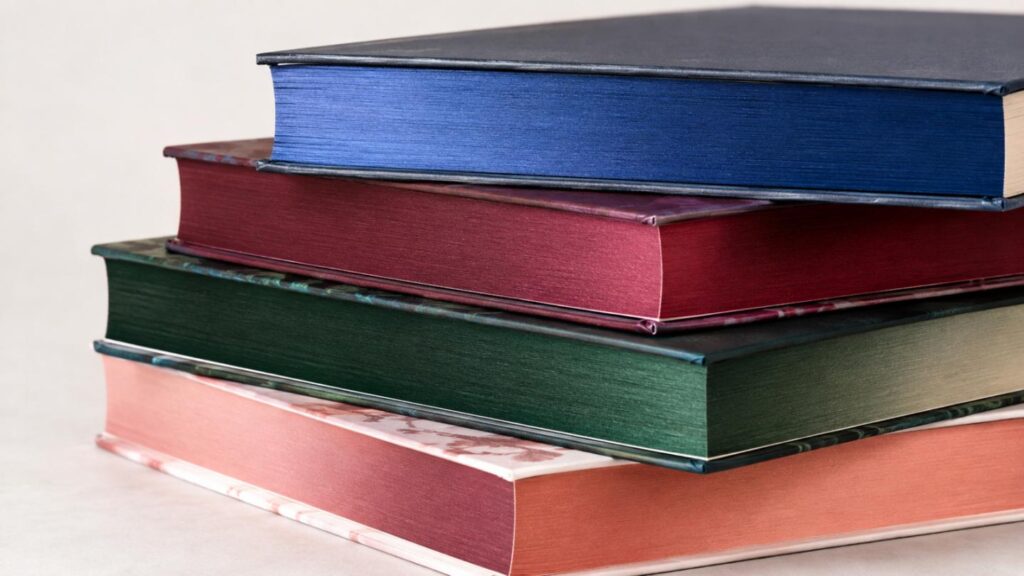
Sprayed book edges are made by compressing the book block and applying ink or coating to the exposed surface. The result may be a solid color, two-tone treatment, or gradient.
This method suits novels, journals, gift books, and special-edition paperbacks. It can match cover colors and is generally more economical than complex printed edges.
Key risks for this application include ink penetration, page sticking, uneven color, inconsistent and/or incomplete coverage. These risks may be a result of paper absorbency, spray volume, dry and/or compressed time.
Printed Book Edges
Printed book edges use digital or specialized equipment to reproduce illustrations, landscapes, characters, text, or repeating patterns across the closed book block.
This type of Custom Book Edge Printing suits fantasy novels, collector’s editions, anniversary books, illustrated publications, and coordinated book sets. It can also create continuous series designs.
Artwork must account for finished book-block thickness, reading direction, trimming tolerance, and image orientation. Poor positioning may cause broken patterns or incorrect three-sided transitions.
Gilded Book Edges
Gilded book edges create a gold, silver, copper, or other metallic appearance. Traditional editions may use genuine metal leaf, while commercial production often uses metallic foil or pigments.
Gilding is done to commemorate books such as the Bible, wedding albums, luxury bound books, and upscale notebooks. Gilding adds a formal touch to the books but has a higher cost when compared to books with a sprayed finish.
The key attributes for a desirable finish are smoothness, adhesion, coverage, and rub resistance. Weak adhesion can cause the finish to become dull or flaking can occur.
Marbled Book Edges
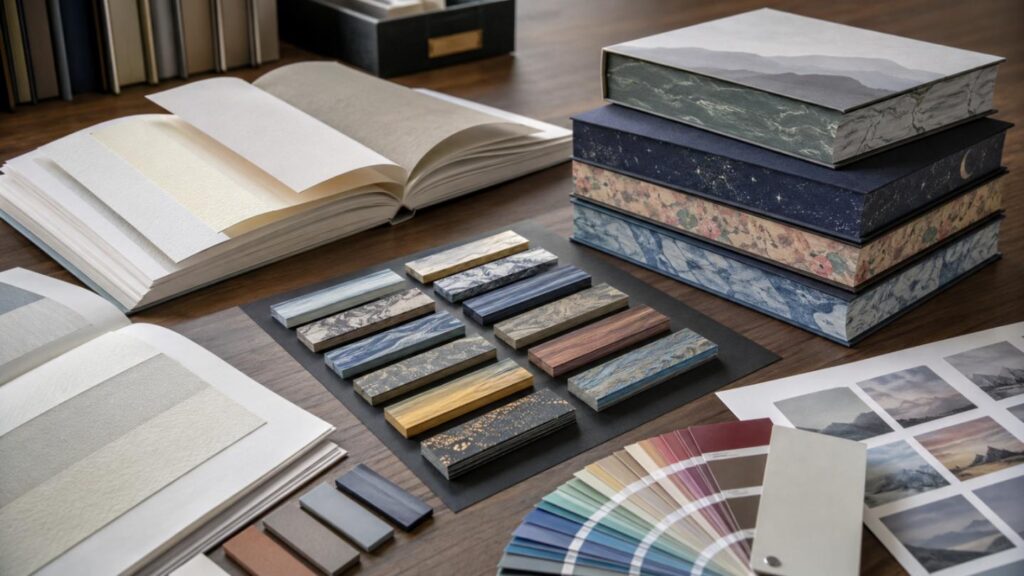
Book edges that incorporate marbling use natural, organic movements, or different methods to create book edges with effects resembling flowing water, clouds, or waves. Noted variation with book edges is generally intentional.
This method is optimal for fine press or art books, historical reproductions, and limited or specialized editions. Marbling (as a decoration) exhibits less repetition and more handcrafted character when compared to Custom Book Edge Printing.
Inconsistency in pattern and additional variables such as pigment transfer, drying time, and color stability and maintenance of integrity over long time intervals are the main challenges of marbling.
Sprayed vs. Printed vs. Gilded vs. Marbled Edges
| Factor | Sprayed | Printed | Gilded | Marbled |
| Main effect | Solid or gradient color | Images and patterns | Metallic shine | Organic patterns |
| Complexity | Low to medium | High | Low | Medium |
| Consistency | High | High | High | Medium to low |
| Relative cost | Low to medium | Medium to high | High | High |
| Typical quantity | Short to large runs | Short to medium runs | Small to medium runs | Limited runs |
| Main risk | Bleeding or sticking | Misalignment | Flaking | Pattern variation |
Costs and minimum quantities depend on book size, page count, paper, artwork, binding, order volume, sampling, and equipment.
How Paper Type Affects Custom Book Edge Printing
Paper affects color density, detail, adhesion, and drying.
| Paper Type | Behavior | Main Consideration |
| Uncoated paper | Natural absorption | Ink may bleed |
| Coated paper | Sharper images | Coating may reduce adhesion |
| Lightweight paper | Thick block, thin pages | Sticking or distortion |
| Textured paper | Tactile effect | Reduced image clarity |
| Colored paper | Distinctive base tone | Base color alters ink |
Custom Book Edge Printing should be tested on the actual paper stock. A screen proof cannot fully predict absorption, page release, metallic adhesion, or the appearance of the trimmed book block.
Artwork Preparation for Printed Book Edges
Artwork should be scaled to the finished book-block dimensions. Designers should:
•Confirm fore-edge, head, and tail orientation
•Allow a safe area for trimming variation
•Avoid very small text near critical edges
•Plan transitions for three-sided artwork
•Supply suitable-resolution CMYK files
•Identify Pantone or metallic references
•Confirm reading direction
•Approve a physical prototype before production
Can Detailed Images Be Printed on Book Edges?
Yes. Printed-edge technology can reproduce illustrations, patterns, and selected text. Final clarity depends on book-block thickness, paper smoothness, artwork resolution, edge preparation, and production tolerance.
Selecting a Technique That Supports the Book Design
No single method of Custom Book Edge Printing is suitable for all publications. Sprayed edges give support for color-based designs. Printed edges reproduce detailed imagery.
The final call on all aspects of a project must be made. These aspects will include (but not be limited to) artwork, paper, page count, binding type, budget, time to produce, types of production, and durability.
CAIMEI offers all the necessary services to facilitate your Custom Book Edge Printing project. CAIMEI will guide you through evaluating and selecting the design you want, assessing paper options, and assisting you with edge trim artwork and book binding. With CAIMEI, you can get the entire design and finish for final production of your book.
FAQs
Q1. What services in custom book edge printing does CAIMEI offer?
CAIMEI offers Custom Book Edge Printing that can apply any or all of the following finishes to books edges: sprayed, printed, gilded or any other decorative edge finishes. The most appropriate process is determined based on the artwork, thickness of the book block, type of paper, type of binding, number of copies required, and expected overall visual effect.
Q2. Can CAIMEI printbook edges with elaborate artwork?
Yes. For Custom Book Edge Printing, CAIMEI can print illustrations, patterns, landscapes or any text on the edges of book blocks that have been exposed. The quality of the image would depend on the smoothness and thickness of the book block, resolution of the artwork, printing accuracy, and production tolerances.
Q3. Can CAIMEI produce three-sided book edge printing?
Three-sided Custom Book Edge Printing is possible. Evaluation for all three edges (free, head and tail edges) is possible. Continuous artwork requires careful planning of alignment and placement, and positioning allowances since each edge is processed from a different direction.
Q4. What paper type is suitable for Custom Book Edge Printing?
Uncoated, coated, lightweight, textured and colored papers are all applicable. Each paper behaves differently in terms of ink absorption, adhesion, image sharpness and page release. CAIMEI recommends checking the suitability of the paper before proceeding with bulk production.
Q5. Does CAIMEI provide samples of mass production?
Prototype sampling is required for Custom Book Edge Printing, especially when the design includes detailed images, metallic finishes, gradients or three-sided artwork. A physical sample helps confirm color, alignment, page separation, edge coverage and the overall appearance.



NAME
text text text text. text text text text. text text text text. text text text text. text text text text. text text text text. text text text text. text text text t text xt. text text text text. text text text text. text text text t text
Contact Us
In This Article
Related Posts
Bulk Custom Book Printing in China for Publishers and Brands
September 30, 2026
Children’s Book Printing for Publishers: 2026 Interactive Book Trends
September 30, 2026
Bulk Journal Printing Quality Control: Binding Strength, Page Order and Trim Accuracy
September 29, 2026
Softcover Book Printing in China: Short Runs, Bulk Orders and Reprint Planning
September 29, 2026


