

How to Prevent Shipping Damage to Bulk Book Orders



To avoid damage to books in transit, ensure each book surface is protected, boxes are the right size for bulk orders, pallets are properly loaded and agree on handling needs prior to dispatch. The packaging should be of the same weight as the book, of the same construction, finish and shipping route as the book.
Damage is more than just a crushed box for publishers. Finished inventory can deteriorate into unsalable product due to bent corners, damaged covers, moisture and warped bindings.
These problems are best resolved at the time of production planning. When cartons arrive at a freight terminal, your choices become very limited.
Identify What Could Damage Your Particular Book
Protecting the text in different publications requires different protection.
A thick art book can focus the power on its corners. Surface abrasion can occur on a foil stamped hardcover. A spiral bound workbook should be protected from being compressed in the coils.
Begin with the completed products such as jackets, slipcases and accessories. Request the manufacturer to specify any weak points and offer filling.
| Book format or feature | Main shipping concern | Protection to evaluate |
|---|---|---|
| Heavy hardcover | Corner and board damage | Suitable cushioning and secure carton fit |
| Laminated paperback | Scuffing and bent covers | Surface protection and limited movement |
| Dust jacket | Torn edges and abrasion | Protective wrapping and careful placement |
| Slipcase edition | Crushed edges or marked surfaces | Fitted protection around the complete set |
| Spiral or Wire-O binding | Distorted coils or wire | Clearance and protection from compression |
| Mixed-size books | Uneven support inside cartons | Separate cartons or fitted dividers |
1. Approve Packaging Alongside the Book
Publishers often approve paper, color, and binding while leaving packaging described as “standard export cartons.”
That phrase leaves important questions unanswered.
Request the carton dimensions, approximate gross weight, copies per carton, protective materials, and pallet arrangement where applicable. Ask whether the proposed packing resembles previous shipments of comparable books.
For custom hardcover book printing, approve protection around the finished boards and corners. A sample book without its shipping packaging does not demonstrate how the bulk order will travel.
2. Choose Cartons for the Packed Load
The carton needs to withstand the weight and treatment of the product(s) it’s meant to hold. Just looking at it doesn’t tell you much about how it performs.
Request the packaging provider for a suggested package structure based on the packed weight, stacking configuration, route and handling requirements. Don’t select a carton because the books fit into it.
Excessive cartons leave space to maneuver around. Overfilled cartons have the potential to bulge, apply pressure upon books, and put pressure on closures.
Take measurements with receiving warehouse for realistic carton weight. This could be better for handling, but too many cartons can incur extra effort and expense.
3. Stop Books Moving Inside the Carton
Books should remain supported during normal handling without being forced into a tight cavity.
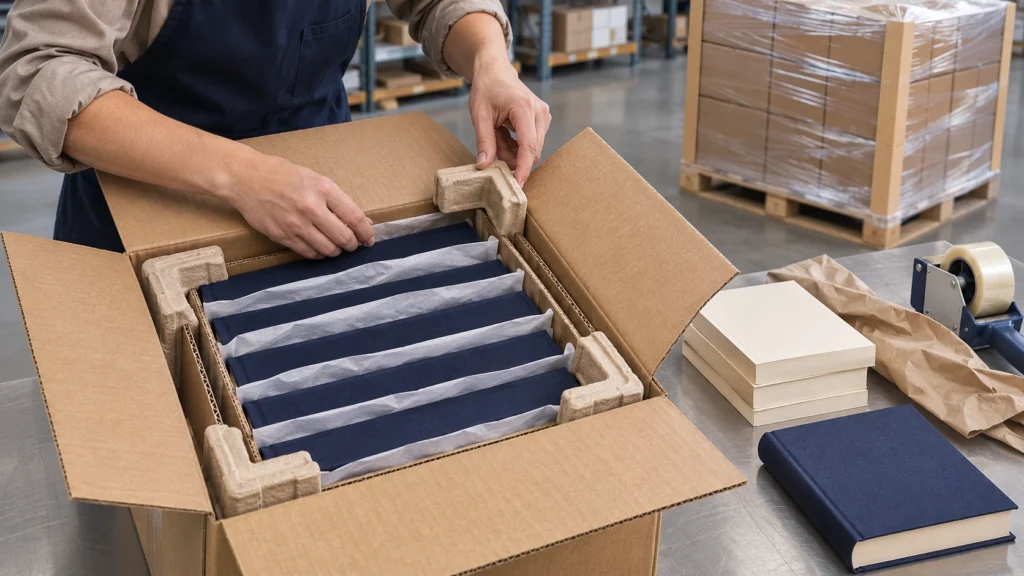
Use suitable dividers, cushioning, or fitted inserts to control movement. Pay particular attention to corners and the space beside uneven stacks.
Loose filler that settles during transport may leave gaps. Ask to inspect the actual packed arrangement rather than judging a list of materials.
For a hardcover book with a slipcase, protect the complete set. The slipcase itself may be a saleable component, so it should not serve as disposable shipping protection.
4. Protect Covers and Decorative Finishes
When books touch, they can show signs of wear, particularly if they have a sensitive cover.
Assess tissue, sleeves, individual wrapping or separators for the finish. Test to ensure that the protective material does not scratch, transfer color, stick or make unwanted impressions.
Don’t think that all titles have to be wrapped in plastic individually. It depends on the surface sensitivity, moisture strategy, handling, and customer requirements.
Try the combination you propose with finished samples. The material in a plain cover could not be the same as the material used in a foil or textured cloth cover or soft-touch lamination.
5. Manage Moisture Before Sealing
Paper and board are hygroscopic. Books that have not been adequately conditioned, or are damp, can create a problem within a good carton.
Request confirmation from the printer that books and packing material is ready for packing under appropriate conditions.
Discuss with the packaging provider appropriate barriers and moisture control materials for routes with moisture exposure. When choosing a desiccant, the enclosed space, materials and travel should all be taken into consideration.
Don’t assume a few loose desiccant packets are sufficient. Protection must be both at packing and during transport.
6. Build a Stable Pallet Load
In the palletizing process, a supported load should be created that can be lifted safely.
Ensure the use of pallets appropriate for the overall weight and equipment. Do not overhang above the pallet and not more than the pallet footprint. Consensus on stacking height and orientation.
Stretch wrap is a good load stabilizer, but is not a substitute for proper cartons or stacking.
Check if corner protection, top protection or straps are necessary. Restraints should hold the shipment, but not crush cartons or put undue pressure on the books.
7. Give the Warehouse Clear Handling Information
Good packaging still needs an agreed receiving plan.
Confirm delivery appointments, unloading equipment, pallet limits, and carton identification before dispatch. Provide a packing list showing titles, quantities, and carton references.
For perfect-bound paperback books, revise the packing plan if paper, pagination, or quantity changes. Small specification changes can affect carton weight and stacking.
Handling labels can communicate requirements, but the package must remain robust enough for the expected journey.
8. Inspect and Photograph Before Dispatch
Create a practical packing inspection record.
| Checkpoint | What to document |
|---|---|
| Finished books | Covers, corners, bindings, and representative interiors |
| Internal packing | Separators, cushioning, orientation, and fit |
| Closed cartons | Condition, closures, weight, and identification |
| Pallets | Support, stacking, restraint, and protective components |
| Loading | Visible condition and arrangement before departure |
| Receiving | Carton condition, shortages, and affected books |
Photographs help establish condition, but they do not replace an appropriate inspection or packaging test. For unfamiliar formats or demanding routes, discuss representative transit testing with a qualified packaging provider.
Frequently Asked Questions
What causes most book shipping damage?
Common causes include movement, compression, impacts, abrasion, and moisture. Several may act together during one shipment.
Should every book be individually wrapped?
Not necessarily. Select protection according to the cover finish, packing method, route, and receiving requirements.
Are heavier cartons always safer?
No. Carton performance must match the load and handling conditions. Excessive packed weight can also make handling difficult.
Can shrink wrap prevent moisture damage?
It may provide some protection, but it does not correct moisture already present or replace a complete moisture-control plan.
Should books be packed flat or upright?
There is no universal answer. Evaluate support, binding, weight, carton fit, and compression in the proposed arrangement.
Does pallet wrap replace internal cushioning?
No. Pallet restraint stabilizes cartons; internal protection limits movement and damage within them.
What should I do if cartons arrive damaged?
Photograph their condition, record concerns on delivery documentation where appropriate, inspect affected books, and notify the responsible parties promptly.
Does cargo insurance prevent losses?
Insurance does not prevent damage. Confirm coverage, exclusions, reporting deadlines, and evidence requirements alongside your packaging plan.
Share on Social:


