

Print on Demand for Booksellers: Custom and Personalized Book Printing Opportunities
Related Posts
Bulk Custom Book Printing in China for Publishers and Brands
September 30, 2026
Children’s Book Printing for Publishers: 2026 Interactive Book Trends
September 30, 2026
Bulk Journal Printing Quality Control: Binding Strength, Page Order and Trim Accuracy
September 29, 2026

Softcover Book Printing in China: Short Runs, Bulk Orders and Reprint Planning
September 29, 2026
The classic method of bookselling happens with purchases made, typically, with forecasts in mind. In traditional bookselling, the bookseller is the one ordering books in advance. This is the seller who stores books in their store inventory and takes the financial risk that some of the books in their store remain unsold. This is practical only if the books have generally high demand.
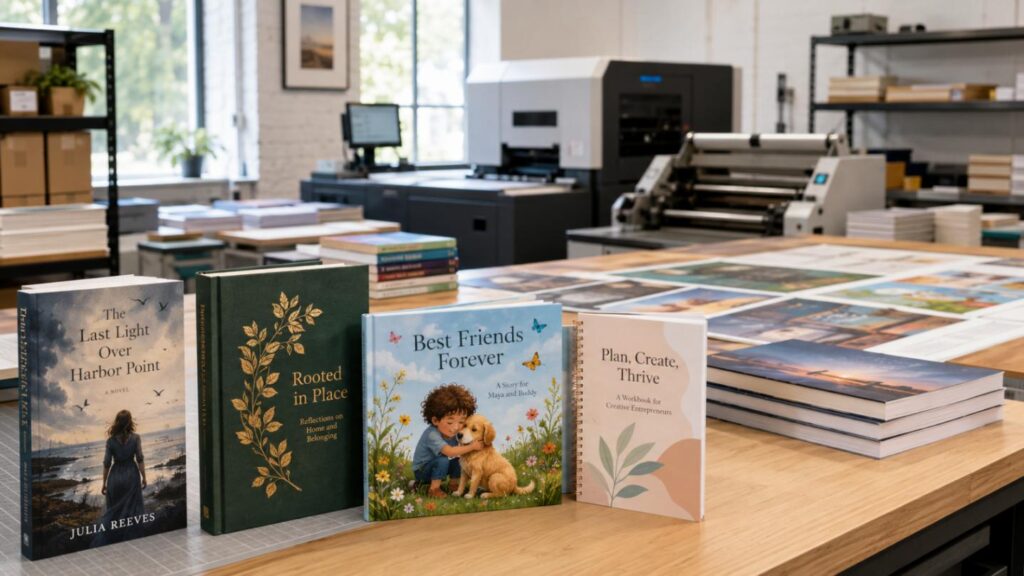
Print on Demand for Booksellers offers a flexible production model. Books can be printed after the sale of that individual book. Books can be printed before a sale on a book as part of a preorder campaign. For Booksellers, Print on Demand can allow Booksellers the flexibility to test the saleability of a book, create personalized books, expand their bookselling offerings, and reduce the capital they have tied up in slow-moving inventory.
What Is Print on Demand?
Print on Demand is a production and replenishment model in which books are manufactured after an order is received or when stock falls below a defined level.
Depending on book specifications, sales frequency, and production economics, a bookseller may replenish in batches of 100, 500, 1000, or more copies.
The model is particularly suitable for:
• Long-tail and low-volume titles
• Personalized children’s books
• Local history and regional publications
• Educational workbooks and textbooks
• Author test editions
• Seasonal and event-specific books
• Private-label book collections
• Reprints of older or temporarily unavailable titles
By retaining approved print-ready files, booksellers can reorder titles without repeating the full prepress process.
Why Personalized Books Create New Retail Opportunities
Personalized book printing applies content to a specific reader, organization, location, or event. This method includes the use of names and pictures along with school information, local stories, branding, serial numbers, and personalized messages within the book or the cover.
For retailers, Print on Demand for Booksellers may accomplish various commercial goals:
• Separate products from standard retail editions
• Serve smaller and more specialized audiences
• Increase the gift and commemorative value of books
• Test demand for products prior to large print runs
• Extend the sales life of existing content
• Build proprietary or private-label collections
These opportunities are relevant to online booksellers, independent bookstores, educational distributors, museum shops, gift retailers, and publishing brands.

Book Products Such Products Allow for Personalization
| Product Type | Customizable element(s) | Typical examples of use |
| Personalized children’s books | Names, characters, pictures and messages | Birthday and special occasion books |
| Educational books | School branding, lessons and exercises | Schools and training providers |
| Local history books | Regional stories, archives and images | Museums and independent bookstores |
| Corporate books | Logos, brand stories and case studies | Events and business gifts |
| Limited editions | Numbering, special covers and slipcases | Collectors and author launches |
| Journals and workbooks | Page templates, prompts and branding | Training and stationery retail |
| Photo books | Images, dates and personal text | Weddings, travel and family records |
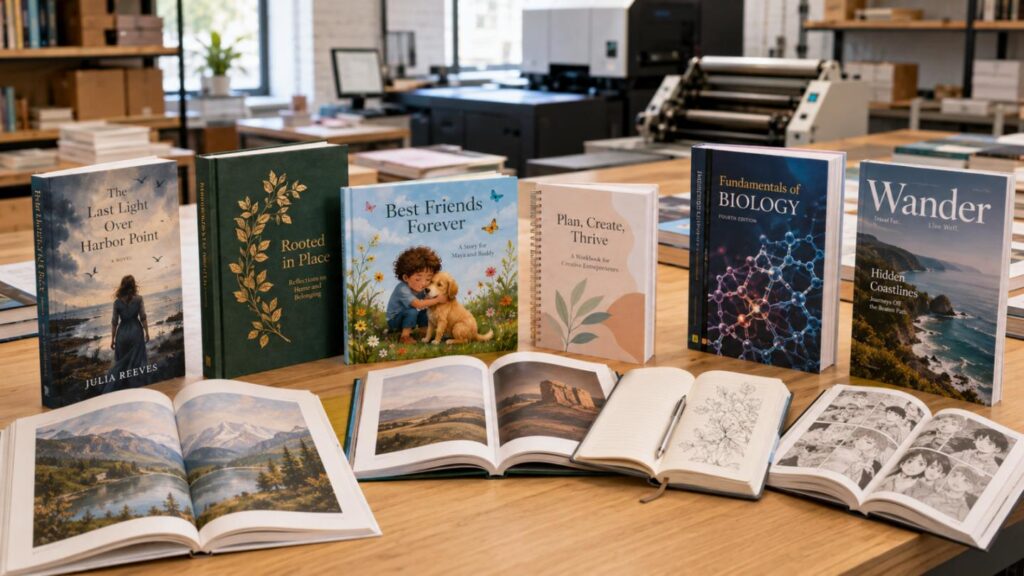
Other suitable categories include paperback books, hardcover books, textbooks, magazines, journals, illustrated books, art books, and children’s books.
An Inside Look at Personalized Book Printing
1. Identify Fixed And Variable Content
Fixed content agrees with branded material as well as the layout and the pictures. This will not vary across copies. Variable content includes:
• The first and last names of customers.
• Photographs of customers.
• Specific customer addresses.
• Personalized messages to customers.
• Specific or customized edition numbers.
• Custom or personalized covers.
Ensure your files have the correct layout size and the correct exterior bleed as well as embedded fonts and images, the correct order of the pages, text and graphics mode on color, correction of the page sequence, and resolution of the text and images.
2. Produce Printable Files
Small projects can have manually prepared PDFs. Larger projects can use variable-data workflows and templates to produce and assemble many files.
Each file must precisely correlate with its paired order. An order-reference system, reliable order barcode, or order naming system prevent mismatches in order processing, printing, packaging, and shipping.
3. Establish Production Path
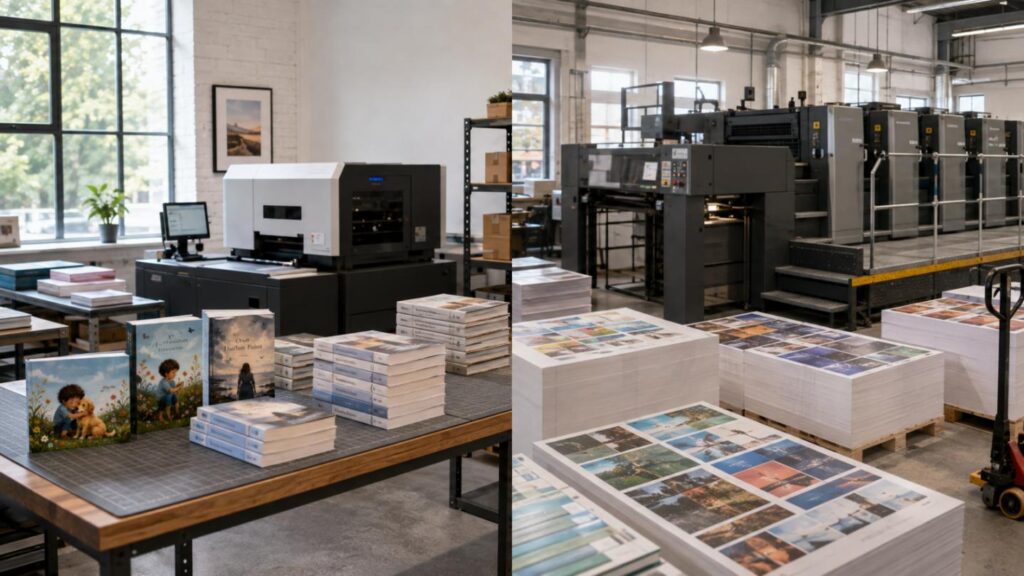
Digital printing is best suited for the highly personalized and short printing runs of books. Offset printing is cost-effective for longer printing runs when the content is fairly standardized.
A hybrid approach can also be used. High volumes of pre-fabricated interior sections can be produced. Separate prints on cover pages, inserts, or title pages can be produced.
4. Bind, Finish and Pack
After printing, books may require:
• Folding and collating
• Perfect or sewn binding
• Hardcover case making
• Spiral binding
• Lamination
• Foil stamping or spot UV
• Die-cutting
• Individual labeling and packaging
Digital Printing vs. Offset Printing
| Production factor | Digital printing | Offset printing |
| Recommended volume | Single copies and short runs | Medium and large runs |
| Setup | Limited setup | Plates and press preparation |
| Variable data | Strong capability | Limited flexibility |
| Small-run economics | Generally more practical | Higher setup cost |
| Large-run economics | Unit cost may remain higher | Unit cost falls as volume grows |
| Typical use | Personalized books, samples, reorders | Standardized retail editions |
Print on Demand for Booksellers should therefore be understood as demand-led production rather than a requirement to print every title one copy at a time.
Choosing Paper, Format and Binding
The correct specification depends on content, selling price, durability, and reader expectations.
Common Formats
• Paperbacks: Suitable for novels, how-to books and workbooks, and books published for the general trade market.
• Hardcover Books: Appropriate for gift books, children’s books, art books, and books published for the collector market.
• Textbooks: Require coverings and rigid covers designed for repeated handling and durability.
• Illustrated Books: Texts which require illustrations and controlled color.
• Magazines and Journals: Titles published for recurring or thematic short runs.
Material Options
• Coated paper for photo reproduction
• Uncoated paper for text reproduction
• Eco-friendly paper for responsibility sourcing
• Cardboard for rigid covers and children’s board books
• Matte or gloss lamination for protective finishes and visuals
Binding usually includes perfect binding, saddle stitching, sewn binding, spiral binding, softcover binding, and hardcover binding.
Practical Business Models
Booksellers can use the following models to print on demand:
Made-to-Order
Production starts after the customer confirms and pays for the book.
Small-Batch Replenishment
Titles are reordered in controlled quantities when the inventory reaches a certain level.
Preorder Production
Orders are collected before the final quantity is confirmed, thus reducing the uncertainty of the demand.
Seasonal and Event Editions
Books are produced for school activities, exhibitions, author events, as well as regional campaigns.
Private-Label Collections
Booksellers create proprietary titles while an OEM manufacturer manages printing, binding, and packaging.
Common Production Challenges
| Challenge | Risk | Recommended control |
| Incorrect variable data | Wrong names or content | Customer confirmation and data validation |
| Low-resolution images | Blurred print quality | Prepress image inspection |
| Inconsistent file setup | Font, size or bleed errors | Standardized templates |
| Frequent specification changes | Delays and waste | Freeze specifications after sampling |
| Small-run cost pressure | High unit cost | Use standard sizes and practical finishes |
| Color variation | Reorder inconsistency | Approved proofs and color references |
| Order matching errors | Incorrect fulfillment | Barcodes and traceable labels |
| Complex international shipping | Delays or added costs | Confirm packaging and logistics early |
How CAIMEI Supports Print on Demand for Booksellers
As an OEM book printing manufacturer, CAIMEI supports paperback books, hardcover books, children’s books, textbooks, magazines, journals, illustrated books, and art books.
Available support includes:
• Full-color and spot-color printing
• High-resolution image reproduction
• Perfect, spiral, softcover, and hardcover binding
• Coated, uncoated, eco-friendly, and cardboard materials
• Cover design, interior layout, and file review
• Proofreading and editing support based on project requirements
• Prototype printing and small-batch trial runs
• Custom packaging, labeling, and order management
• Domestic and international shipping
CAIMEI will help Booksellers gauge the size of books, the number of pages, the type of paper, the method of binding, the type of finishing, the quantity and type of packaging, and the type of printing used before production.
Samples allow the assessment of the quality of the print, the color of the print, the materials, and the performance of the binding. This allows booksellers to place repeat orders or widen the market for books after print quality assessments.
Opportunity to Adjust Your Book Supply Management
Print on demand booksellers rely on accurate specifications and practical limits to control production, and ensure that fulfillment is reliable. The assessment of sample quality, print quality, and color, as well as the materials used and the performance of the binding, allow booksellers to place repeat orders or widen the market for books after print quality assessments.
CAIMEI offers personalized book printing with order quantity flexibility, sample orders, and an international shipping service. Describe your book type, dimensions, page count, binding method, personalization needs, and approximate quantity for your request. We will customize a print-on-demand solution for you.
FAQs
Q1. What types printing services does CAIMEI offer?
Based on quantity, COLOR requirements, personalization level, delivery schedule, and target cost, CAIMEI can evaluate digital printing, offset printing, or a combination of the two methods of printing.
Q2. What types of books can CAIMEI print for booksellers?
CAIMEI can process paperback books, hardcover books, children’s books, textbooks, magazines, journals, illustrated books, artistic books, workbooks, etc. and other individualized publications.
Q3. Does CAIMEI allow personalized book printing?
Yes. Depending on the book project, CAIMEI can support a cover that has a photograph, name, text, information, branding, messages, numerals, edition, insert, and other variable text elements.
Q4. Can CAIMEI fulfill small-batch production of books?
CAIMEI supports small-batch production runs, repeat small-batch production runs, individualized large-batch production orders, sample prints, prototypes, and other individualized print jobs. The ideal quantity relies on the book’s format, printing method, binding, finishing, and degree of personalization.
Q5. Does CAIMEI issue sample book prints before a large-scale production?
Yes. Prototype printing allows booksellers to review color reproduction, paper, dimensions, binding strength, cover alignment, finishing, and overall appearance before approving a larger order.



NAME
text text text text. text text text text. text text text text. text text text text. text text text text. text text text text. text text text text. text text text t text xt. text text text text. text text text text. text text text t text
Contact Us
Related Posts
Bulk Custom Book Printing in China for Publishers and Brands
September 30, 2026
Children’s Book Printing for Publishers: 2026 Interactive Book Trends
September 30, 2026
Bulk Journal Printing Quality Control: Binding Strength, Page Order and Trim Accuracy
September 29, 2026
Softcover Book Printing in China: Short Runs, Bulk Orders and Reprint Planning
September 29, 2026


