

Custom Board Book Printing for Reusable Write-and-Wipe Early Learning Books
Related Posts
Bulk Custom Book Printing in China for Publishers and Brands
September 30, 2026
Children’s Book Printing for Publishers: 2026 Interactive Book Trends
September 30, 2026
Bulk Journal Printing Quality Control: Binding Strength, Page Order and Trim Accuracy
September 29, 2026
Softcover Book Printing in China: Short Runs, Bulk Orders and Reprint Planning
September 29, 2026
Writing and wiping books are designed for a child to repeat an activity many times. Unlike paper-based writing workbooks, they use rigid board pages which means the writing surface can withstand many repetitions of writing workbook activities.
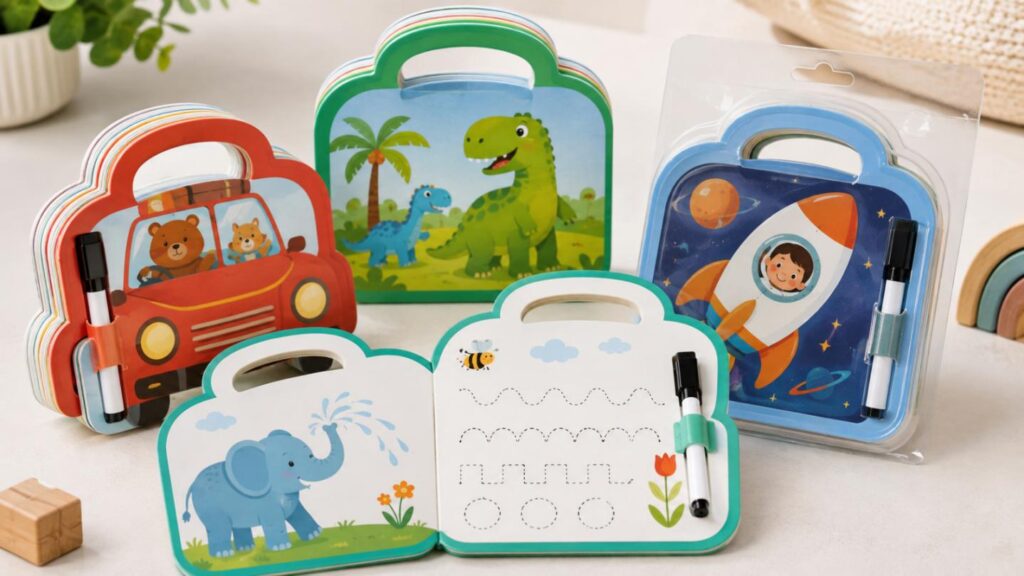
Custom Board Book Printing offers publishers, brands, and companies control of every aspect of a learning book, including dimensions, paper construction, an erasable finish, a die-cut shape, a wipe-clean binding, and marker accessories. A successful product must combine clear educational design with reliable writing performance, strong page construction, and child-friendly finishing.
Why Write-and-Wipe Books Work for Early Learning
Repeated practice is the key to developing initial skills by young children without the need for a fresh worksheet for every practice attempt. Traditional paper-based workbooks are designed with rigid board pages. The writing surface can withstand frequent writing activities that workbook pages are designed for.
Activities commonly include the following:
•Number and letter recognition
•Preparation for the development of handwriting and pencil control
•Tracing practice of lines, shapes and patterns
•Basic counting skills and simple mathematics
•Picture identification and matching
•Activities that include simple problem solving and mazes
•Parent-Child exercises and drawing
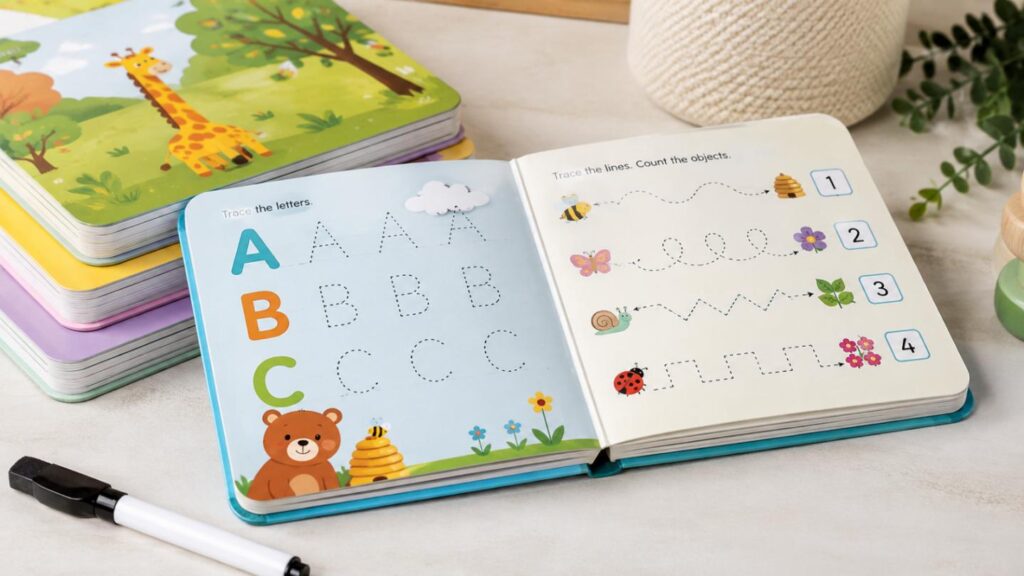
The activities should follow progressive movement that requires large and simple visual tasks and then smaller and more precise writing tasks. Instructions should remain short and writing areas must provide enough space for developing motor skills.
Components of Custom Board Book Printing
The success of a write-and-wipe book depends on the successful integration of its materials and structural components.
| Component | Function | Key Production Consideration |
| Printed face paper | Holds artwork and instructions | Color accuracy and line clarity |
| Board core | Provides page rigidity | Thickness, density and flatness |
| Wipe-clean layer | Permits writing and erasing | Marker compatibility and abrasion resistance |
| Binding structure | Attaches rigid page spreads | Opening performance and spine durability |
| Die-cut edges | Creates shapes, handles and rounded corners | Registration and edge consistency |
| Marker accessory | Supports interactive use | Size, ink type and attachment method |
| Retail packaging | Protects the book and accessories | Blister strength, seals and carton fit |
In professional Custom Board Book Printing, these elements should be evaluated as one product system. A high-quality coating alone cannot compensate for warped pages, weak binding, inaccurate die-cutting, or an unsuitable marker.
Selecting a Wipe-Clean Surface
The surface finish determines how smoothly the marker writes, how easily the ink erases, and how well the page resists repeated rubbing.
Wipe-Clean UV Varnish
UV varnishes are usually applied over printed face paper to improve and protect the appearance of the final printed page. They offer an improved brightness of color, less stain penetration, and a support for the use of dry-erase markers.
Typically, standard UV varnishes are not appropriate for reusable learning books. Testing is required to confirm:
•Good erasing that does not leave any ghosting
•Sufficient hardness of the coating
•Full UV curing
•Good adhesion of the coating to the printed sheet
•Resistance to repeated wiping
•Compatibility with the dry-erase markers used
Gloss Lamination
Moisture, dirt, and smears are naturally attracted to and adhere well to classroom surfaces and materials. Most product surfaces are well suited for classroom use. Rounded corners and edges, however, require variable levels of control by manufacturers and suppliers.
Specialized Wipe-clean Coatings
Specialized coating technology can be used to improve the hardness of a coating, the degree of the UV curing, the adhesion of the coating to the printed sheet, the residual wet-erase marker removal, and the degree of resistance to repeated wiping.
| Finish | Erasing Performance | Durability | Main Consideration |
| UV varnish | Good | Medium to high | Correct formulation and curing |
| Gloss lamination | Good | High | Film adhesion and edge lifting |
| Specialized coating | Customizable | Application-dependent | Testing and material cost |
Board Thickness and Page Construction
Board thickness should be selected according to the finished book rather than treated as a fixed specification. Important factors include:
•Finished size and page count
•Target age group
•Frequency of use
•Total book weight
•Handle or shaped-page design
•Embedded pen clips
•Blister or gift-set packaging
A printed material such as 400gsm C1S may be mounted onto greyboard or whiteboard to create a rigid page. The actual finished thickness depends on the board core, face paper, adhesive, coating, and lamination structure.
Large books and complex designs with punched handles require stiffer boards to prevent bending around the punched area. Pages that are too thick raise concerns about the weight of the book and its ability to be used by young children, who may find the book too difficult to turn. Thin pages may lose their structural integrity and may warp.
The best board book printing therefore requires judiciousness and balance between the degree of stiffness and the weight, usability, durability, and cost of the board book.
Designing Activities for the Target Age
| Learning Stage | Recommended Content |
| Ages 2–3 | Lines, colors, shapes and simple matching |
| Ages 3–4 | Letter recognition, numbers and basic tracing |
| Ages 4–5 | Letter formation, number writing and counting |
| Ages 5–6 | Words, simple arithmetic, mazes and combined tasks |
Each page should focus on one primary activity. Strong layouts generally use:
•Short and direct instructions
•Clear examples before each exercise
•High-contrast tracing lines
•Adequate blank writing space
•Limited background decoration
•Consistent icons and visual cues
•Gradual increases in difficulty
These design choices make Custom Board Book Printing more effective as an educational format rather than simply a decorative printed product.
Custom Shapes, Handles and Marker Integration
Write-and-wipe books can include custom outer shapes, rounded corners, carrying handles, embedded pen clips, transparent APET blisters, and wafer seals.
These features require careful engineering. Every board leaf must align with the same die-cut profile, and handle openings must retain sufficient board strength. When a pen clip is embedded into the last leaf, the construction must prevent the clip from loosening or damaging the page.
A blister used to display the marker should match the pen dimensions and leave enough flange area for secure sealing. Accessory components must also be reviewed for the intended age group and target market.
Common Challenges Associated with Board Book Printing
Marker Ghosting
Though marker application may be complete, markers may still leave ghost images on the page due to coating issues, improper curing, surface porosity, or marker incompatibility.
Page Warping
Warpage of printed pages can be caused by improper printing, moisture inconsistency, uneven adhesive application, unbalanced material tension, and/or insufficient conditioning time.
Delamination
Delamination of printed boards or board book components occurs due to failure of the adhesive to bond properly which could be due in part to the application of too little or too much pressure, and/or poor adhesive bonding around die-cut edges.
Die-Cut Misalignment
Misalignment of die-cut edges and corners of printed boards and board book components may occur as a result of insufficient control of printing, mounting, and cutting tolerances.
Spine Cracking
The spine surface cracks after repeated opening because of unsuitable paper grain, rigid adhesive, poor creasing, or insufficient binding flexibility.
Exemplar samples and repeated use tests are vital because these issues cannot be ascertained from electronic artwork on its own.
A Trustworthy Write-and-Wipe Board Book Printing
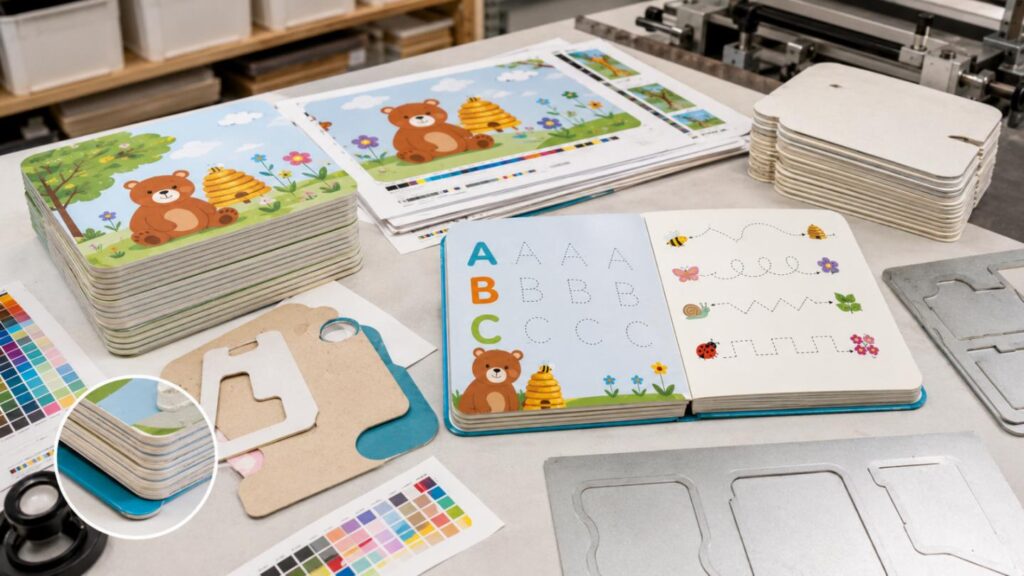
Custom Board Book Printing services are not just about pretty pictures. The structure of the board, the erasable coating, the instructions, the order of the binding, the die-cutting, the assembly, and a final inspection, CAIMEI’s Custom Board Book Printing Services involve every step of book production.Let us know the size, page count, and any artwork for your book. Also provide the age of your target audience and any book activities. Upon receiving your inputs, we will provide a viable and practical reusable early learning book solution.
FAQs
Q1. What services does CAIMEI provide for Custom Board Book Printing?
CAIMEI offers services for artwork review, material check, color checking, sample checking, printing, board book mounting, wipe-clean finishing, die-cutting, padding, packaging, and final inspection.
Q2. Is it possible for CAIMEI to make reusable write-and-wipe board books?
Yes. CAIMEI can create reusable early learning books with erasable surfaces with activities to be repeated, such as tracing, handwriting, counting, matching, and drawing.
Q3. What are the available wipe-clean finishes?
Depending on the design of the product, CAIMEI can assess wipe-clean UV varnish, gloss lamination, or specialized erasable coatings. It is recommended to request sampling to verify marker compatibility and erase performance.
Q4. Can the thickness of the board and the number of pages be customized?
Yes. Individualized requirements for Custom Board Book Printing can be made to the size and thickness, target age, spread number, book weight, expected use frequency, and rigidity required for the pages.
Q5. Does CAIMEI provide custom shapes along with carrying handles?Yes. CAIMEI can create shaped board books with rounded corners, die-cut outer profiles, carrying handles, windows, and other structural features based on the supplied artwork and dieline.
Share on Social:



NAME
text text text text. text text text text. text text text text. text text text text. text text text text. text text text text. text text text text. text text text t text xt. text text text text. text text text text. text text text t text
Contact Us
In This Article
Related Posts
Bulk Custom Book Printing in China for Publishers and Brands
September 30, 2026
Children’s Book Printing for Publishers: 2026 Interactive Book Trends
September 30, 2026
Bulk Journal Printing Quality Control: Binding Strength, Page Order and Trim Accuracy
September 29, 2026
Softcover Book Printing in China: Short Runs, Bulk Orders and Reprint Planning
September 29, 2026


